Orland Park Epoxy Flooring brings more than 20 years of experience to epoxy flooring in Worth, and this page is about one kind of job in particular: a food storefront passing from one operator to the next. When a kitchen sits empty between leases, its floor is exposed in a way it never is during service, with no equipment, no rubber mats and no cooks working around the crew.
That window is short, and it matters. A new operator usually cannot open until inspections are passed, and an inspector reads the floor as it is on the day of the visit, not as it looked when the previous tenant moved in. Cracks, open joints at the base of the wall and worn traffic lanes are all easier to find and fix before anything is rolled back into place.
We treat these floors as an assessment first and a coating second. The slab is mapped, the moisture is tested, and the proposal says plainly whether the existing floor can be repaired and coated or whether something more is needed before a coating makes sense. The rest of this page walks through how that applies to a storefront that is changing hands right now.
A Bakery Storefront Becomes a Mediterranean Carry-Out
Worth is a largely residential village with a modest business district, and storefronts along Harlem Avenue change hands the way small retail strips do. One recent turnover shows why the floor deserves attention during the gap between tenants, and why the timing is set by the business license rather than by whoever installs the floor.
What the Village Board Approved in March 2026
At its March 18, 2026 meeting, the Worth village board approved a business license for Asoul Almansaf Inc. at 11228 S. Harlem Avenue. The applicant told the board the business would be Mediterranean foods, carry-out only. The address geocodes inside the village, on the Palos Township side of Harlem, and a directory listing places Al Medina Bakery at the same storefront.
That listing is undated, so there is no telling from the record when the bakery left or how the space was used in between. What the record does show is a food space handing off to another food use. A carry-out kitchen has no dining room, so most of its floor area is likely to be working kitchen: prep, cooking, dishwashing and storage, all of it wet and all of it inspected.
A License That Waits on the Inspections
The board’s approval carried a condition: the license is contingent upon having passed all inspections and being in compliance with all codes and ordinances. In practice, that makes the inspection the scheduling constraint for the whole fit-out. Everything that has to be right on the day of the visit, the floor included, has to be finished and cured before it.
The same minutes record that the North Palos Fire Protection District wrote that the operator will need a full fire alarm with monitoring and a Knox box, with plans submitted to the district for approval. Fire alarm work, equipment delivery and flooring all compete for the same weeks, so the floor belongs early in the sequence, before equipment lands on it and before other trades start crossing a fresh coating.
Looking for epoxy-flooring closer to Palos Hills? See Epoxy-Flooring in Palos Hills.
Inheriting the Last Operator’s Floor
When a food space changes hands, the new operator inherits whatever floor the last one left behind. That floor may be in good shape or it may not, and nobody knows until it is looked at with the equipment out. We have no connection to the new tenant, the bakery or the property owner and have not seen this particular floor, so what follows is how we approach an inherited kitchen floor like this one.
What Years of Baking Tend to Leave Behind
Bakery floors in general take a particular kind of wear. Flour and sugar are swept and mopped daily, water is used heavily at the sinks, and mixers, racks and ovens sit in fixed spots for years. Rack wheels wear lanes into a finish, and the joint where floor meets wall gets wet every night. Those are the places to look first, whatever the condition of any one floor turns out to be.
Equipment removal tells its own story too. Bolt holes from anchored shelving, cut-outs around old floor drains and patches where a utility line was moved are common in any kitchen that has operated for a while. A new carry-out will set its own equipment in its own layout, so old patches can end up under new traffic paths and beneath a new cooking line.
Mapping Before Anything Is Priced
We start by mapping cracks, spalls, loose patches and any old coating still on the slab, and we mark where cove bases are open, chipped or missing. A sound existing coating may be prepared and recoated; one that is lifting comes off. Where a slab needs repair or replacement before it should be coated, we say so in writing rather than coating over the problem.
A moisture test is part of the written scope before the price is final. Depending on the slab, that may be ASTM F2170 in-situ relative humidity probes, ASTM F1869 calcium chloride testing, or an ASTM D4263 plastic sheet test as a first read. A slab mopped for years can hold more moisture than it shows, and moisture is the first exclusion we name when we explain what a coating warranty leaves out.
Good Repair, a 1 mm Cove and No Absorbent Finish Where It Gets Wet
The FDA Food Code sets out the plain floor lines an inspection reads against. Which agency reviews a food business in Worth is something to confirm with the village before the work is planned, but the text of the code explains what any reviewer will be looking at, and three of its provisions do most of the work on an inherited floor.
Maintained in Good Repair
Food Code 6-501.11 says physical facilities shall be maintained in good repair. On a floor, that reads as no open cracks holding water and debris, no broken tile or delaminating coating, and no patches pulling away from the surrounding slab. It is a short sentence, and it applies to the floor as found on inspection day, regardless of which tenant wore it down.
That is why the gap between leases is the right time. A crack routed and filled, a spall rebuilt with repair mortar, and an old coating ground back to sound concrete are all straightforward in an empty room. The same repairs after the cooking line is installed mean moving equipment, working around gas and water connections, and pushing back an opening date.
Coved and Closed to No Larger Than 1 mm
Food Code 6-201.13(A) says that where floors are cleaned by methods other than water flushing, the floor and wall junctures shall be coved and closed to no larger than 1 mm, or one thirty-second of an inch. A square corner collects grease and food debris where a mop cannot reach, and a gap at the base of a wall lets water sit behind the finish.
On an inherited floor, the cove is often the first detail to go. Vinyl cove base peels away, quarry tile cove cracks at the grout, and an old resin cove can separate from the wall. We grind the junction, rebuild it as a troweled resin cove continuous with the floor, and seal the top edge tight to the wall so the joint is built to that 1 mm line.
Nonabsorbent Where the Floor Gets Wet
Food Code 6-201.14(A) bars carpeting and similar material in food preparation areas, walk-in refrigerators, warewashing areas, toilet rooms, refuse storage rooms and other areas where the floor is subject to moisture, flushing or spray cleaning. Section 6-101.11(A)(3) calls for nonabsorbent surfaces in areas subject to moisture, such as food preparation and warewashing areas.
Bare concrete is porous, so a sealed, seamless resin floor is the usual answer in those rooms. A coating cannot promise an inspection result, though, and we are neither inspectors nor plan reviewers. Our part is to build the floor to the written lines, document what was installed, and leave the verdict to whoever conducts the inspection.
Fixing the Floor Between One Food Tenant and the Next
With the slab mapped and the moisture known, the work follows a set order. That order matters more in an empty storefront than almost anywhere else, because every trade waiting on the floor is really waiting on the cure, not on the installation day itself.
Opening and Repairing the Slab
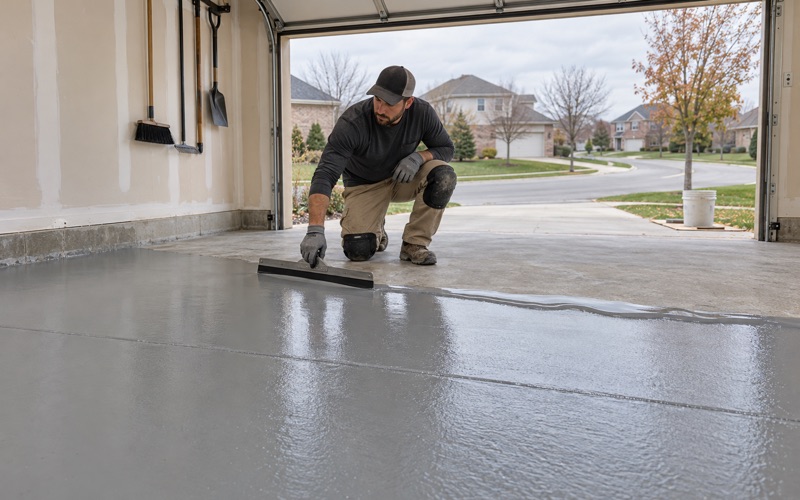
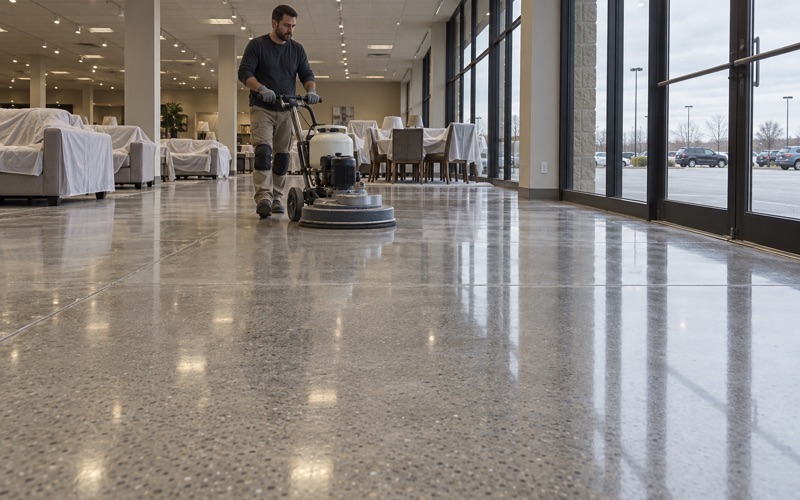
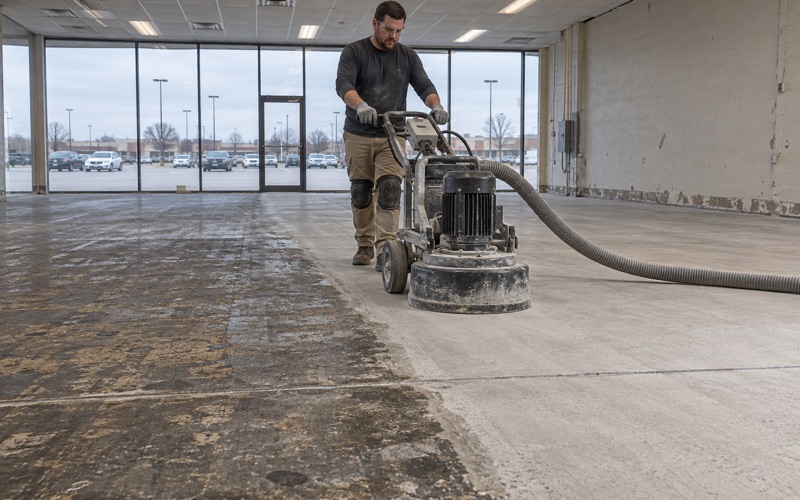
Every slab we coat is opened with a diamond grinder or a shot blaster, never an acid etch, to an ICRI CSP profile suited to the system going down. Old sealers, grease-soaked surface paste and loose topping come off in the same pass. Grinding dust is captured at the machine with a vacuum instead of being rinsed toward a floor drain.
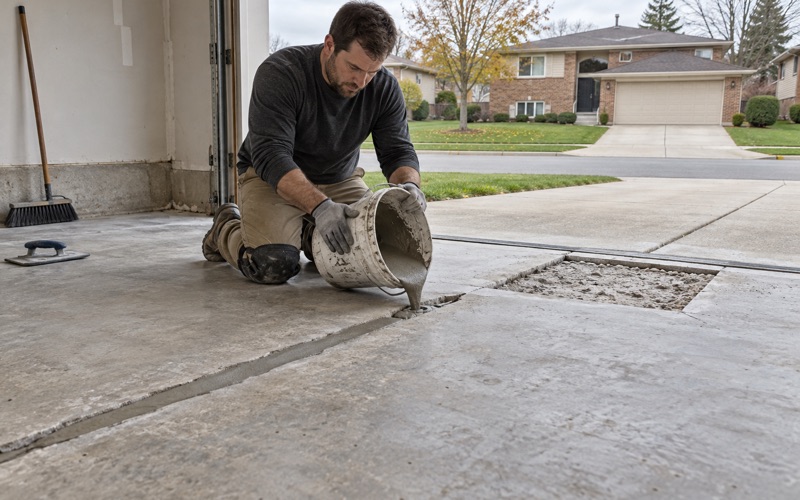
Cracks are then routed and filled, spalls rebuilt, and transitions at drains and doorways set so the new floor sheds water toward the drains rather than pooling against the walls. If the moisture readings call for it, a moisture-mitigation primer goes down before the body coat. That decision comes from the test results, not from how dry the floor happens to look.
Choosing a System for a Carry-Out Kitchen
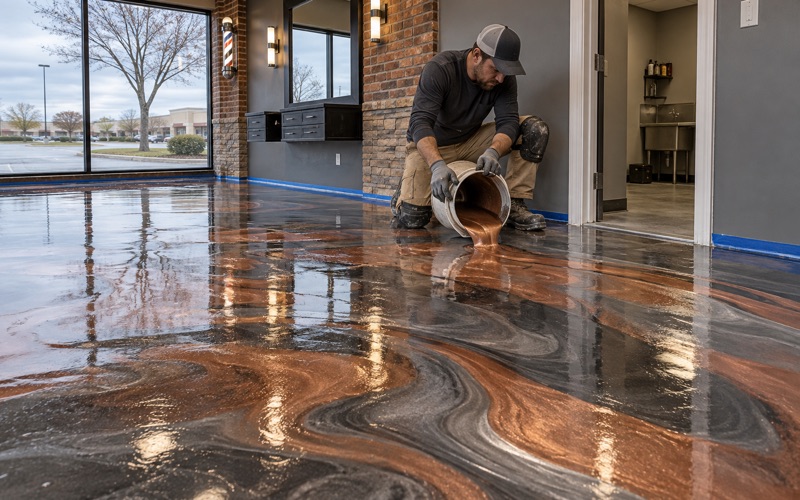
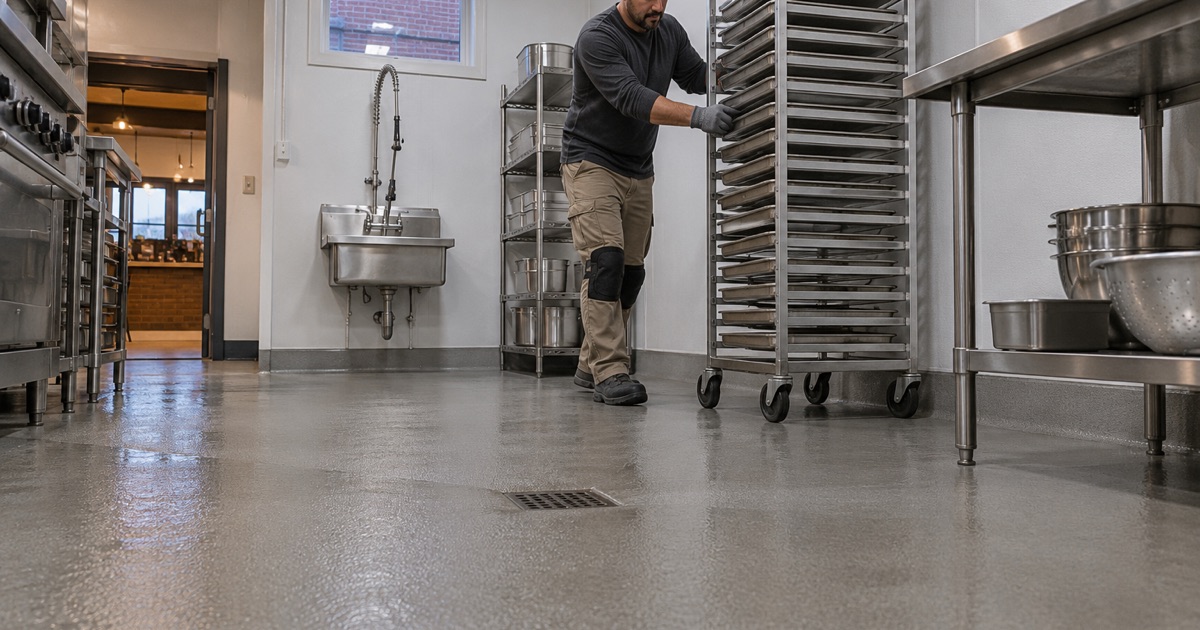
Commercial kitchens see hot water, cleaning chemicals, thermal shock near ovens and fryers, and constant wet mopping. For those conditions, urethane cement is often the right body coat, with 100% solids epoxy suited to drier storage and prep areas. The proposal names the product line, the number of coats and the finished thickness, so the floor can be checked against the quote.
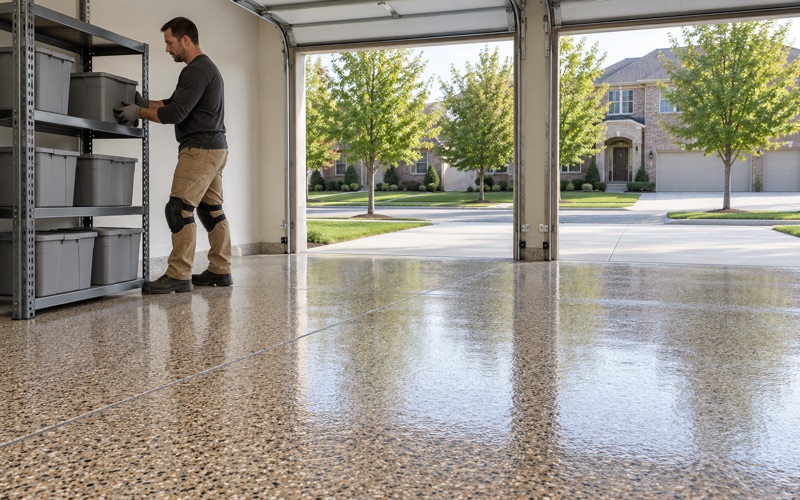
Slip resistance comes from the broadcast and the topcoat, so we specify a quartz aggregate broadcast and the topcoat that locks it in rather than promising a nonslip floor in general terms. The Food Code’s own antislip exception under 6-201.11 allows textured floor applications where safety calls for them. Texture runs heavier at the sinks and cooking line and finer where carts roll.
Paperwork, Cure and Scheduling
Illinois has no state flooring license, and Worth registers contractors itself: a $110 registration, a certificate of insurance naming the village and a $10,000 surety bond. We confirm those requirements before booking work in the village. The building department’s permit list names many remodeling projects but not flooring, so we ask the village about a floor job rather than assume either answer.
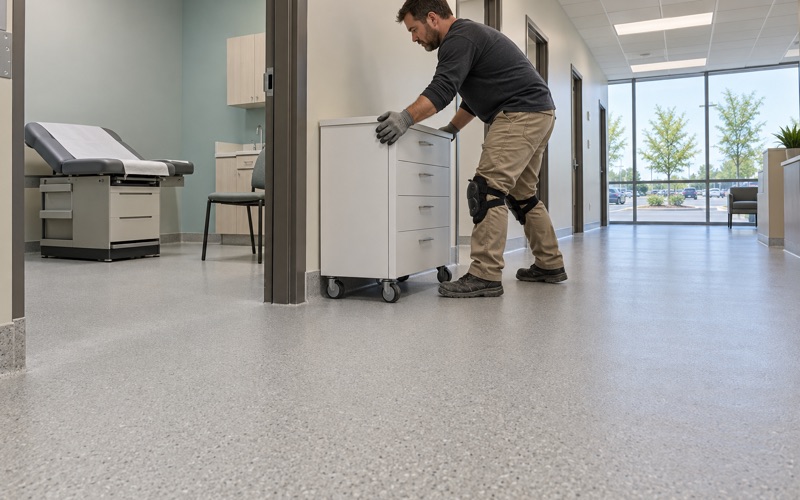
Cure schedules follow slab temperature and dew point, not the calendar, which matters in a storefront that may have sat with the heat turned down between tenants. We plan the coating so it has fully cured before equipment is set and before the inspections the license depends on. The floor goes in first, the kitchen goes in on top of it, and both are finished when the inspector arrives.
- 20+ Years on Concrete
- Moisture Tested Before Pricing
- Written Specs on Every Quote