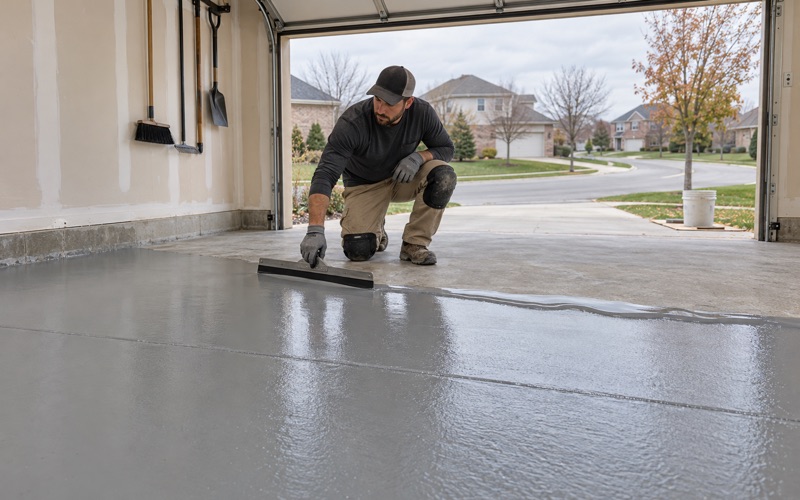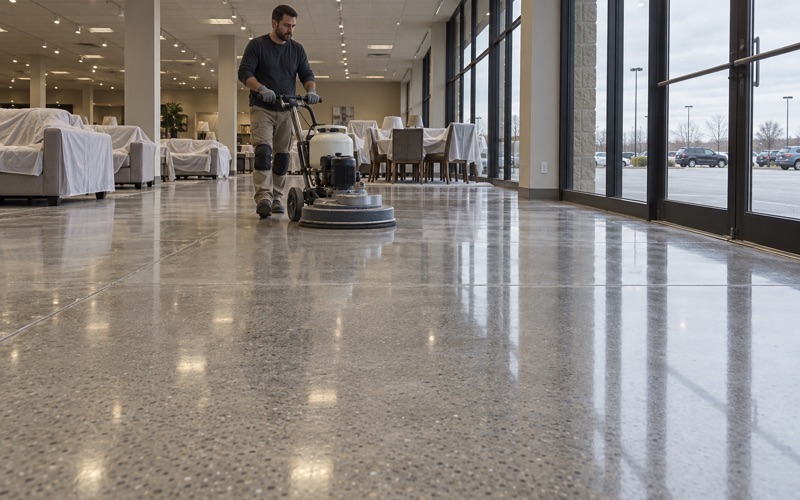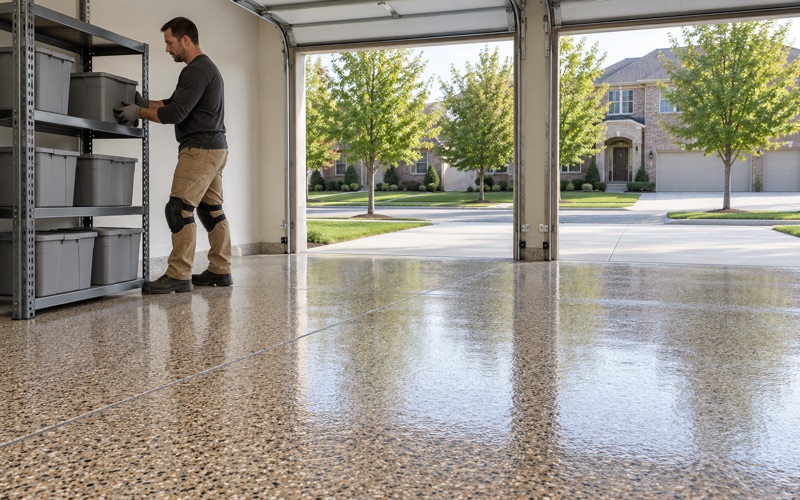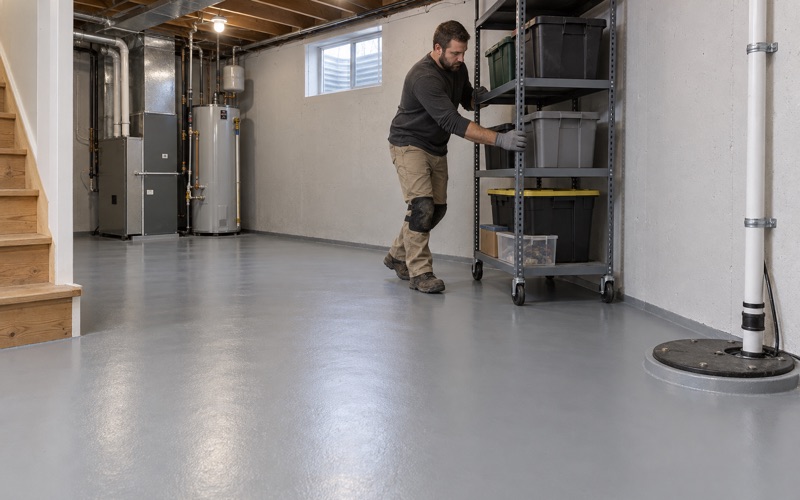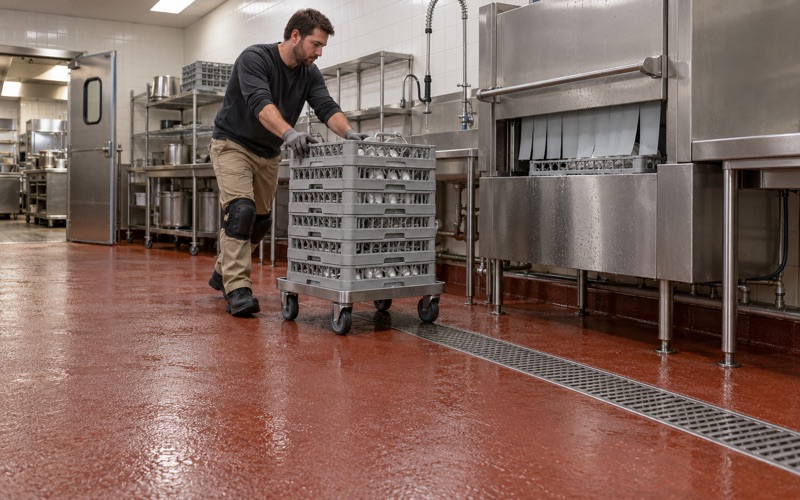
Orland Park Epoxy Flooring has spent more than 20 years installing epoxy flooring in Western Springs and across the southwest suburbs, and the floors that teach us the most are the ones that get washed instead of swept. A room that is hosed, squeegeed and scrubbed every day asks a different question of a coating than a showroom does. It has to shed water toward a drain, stay gripping when wet and leave no seam for grime to settle into.
That is the lens for this page. Rather than walk through every kind of floor we coat, we want to follow one hard case, the holding cell, because Illinois has written down in plain language what its floor must do. Once you see why that rule reads the way it does, the same reasoning carries straight into a basement laundry, a pet-washing room or a garage bay that gets rinsed out.
None of this is a sales pitch for a public building. It is a way of explaining how we think about any floor where water, cleaning chemicals and foot traffic all meet on the same slab, which is where a coating either earns its keep or fails within a season.
Police at Village Hall and a Consultant’s Verdict
Western Springs does not have a freestanding police station. The police department works inside Village Hall at 740 Hillgrove Avenue, which sits within the village limits in Lyons Township, Cook County. The records window keeps weekday office hours, and the same building houses the village’s other administrative work, so the lockup and the public counters share one roof.
What the 2023 assessment found
At a Village Board meeting reported in October 2023, Rich Gallas of Baxter & Woodman, the village’s engineering consultant, told the board that the current condition of the police facilities within the building was inadequate. The lockup was the main problem he named. Police sometimes work with neighboring communities to hold people in custody, according to the same report.
The rest of his review was kinder to the building. Gallas found no structural defects and working heating and cooling, and he said that in general the building was in pretty good shape given its age. The police space is part of Village Hall rather than a separate structure, which is why his comments covered both at once.
What has not happened since
It matters to be exact about what followed. No recommendation or cost was reported at that meeting, and we found no later lockup project, design or budget. Baxter & Woodman presented the village’s final Capital Infrastructure Plan, which included municipal properties, in February 2024, but that is a planning document, not a construction contract.
We have no relationship with the village, its police department or its consultant, and we are not describing any job we expect to do there. We bring the lockup up because the state rule for building one is one of the clearest statements anywhere of what a washable floor must be.
Looking for epoxy-flooring closer to Hinsdale? See Epoxy-Flooring in Hinsdale.
What Illinois’ Lockup Standard Says About the Floor
The Illinois Municipal Jail and Lockup Standards live in Title 20 of the Illinois Administrative Code, Part 720. Section 720.160 governs new construction, so it would apply if a lockup were ever built or rebuilt, while the section for existing buildings sets no floor rule at all. The new-construction text is short, and nearly every line of it is about water.
Concrete that may have non-skid material
The standard says floors must be concrete or precast concrete and may have non-skid material. That wording is worth reading twice. The structural floor is fixed as concrete, and a slip-resistant surface is permitted on top of it rather than required, which leaves the designer to decide how much grip a wet floor needs.
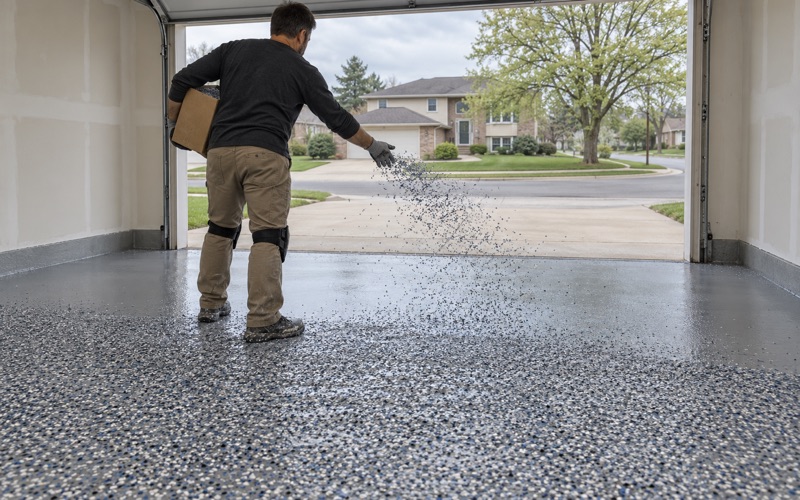
In coating terms, that permission is usually met with a textured system. A resin base coat broadcast with quartz aggregate, then locked in with a topcoat, gives a surface whose grip comes from the grit and the film build, not from a promise. The concrete underneath stays exactly what the rule names.
Pitched to drain, with anchored covers
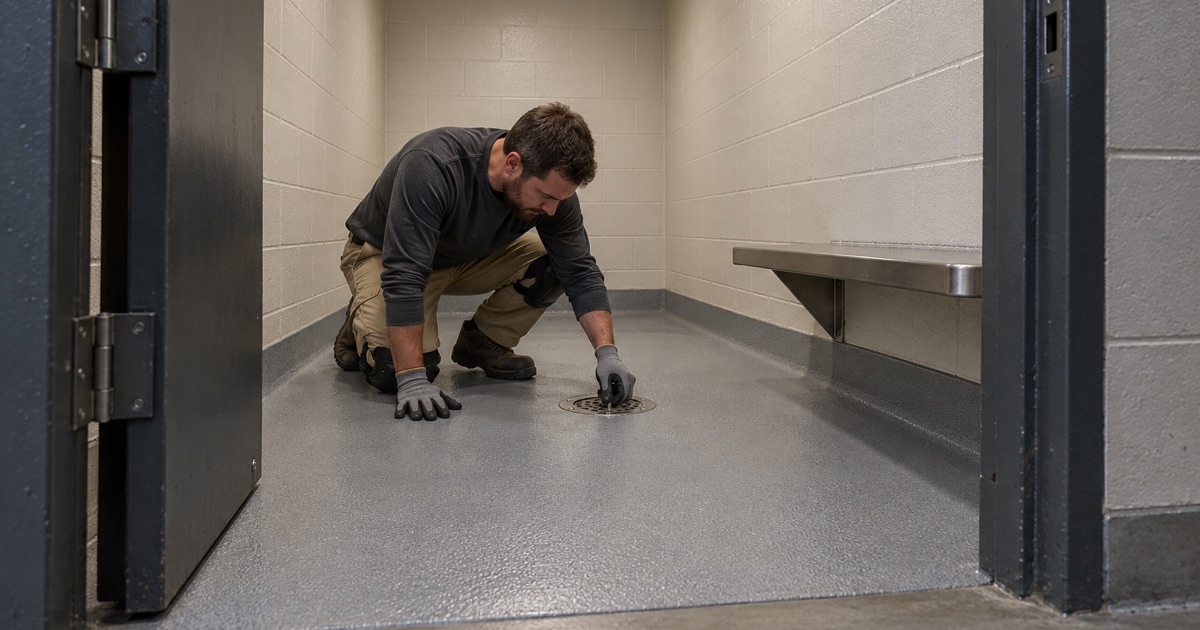
The same section says the floor shall be pitched one to two inches above the corridor floor for drainage purposes. It calls for floor drains in the cell block corridor or the plumbing chase, one for every three cells, and it says drain covers must be securely anchored.
Pitch is set in the concrete, not in the coating. A coating follows the slope it is given, so a floor that ponds before it is coated will pond afterward, only with a shinier puddle. Anchored covers matter to us too, because the coating has to stop cleanly at the drain body without lifting at its edge.
Flushing drains and daily cleaning
Floor flushing drains are required in cells used for people under the influence of alcohol. Section 720.90 adds that occupied cells shall be cleaned daily, and that areas next to them must be kept clean and orderly, with walkways and corridors never used for storage.
Put those rules together and the floor is washed every day it is in use, often with a hose. The paint rule in the same section adds one more constraint: paint, if used, must be flame retardant and lead-free.
Seamless, Drainable and Washable by Design
Read as a set, the standard turns a holding area into a drainage and sanitation problem first and a finish choice a distant second. That is the same order we work in on any floor that gets wet on purpose, and it changes what we look for before a price is ever written.
Why the seam is the weak point
Water does not attack a good coating head-on. It finds the joint, the crack, the gap at the wall or the edge around a drain, and it works underneath from there. A seamless resin floor with a cove turned up the wall removes most of those entry points, which is why washed rooms are coated rather than tiled or rolled with thin paint.
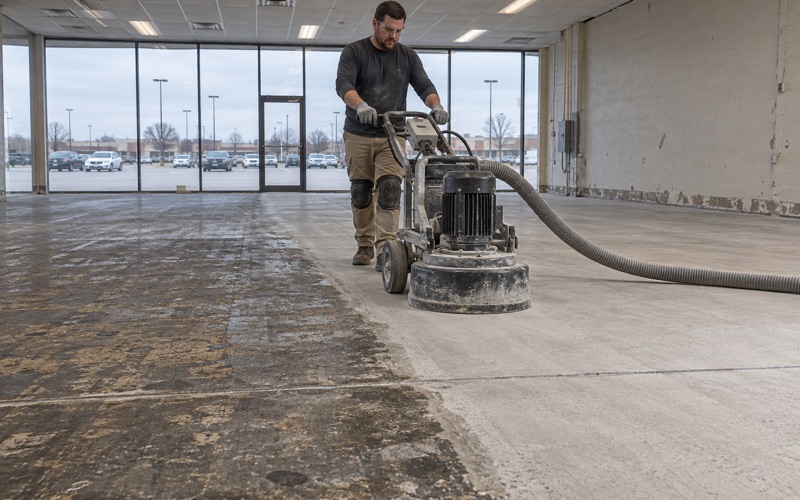
That only holds if the slab is opened properly first. We open every slab with a diamond grinder or a shot blaster, never an acid etch, to a concrete surface profile on the ICRI CSP scale that suits the system. A floor that is scrubbed daily punishes a weak bond faster than any other kind.
Grip that is specified, not claimed
A wet floor needs texture, and texture is a material choice. We specify slip resistance by the broadcast and the topcoat, whether that is a fine quartz aggregate or a heavier one, so the proposal shows how the grip is built. Too coarse and the floor resists the mop; too fine and it is slick under water.
The topcoat also decides how a floor handles cleaners. A polyaspartic or urethane topcoat over 100% solids epoxy resists repeated wet cleaning far better than a single thin coat, and it holds the broadcast in place so the texture does not wear smooth in the first year.
The paint rule and the product list
The lockup standard’s flame-retardant, lead-free line is a reminder that a floor product is chosen against rules, not only against looks. On every job we pick products inside the Illinois limits on volatile organic compounds for floor and industrial coatings, because those limits bind the person applying them.
The proposal names the product line, the number of coats and the finished thickness. That way anyone can check the floor they received against the one they were quoted, which matters most on a floor that will be scrubbed hard enough to show any shortcut.
The Same Logic for a Home Wash-Down Room
Most Western Springs floors we see are in houses, and about 95.6 percent of the village’s occupied homes are lived in by their owners, so the person choosing the floor is usually the person who will clean it. A basement laundry with a floor drain, a dog-washing corner or a mudroom that gets hosed out runs on the same principles as a holding cell, just at household scale.
Drain and slope come first
We start where the lockup standard starts, with water. If a floor drain sits high, or the slab dishes away from it, we say so before anything else, because a coating will not correct a slope. Sometimes the honest answer is that a section needs patching or regrading before it should be coated at all.
Cracks, spalls and old coatings get mapped on the first visit. A washed floor magnifies every one of them, since a hairline crack that never mattered under a rug becomes a water path once the room is hosed weekly.
Moisture is tested, not assumed
A moisture test is part of the written scope before the price is final. Depending on the slab, that may be an ASTM F2170 in-situ relative humidity probe or an ASTM F1869 calcium chloride test, and the result decides whether the floor needs a moisture-mitigation primer under the main coats.
We also explain what a coating warranty leaves out before the job is sold, and moisture is the first exclusion we name. Cure schedules then follow slab temperature and dew point, not the calendar, so a cold lower level may need to warm up before the coating goes down.
Paperwork before the grinder
Illinois has no state flooring license, so we check the village’s own contractor registration, bond and insurance rules before a job is booked. In Western Springs that runs through Community Development, which requires registered contractors on permitted work.
Home jobs over the state threshold get a written contract and the Illinois consumer-rights pamphlet before any grinding starts. Grinding dust is captured at the machine with a vacuum rather than rinsed toward a floor drain, which matters doubly in a room built around one.
- 20+ Years on Concrete
- Moisture Tested Before Pricing
- Written Specs on Every Quote