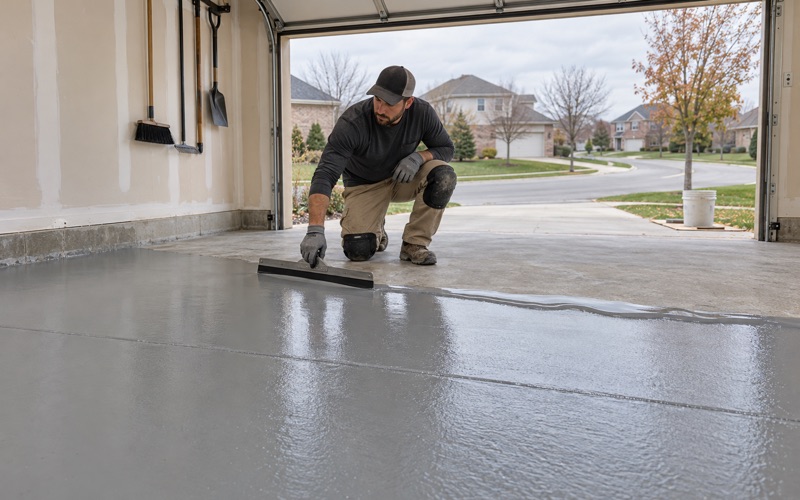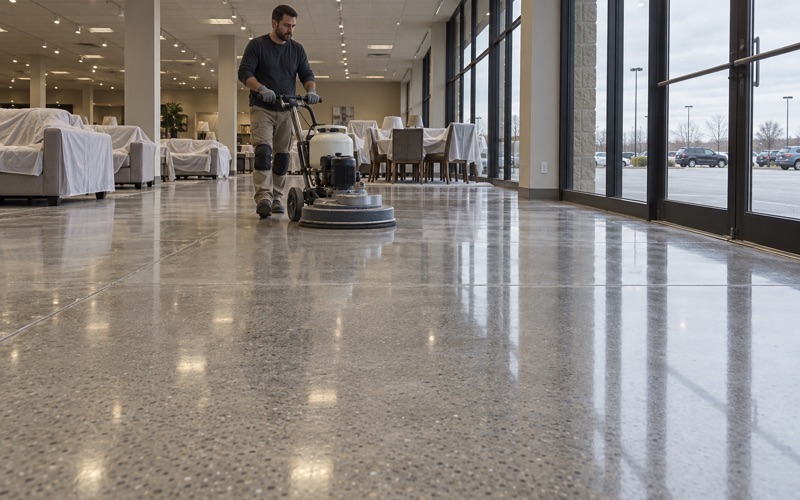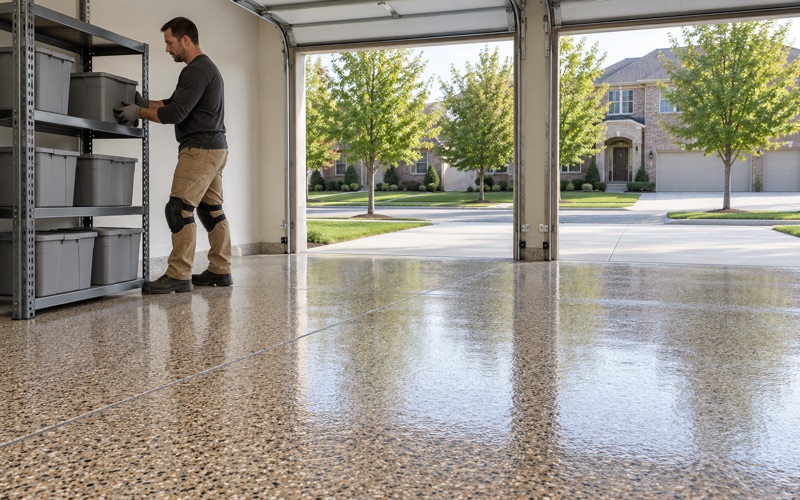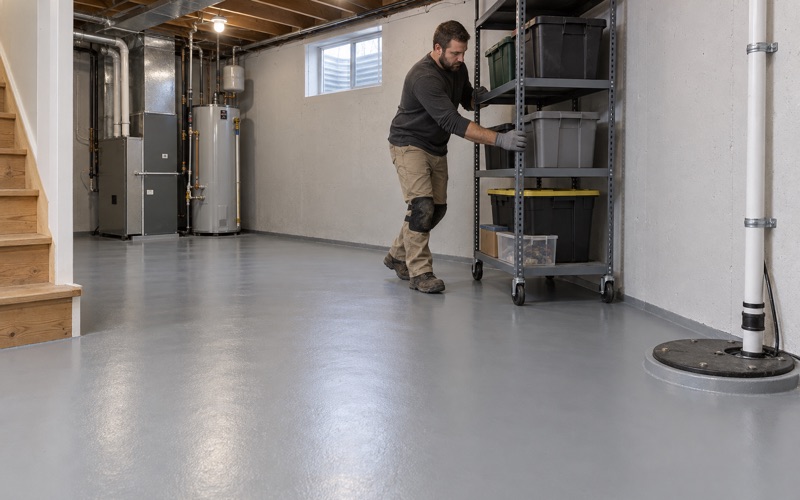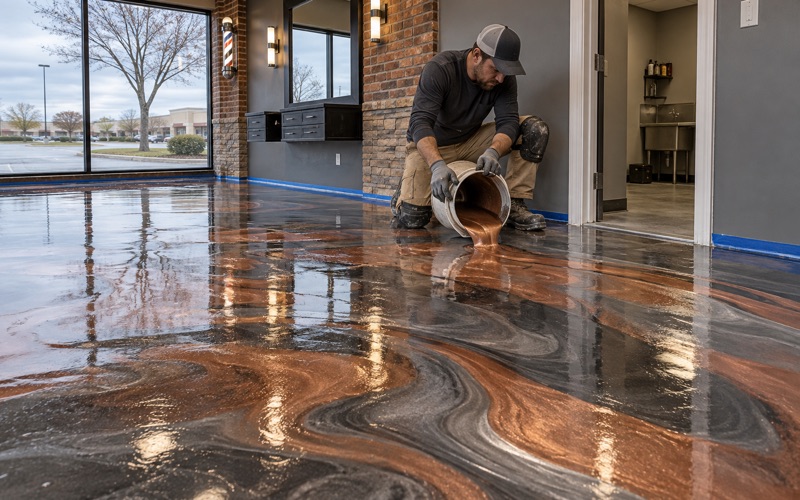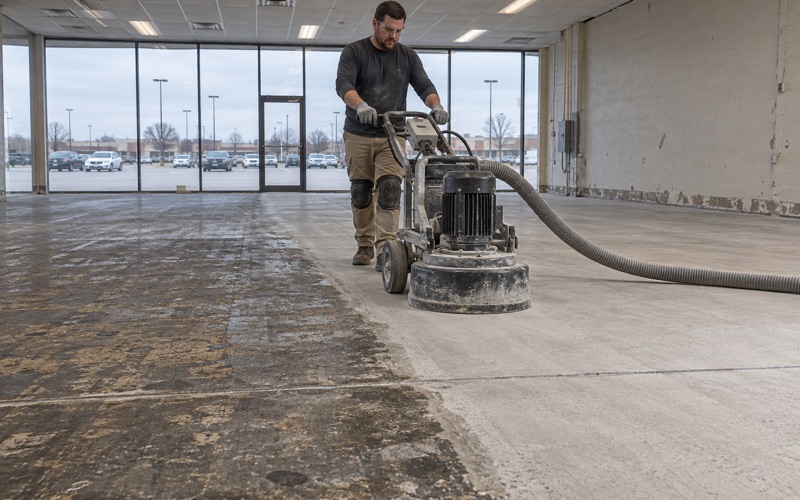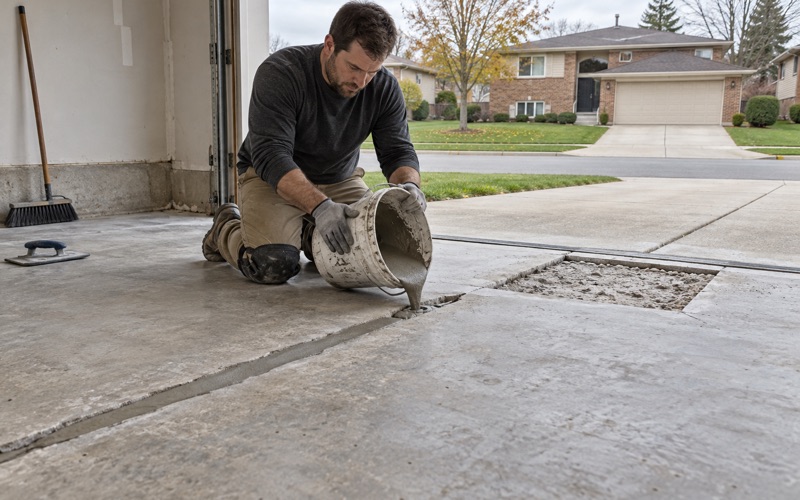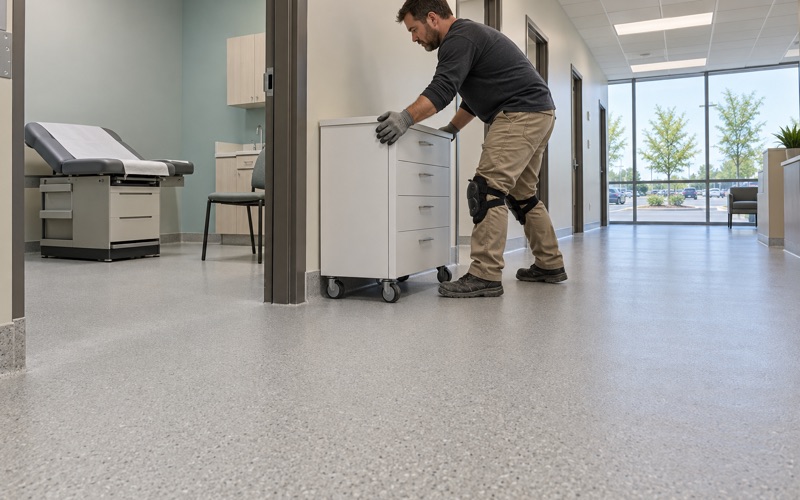
Orland Park Epoxy Flooring brings more than 20 years of epoxy flooring in Summit to shop floors and garages where the slab has to take a scraper, a solvent rag and a rolling cart in the same week. Our work starts with the concrete itself. We open every slab with a diamond grinder or a shot blaster, never an acid etch, so the first coat bonds into a real profile instead of sitting on a weak surface skin.
Before a price is final, a moisture test goes into the written scope, and the proposal names the product line, the number of coats and the finished thickness. That gives an owner something concrete to check the finished floor against. Cracks, spalls and any old coating get mapped first, and when a slab should be repaired before it is coated, we say so in writing.
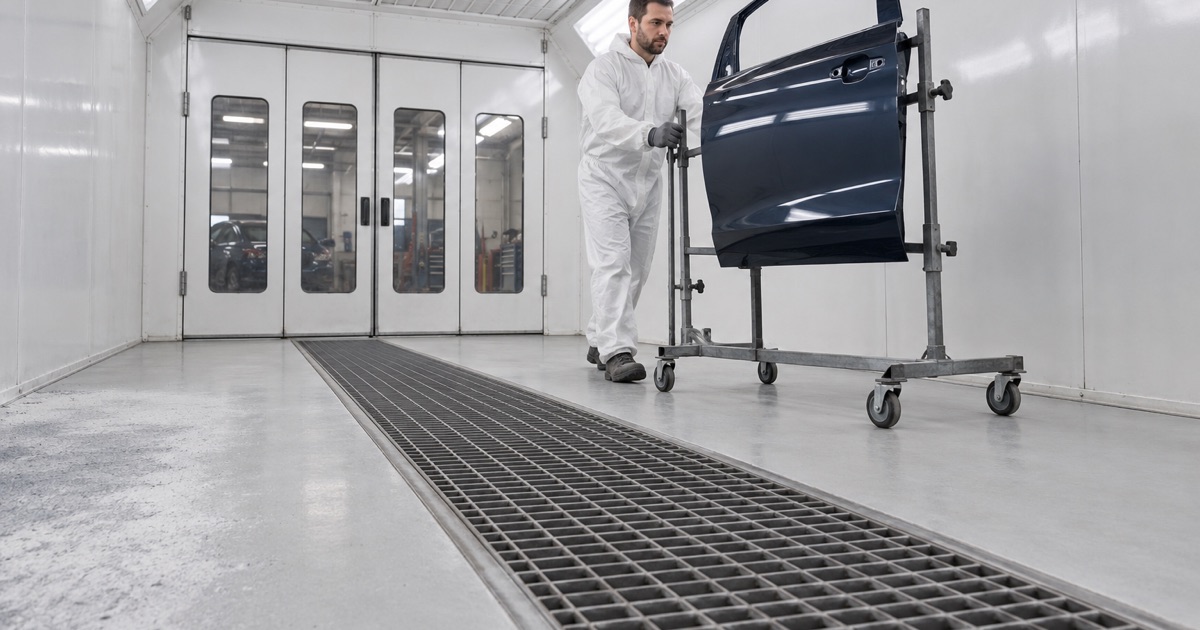
This page is about one kind of floor in particular: the work area around automotive painting and refinishing, and the home garage where someone sprays a fender on a Saturday. Both ask the same thing of a coating, which is to be cleaned hard and often without giving way.
Paint Shops Along Archer Road
Two body shops with long Summit histories
Archer Road is where Summit’s auto body trade is easiest to see. M W Autobody and Repair, at 6313 South Archer Road, lists auto painting and refinishing and car painting services among its offerings, along with collision repair, frame and structural repair and rust repair, and says it was established in 2005. Summit Auto Body, at 5601 South Archer Road, says it has been in business since 1989.
Search turns up more of the same trade on the corridor, including a body-work-and-paint shop at 5805 South Archer Road and Bud’s Body Shop Supply and Paint at 6001 Archer Road. We have no relationship with any of these businesses and have not seen their floors. They are named here because they show what kind of work the road carries.
Which side of the village line
Both shop addresses geocode inside Summit village, in Lyons Township, Cook County. That matters on Archer Road more than on most streets, because the village line runs along it. The published address of Ingredion’s Argo plant, 6400 South Archer, geocodes to Bedford Park, not Summit, so a job quoted off an Archer Road address gets geocoded before anyone assumes which permit desk it belongs to.
On the Summit side, building work goes through the Village of Summit Building and Public Works department at the Strzelczyk Municipal Center, 7321 West 59th Street. Illinois has no state flooring license, so we check the village’s own contractor license, bond and insurance rules before a job is booked rather than after a crew arrives.
What a paint area asks of a slab
Neither shop’s website describes a spray booth, and we make no claim about how either one is set up. Still, any shop that paints and refinishes cars has an area where overspray lands, and that area is where a floor coating earns or loses its keep. The question is not how the floor looks on day one but how it handles months of scraping and wiping.
That is a different job from a showroom or a parking bay. Tire traffic, dropped tools and fluid drips still matter, but a paint area adds a cleaning routine that most coatings never see. Federal workplace rules spell part of that routine out, and they are worth reading before choosing a system.
Looking for epoxy-flooring closer to Western Springs? See Western Springs Epoxy-Flooring.
What OSHA’s Spray-Finishing Rule Says About the Floor
The floor surface under the spray area
OSHA’s standard for spray finishing with flammable and combustible materials, 29 CFR 1910.107, addresses the floor directly. Paragraph (b)(3) says the floor surface of a spray booth and the operator’s working area, if combustible, shall be covered with noncombustible material of such character as to facilitate the safe cleaning and removal of residues.
We read that sentence as a description of how the floor gets used, not as a product specification, and we never sell a coating as a way to satisfy it. A floor coating is not fire protection and does not make a spray area compliant. Safety and code questions belong with the shop’s own safety program and the authorities that enforce it, not with a flooring contractor.
Overspray residue and the daily scrape
Paragraph (g)(2) asks that spraying areas be kept as free from accumulated combustible residues as practical, with cleaning conducted daily if necessary. Paragraph (g)(3) says residue scrapings and debris contaminated with residue shall be immediately removed from the premises. In practice, overspray residue on the floor is scraped up, swept and hauled out, sometimes every working day.
A floor under that routine is worked mechanically far more than a typical garage floor. Every pass with a blade looks for an edge to catch, and every low spot or pinhole in the coating becomes a pocket where residue packs in and has to be dug out. A smooth, uniform film at a consistent thickness is what lets a scraper glide rather than chatter.
Rags, waste cans and what reaches the floor
The same paragraph keeps rags or waste soaked in finishing material in approved metal waste cans, emptied at least daily. That keeps most solvent-soaked material off the floor, but it does not keep solvent off the floor entirely.
Drips from a rag on its way to the can, a tipped cup of reducer and the wipe-down itself all put solvent on the coating. A paint-area floor is therefore judged on two things at once: whether it survives the scraper, and whether it survives the solvent that follows. The next section takes those in turn.
Nonsparking Tools, Solvent Wipe-Down and a Coating That Holds
Nonsparking scrapers against a cured film
Paragraph (g)(2) also says scrapers, spuds and other cleaning tools shall be of nonsparking material. Those tools are commonly brass, bronze or similar alloys, and they behave differently on a floor than a steel blade. A softer tool is gentler on a hard film, but it leaves more behind on a soft or rough one, so the surface has to release residue rather than grip it.
That is why we lean toward a dense, high-build 100% solids epoxy body coat under a hard topcoat for a refinish area, and keep the broadcast fine where scraping happens. A heavy vinyl flake or coarse quartz aggregate broadcast gives traction, but its peaks hold residue. Slip resistance is set by the broadcast and topcoat we specify, and the proposal says which ones.
Solvent wipe-down, short term and long term
Solvent resistance is measured, not promised. One epoxy floor coating’s published chemical-resistance chart separates short-term exposure, meaning splashes rinsed off the same day, from long-term exposure, meaning repeated splashes to one spot or standing contact up to three months. On that chart solvent naphtha rated well on both counts, while xylene rated well short term and lower over the long term.
Acetone on the same chart was acceptable short term but noted to change color and gloss. Gasoline, diesel oil and dirty motor oil rated well on both counts. Charts differ by product, so we match the topcoat to the solvents a shop actually wipes with, name that product line in the proposal, and explain what the warranty excludes before the job is sold.
Getting the film to bond and cure
None of that resistance matters if the coating lets go of the slab. A paint area puts softening solvents at the surface and blade pressure at every edge, so the bond underneath carries the whole system. We grind or shot blast to an ICRI concrete surface profile suited to the build, and we capture the grinding dust at the machine with a vacuum instead of rinsing it toward a drain.
Cure follows slab temperature and the dew point spread at the slab surface, not the calendar. An undercured film is softer under a solvent rag and more prone to amine blush, so the schedule waits on the slab. Where a shop cannot close, we phase the work into overnight and weekend windows, using products inside the Illinois VOC limits for floor and industrial coatings.
Spray Painting in a Coated Home Garage
Masking the floor before the first coat of paint
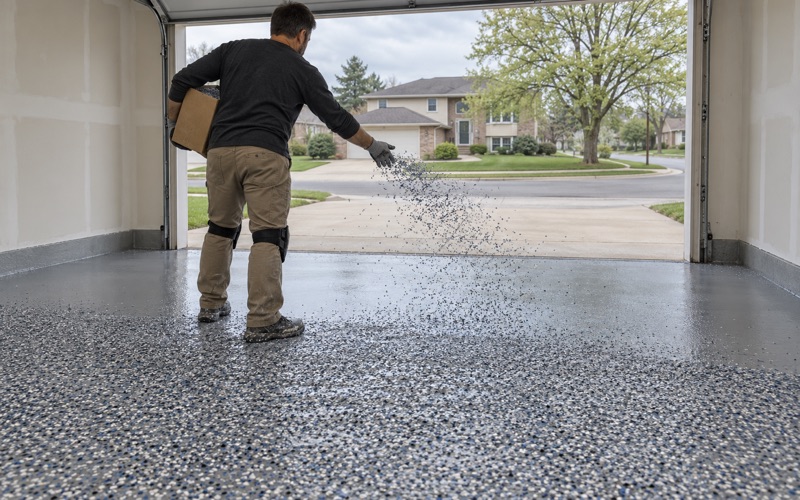
Spray work in Summit is not limited to the shops on Archer Road. Plenty of owners prime a fender, refinish a bumper or paint cabinet doors in their own garage, and a coated garage floor changes how that weekend goes. Overspray settles on everything within reach, and how easily it comes off depends on the coating underneath.
We tell homeowners to mask the floor anyway. Painter’s paper or plastic sheeting taped at the edges keeps the heaviest overspray off the coating, and a drop cloth under the part catches runs and drips. Open the overhead door for airflow, and set the work up in the middle of the bay rather than against a wall.
Cleaning overspray off the floor
Dry overspray on a smooth topcoat often lifts with a plastic scraper and a damp microfiber pad. Reach for a solvent only after reading the topcoat’s resistance chart, and test it on a corner first. Acetone in particular can dull the gloss of some epoxy systems even when it does no deeper damage.
A plastic or other nonsparking scraper is also a sensible habit at home, even though OSHA’s rule governs workplaces rather than private garages. Keep solvent-soaked rags in a closed metal can and take them out of the garage when the job is done, rather than leaving a pile of them on the floor overnight.
Choosing a garage system with paint work in mind
If spray work is a regular hobby, tell us before we write the scope. A smoother finish with a fine broadcast releases overspray better than a heavy flake floor, and a solvent-resistant topcoat buys margin against the occasional spill. The same system still has to stand up to the brine and rock salt that ride in on tires every winter, so the product choice balances both.
Every garage proposal includes a moisture test and states the coat count and finished thickness. Home jobs over the state threshold get a written contract and the Home Repair: Know Your Consumer Rights pamphlet before any grinding starts. An unheated garage in deep winter is told to wait for a slab warm enough to cure, because a rushed floor is the one that softens under the first solvent rag.
- 20+ Years on Concrete
- Moisture Tested Before Pricing
- Written Specs on Every Quote