Orland Park Epoxy Flooring installs polyaspartic floor coating systems in Orland Park, IL, serving surrounding cities including Palos Heights, Mokena, Worth, Palos Hills and Crestwood. With 20+ years of floor work behind us, we use polyaspartic where its speed and color stability earn their place, and we prep the slab exactly as carefully as we would for a slower epoxy.
Polyaspartic coatings cure in hours rather than days, resist sunlight without yellowing and stand up to abrasion and road salt. Those strengths make them a strong choice for garages, storefronts and floors that have to go back into service quickly. They also make the coating less forgiving, because a fast cure leaves little time to fix mistakes in the field.
Every proposal names the products for each layer, the number of coats and the finished thickness. We test for moisture and map cracks before pricing, because the fastest coating in the world still fails over a slab that was never checked.
What a Polyaspartic Floor Coating Is
Polyaspartic and Polyurea Chemistry
Polyaspartic coatings are a branch of the polyurea family, built to slow the extremely fast reaction of pure polyurea to a working time a crew can roll and broadcast. The result is a tough, flexible film that cures quickly across a wider range of temperatures than most epoxies.
Aliphatic polyaspartics hold their color in sunlight, which is why they are used so often as topcoats. Pure polyurea, by contrast, is usually sprayed with special equipment and is more common on industrial and exterior work than in a home garage.
Polyaspartic Compared With Epoxy
A 100% solids epoxy builds thickness in a single coat and soaks deeply into ground concrete, which makes it an excellent base. It cures more slowly, ambers in sunlight and becomes brittle at the surface if used as the only layer on a floor that takes heavy impact and sun.
Polyaspartic cures fast, stays clear in ultraviolet light and resists abrasion and chemicals well. It costs more per gallon and builds less thickness per coat, so we choose between them, or combine them, based on the slab and how the floor will be used.
Where Polyaspartic Sits in a System
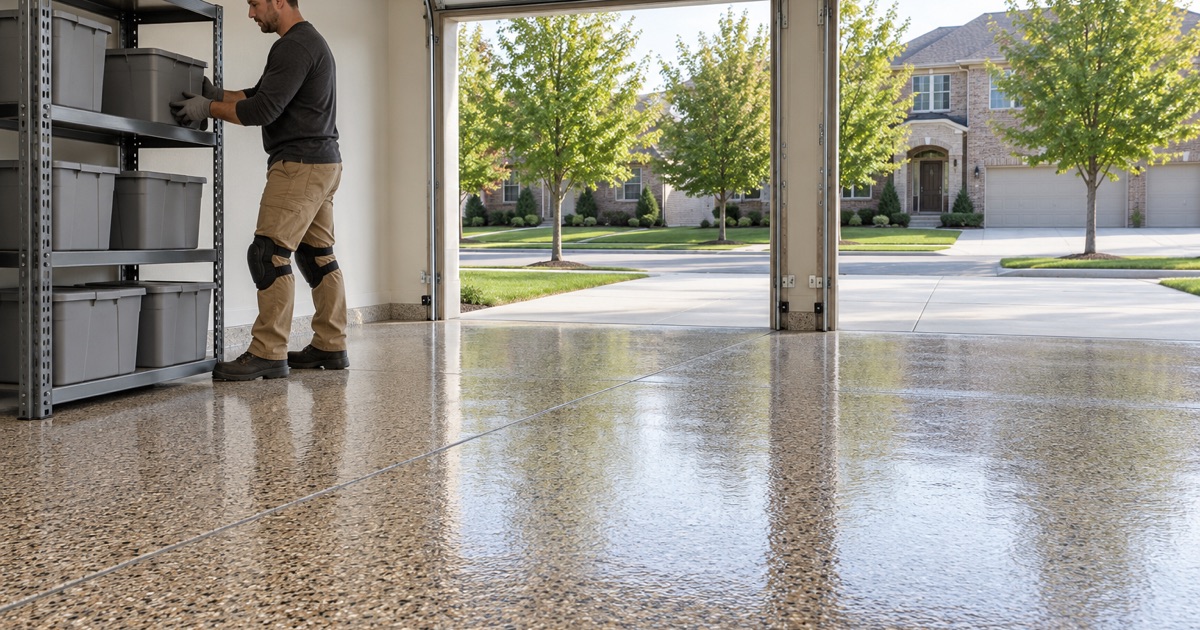
On many of our floors polyaspartic is the topcoat over an epoxy base and a vinyl flake broadcast. In that role it locks in the flake, takes the wear and keeps the color steady near doors and windows.
On other floors we run a full polyaspartic system, base and top, when a one-day return to service matters most. The proposal states which approach you are getting, so you are not comparing a two-layer system with a single coat on price alone.
Why a Fast Cure Cuts Both Ways
One-Day Garage Floors
The biggest draw of polyaspartic for homeowners is time. On a sound, dry slab with modest repairs, we can often grind, coat and broadcast a garage floor in a day, with foot traffic soon after and vehicles following once the topcoat has hardened enough.
That schedule depends on the slab. Heavy crack repair, removing an old coating, moisture mitigation or a cold garage can push the work into a second day or more, and we tell you that before booking.
Short Working Time and Crew Skill
A polyaspartic batch stays workable for only a short time once mixed, and humidity and slab temperature shorten it further. Crews have to mix in measured amounts, roll in a steady pattern and broadcast on time, or the floor shows lap marks and uneven texture.
This is where experience shows. A crew that has run polyaspartic on many floors knows how much to mix for the conditions and how to keep a wet edge, which is not something a fast-cure label can supply.
Prep Still Takes the Time It Takes
A fast coating does not shorten grinding, crack repair or moisture testing. We still diamond grind or shot blast the slab to a real profile, fill cracks and spalls, and test for moisture before any product is opened.
Skipping those steps to protect a one-day promise is the most common reason fast-cure floors fail. A polyaspartic coating over an acid-etched or damp slab peels just like any other coating, only sooner.
Residential and Commercial Polyaspartic Floors
Garages Facing Sun and Salt
Most Orland Park garages are attached and many face the street, so the floor just inside the overhead door gets direct sun and the heaviest load of winter brine. A polyaspartic topcoat handles both better than an epoxy topcoat, staying clear in daylight and resisting the salt and calcium chloride carried in on tires. We still specify a broadcast texture for wet winter floors, and we build enough total thickness to resist hot tire pickup in the wheel tracks.
Showrooms and Storefronts That Reopen Fast
Retail and showroom floors often have only a night or a weekend to be coated. Polyaspartic’s fast cure lets us coat in phases and have sections back in service the next morning, without the extended cure wait an epoxy topcoat would need.
Storefront windows also let in a lot of sunlight, so color stability matters as much as speed. Clear and tinted polyaspartic topcoats keep a showroom floor looking even across the sunny front and the shaded back of the store.
Clinics, Kitchens and Back Rooms
Clinics and back rooms that clean with strong disinfectants need a chemical-resistant topcoat, and many cannot close for long. Polyaspartic offers both, letting us coat a room after hours and hand it back by morning.
For kitchens that take hot water washdowns and thermal shock, we usually recommend urethane cement instead. We explain that choice rather than forcing a fast coating into a room it is not built for.
Temperature, Humidity and Moisture
Cool-Weather Installation
Polyaspartic tolerates cooler slabs better than most epoxies, which helps on late fall and early spring jobs in the Chicago area. We still measure slab temperature before mixing, because the cure speed, working time and final hardness all change with temperature.
In an unheated garage during a deep cold stretch, even polyaspartic may not be the right call. If the slab cannot be kept warm enough through the cure, we recommend waiting rather than gambling on a floor that never fully hardens.
Humidity and the Dew Point
High humidity speeds up some polyaspartic reactions and can cut working time sharply. A slab close to the dew point invites condensation, which can cause bubbles, haze or a weak bond.
We check the dew point spread at the slab surface before starting and adjust batch sizes or the schedule when conditions are tight. That check takes minutes and prevents most of the defects that show up on fast-cure floors.
Moisture Testing Under a Fast Coating
A polyaspartic film is relatively thin and does not stop vapor coming up through a damp slab. We test with ASTM D4263 plastic sheets, ASTM F1869 calcium chloride kits or ASTM F2170 relative humidity probes, depending on the slab and the products being used.
When the readings run high, a moisture-mitigation primer can go down under the system. When they run too high for any primer, we say so, because moisture is the first exclusion on nearly every coating warranty.
- 20+ Years on Concrete
- Moisture Tested Before Pricing
- Written Specs on Every Quote