
Orland Park Epoxy Flooring grinds and finishes polished concrete floors in Orland Park, IL, serving surrounding cities including Palos Heights, Mokena, Worth, Palos Hills and Crestwood. In 20+ years of floor work we have learned that polishing rewards honest planning: the slab decides much of the look, so we show you what your concrete will become before the whole floor is ground.
Polished concrete is not a coating. We grind the slab flat with metal-bond diamonds, harden it with a lithium silicate densifier and refine it with progressively finer resin diamonds until the surface reflects light. Nothing sits on top to peel, which is why polished concrete suits floors that take heavy traffic and a lot of cleaning.
Every proposal states the exposure level, the final sheen, whether dye or a stain guard is included, and how cracks and joints will be treated. Grinding dust is collected at the machine, and any wet slurry is picked up rather than rinsed toward a floor drain or a storm inlet.
Commercial Polished Concrete
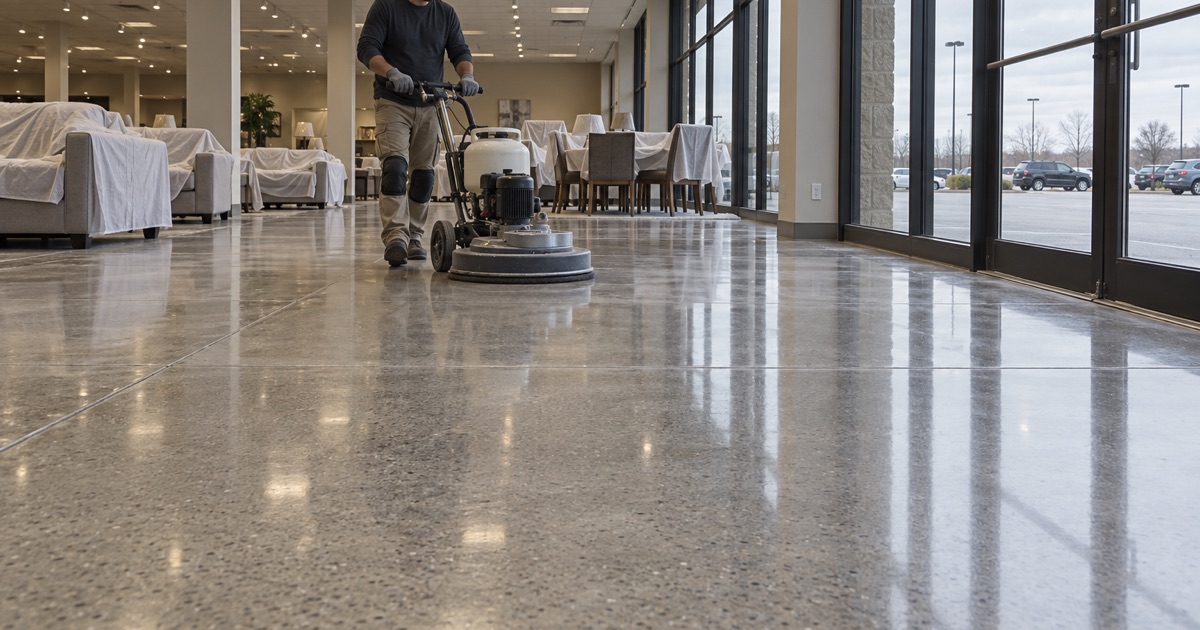
Retail Stores and Furniture Showrooms
Retail, furniture and grocery space makes up a large part of Orland Park’s commercial floor area, and those floors take carts, pallet jacks and constant foot traffic. Polished concrete holds up well under that use, and it does not need to be stripped and recoated the way waxed tile or a thin coating does.
When a store cannot close, we phase the work by section and schedule grinding overnight or across weekends. The floor can usually take traffic as soon as the final polish and guard are done, so fixtures move back without waiting on a long cure.
Offices, Clinics and Common Areas
Office lobbies, clinic waiting rooms and building corridors often start as bare slab under old carpet or tile. Once the flooring and adhesive are removed, polishing turns that slab into a durable finish floor with a clean, light-reflecting look.
Medical and office spaces clean often, so we finish with a guard that resists the cleaners in use and tune the sheen so the floor does not glare under bright overhead lighting. Work is scheduled around patient hours and office schedules.
Warehouses and Back-of-House Floors
Stockrooms, receiving areas and service corridors benefit from a densified, polished slab that resists dusting and wear from forklift and pallet jack wheels. A lower sheen is common here, where durability matters more than shine.
We also look at the joints. Forklift wheels crossing open control joints chip the edges over time, so we fill them with a semi-rigid joint filler as part of the scope rather than leaving them to break down.
Residential Polished Concrete
Basements and Lower Levels
Many Orland Park homes have a full or partial basement, including the half-buried lower level of a split-level. A polished slab gives those rooms a finished floor that does not trap moisture the way a coating or carpet can, since there is no film for vapor to push against.
We still test the slab and look for efflorescence, cracking and staining first. Moisture coming through the floor shows up as white salts on a polished finish, so a wet slab needs its water source handled before we polish it.
Garages and Workshops
A polished and densified garage or workshop floor resists dusting and is easy to sweep and clean. It does not have the chemical barrier of a coating, so oil and brine spills need to be wiped up promptly to keep them from staining the concrete.
For a garage that sees a lot of salt and fluids, we may recommend a coating instead, and we say so. Polishing works best where the floor stays relatively dry and the goal is a durable, low-maintenance surface.
Main Floors and New Construction
On new construction or a remodel with a slab-on-grade main floor, polished concrete can serve as the finished floor throughout. Planning starts before the slab is poured, because finishing, curing and protection during construction affect the final look.
On existing slabs we work with what is there. Cut lines from removed walls, patched trenches and old adhesive marks may remain visible, and we walk through those with you during the test grind.
Exposure, Sheen and Color
Cream, Salt and Pepper or Full Aggregate
The depth of the first grind decides how much stone you see. A light grind keeps the cream at the surface, a moderate grind exposes fine sand and small stone for a salt-and-pepper look, and a deeper grind cuts into the coarse aggregate for a terrazzo-like finish.
Deeper grinds cost more and can expose uneven aggregate if the slab was not placed for polishing. A test area on your own floor shows the result before the full floor is cut.
Matte, Satin or High Gloss
The number of polishing passes sets the sheen, from a low matte to a high reflective gloss. Higher sheens show off the floor and bounce light around a room, while lower sheens hide scratches and dust between cleanings.
We match the sheen to how the space is used, often keeping entries and wet areas lower and saving the brightest polish for showrooms and lobbies where it pays off.
Dyes, Guards and Saw-Cut Patterns
Penetrating dyes can tint polished concrete during the process, and saw-cut lines can divide the floor into borders, grids or logos. Dyes vary with the concrete, so we test them before committing a color to a whole room.
A penetrating stain guard is applied at the end to resist oil, coffee and food stains. It does not form a thick film, so it can be refreshed during maintenance without stripping the floor.
Full Polish Versus Grind and Seal
Some floors are sold as polished when they have only been ground and covered with a topical sealer. That look can be attractive at first, but the sealer is a film that wears in traffic lanes and has to be stripped and reapplied.
A true mechanical polish builds the shine into the densified concrete itself. We state in the proposal which one you are getting, so the floor can be judged against what was promised rather than against a photo.
Burnishing and Re-Polishing Over Time
Even a well-polished floor dulls in the busiest lanes after enough foot traffic, carts and grit. Regular dust mopping and a neutral cleaner slow that down a great deal.
When the sheen does fade, a high-speed burnish or a light re-polish with fine diamonds usually brings it back without starting over. We explain that maintenance cycle up front, so the floor’s long-term cost is clear before you choose it over a coating.
Slab Problems Polishing Will Show
Cracks, Patches and Old Coatings
Polishing refines the slab you have rather than covering it, so existing cracks and patches stay visible. We fill cracks with a color-matched filler, but we do not promise they will disappear.
Old coatings, paint and tile adhesive must be fully removed first, and some adhesives require testing before grinding. That removal is part of the written scope, not a surprise on the invoice.
Soft or Uneven Concrete
Some slabs have a weak surface or uneven flatness from the original pour. A soft surface may need a densifier earlier in the process or a deeper grind to reach harder concrete underneath, and very uneven floors may show low spots that the grinder cannot reach.
When a slab is unlikely to polish well, we tell you and explain the alternatives, including a coating system or an overlay, instead of starting a floor that will disappoint.
- 20+ Years on Concrete
- Moisture Tested Before Pricing
- Written Specs on Every Quote