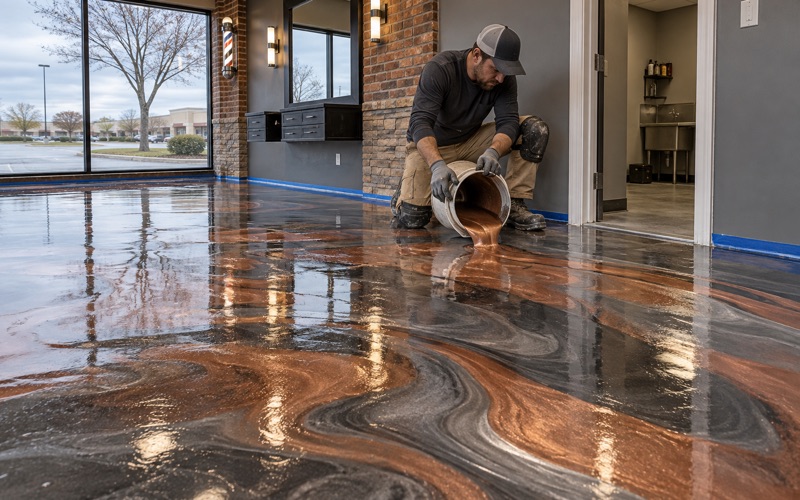
Orland Park Epoxy Flooring has spent more than 20 years putting down epoxy flooring in Mokena and the rest of the southwest suburbs, and the rooms that teach us the most are the ones where the floor is part of the process rather than a surface under it. A production room where beer is brewed, transferred and packaged is one of those rooms. Liquid reaches the floor every day, and the floor decides whether that liquid drains away or settles into a seam.
That is the frame for this page. We are not writing about a showroom finish or a color chart. We are writing about seamless resin floors for small production spaces, where cleaning happens with a hose, a squeegee and a sanitizer, and where a crack or an open joint is a place the cleaning never quite reaches.
If you run a production unit, a tasting room, or a garage where you brew at home, the questions are the same: what the slab is like now, what the floor has to survive, and what a written scope should promise before any grinding starts.
A Sour-and-Clean Brewery in a Mokena Business Park
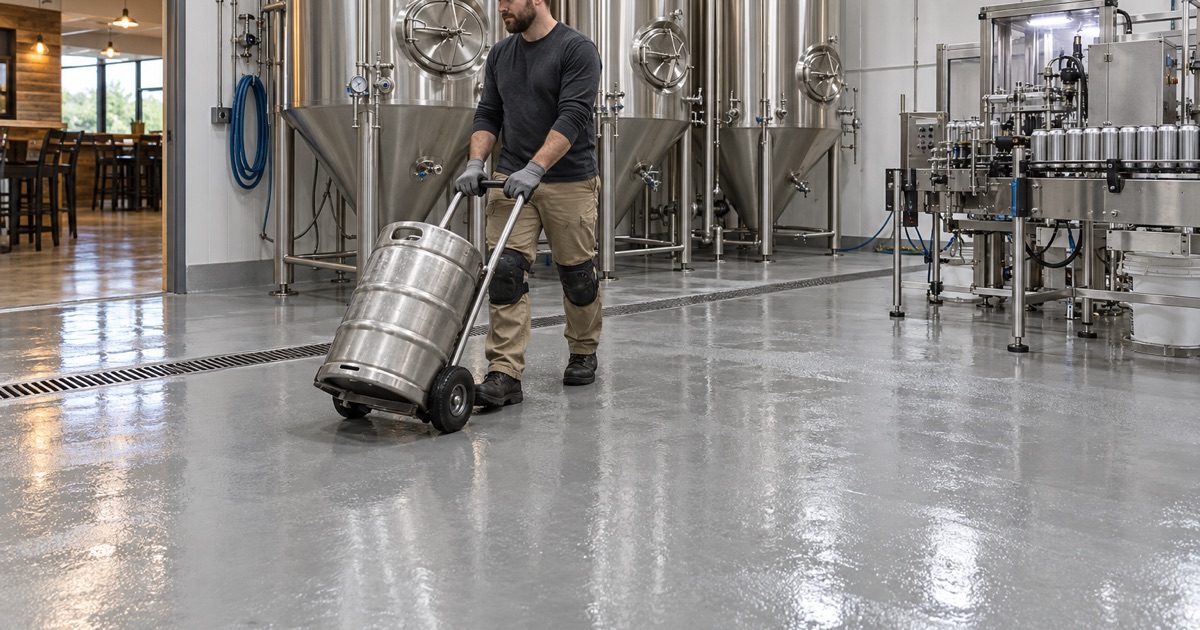
One production room, two kinds of beer
Brothership Brewing sits at 18781 S. 90th Avenue, in the Corporate Corridors North Business Park. When the village board approved its special use permit in September 2019, the approval described a 3,357-square-foot alcohol production facility along with a tasting room. The Chicago Southland visitors bureau lists the brewery as specializing in New England IPAs, imperial stouts and sour IPAs.
That last item is the reason this page exists. A brewery that makes sour IPAs beside clean beers is running two programs in one small footprint. Sour beer depends on bacteria that a clean IPA or a stout must never pick up, so the brewery has to keep those organisms where they are wanted and away from everything else. We have never worked at Brothership and have not seen its floor; we use it here because it shows clearly what a mixed program asks of any production room in the village.
What a business-park unit starts with
A unit in a business park was usually built as flexible space, which means a plain concrete slab designed for racking, a forklift and maybe an office build-out. Nobody poured it expecting wort, hot rinse water and daily washdown. Saw-cut control joints, patched trenches for new drains, and old adhesive or sealer from a previous tenant are all common.
That is why we map every crack, spall and old coating before anything is priced. Sometimes the honest answer is that a section of slab needs repair or replacement before resin goes on it, and we say so in the proposal rather than coating over a problem that will come back through the floor.
Looking for epoxy-flooring closer to Worth? See Worth Epoxy-Flooring.
Where Souring Bacteria Live: The Floor Is on the List
What one brewery survey found
The most useful reference here is a peer-reviewed study published in eLife in 2015 by Bokulich, Bergsveinson, Ziola and Mills. The researchers mapped the microbes in one North American brewery that made both sour and conventional beers. It was a single brewery, not Brothership, and the paper names no floor material, but its findings on floors are direct.
They found Lactobacillus and Acetobacter on conveyor belts and on floors below packaging areas, as well as at hotside and cellar sinks. Floor and packaging surfaces carried a more diverse mixture of lactic acid bacteria than other areas. Genes linked to hop resistance, which let souring bacteria survive in hopped beer, were highest in sour beer samples and on surfaces that contact sour beers and unsanitary surfaces.
Why that matters for a mixed program
Lactic acid bacteria are the organisms a sour program cultivates on purpose. In a clean beer they are spoilage. When the study finds the most varied population of them on the floor below packaging, it is pointing at the floor as a reservoir that sits right where cans and kegs of every beer pass through.
A floor cannot sanitize anything, and no coating kills bacteria. What a floor can do is give organisms fewer places to hide and make the sanitation crew’s work reach the whole surface. That is a physical question about joints, cracks, porosity and slope, and it is where a resin system earns its place in a brewery.
Home brewers who sour in a garage
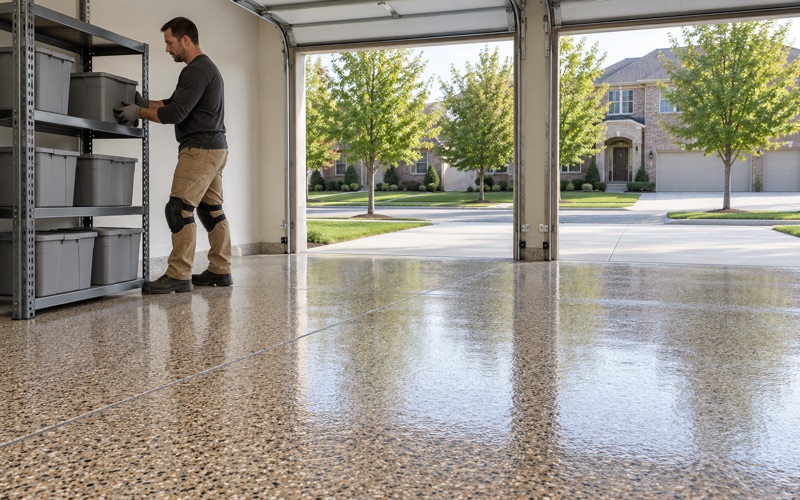
The same logic scales down. A home brewer who runs a sour batch in a garage or basement on bare, dusty concrete is working over a porous surface that soaks up spills and holds them. A sealed, seamless floor that can be mopped and rinsed is a reasonable upgrade for that hobby, and it is the same system logic at a smaller size.
Hosed, Not Scrubbed: Joints, Cracks and a Floor That Takes Sanitizer
Cleaning by hose leaves the seams behind
The eLife authors noted that non-production surfaces that meet beer and waste streams, including floors, sinks and grain-handling equipment, are typically cleaned only by hosing. Hosing moves liquid and loose debris. It does not scrub the inside of a saw-cut joint, the open edge of a spall, or the gap where a slab meets a wall.
Bare concrete is porous on top of that, so beer and wort wick into it. Every crack becomes a small channel that holds liquid after the hose is put away. In a room that runs sour beer, those are exactly the places where the floor stops being cleanable.
Filling joints and building a cove
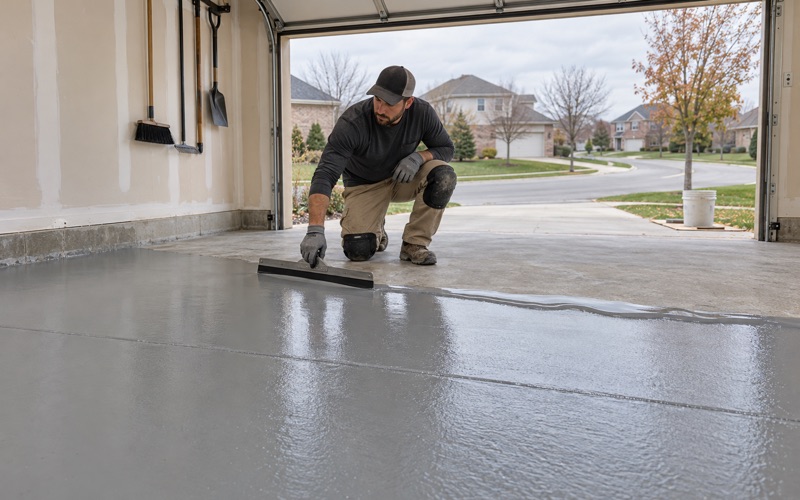
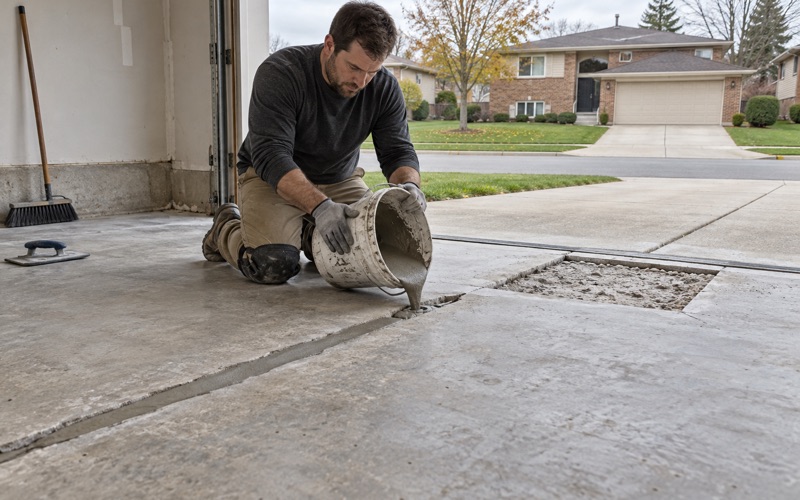
Our approach is to take the seams out of the floor. Cracks and non-moving joints are routed and filled so the resin runs continuously across them. Where the floor meets walls, curbs and equipment bases, we build a cove so the finish turns up the wall in a curve instead of stopping at a corner. A curve can be squeegeed and rinsed; a ninety-degree joint collects residue.
The FDA Food Code addresses coved floor and wall junctures in food establishments, and the same reasoning applies to a brewhouse. Slope to the drains matters as much as the cove. If beer stands in a low spot after washdown, a perfectly sealed surface still holds a puddle, so we check the fall of the floor before the system is chosen.
Choosing a system the sanitizers will not soften
Breweries clean with caustic, acid and sanitizer solutions, often hot. The floor has to take those chemicals day after day without softening, staining or losing its bond. Hot wort and hot cleaning water also put thermal stress on a rigid coating, which is one reason urethane cement or a heavier build of 100% solids epoxy is often the better fit than a thin roll-on product.
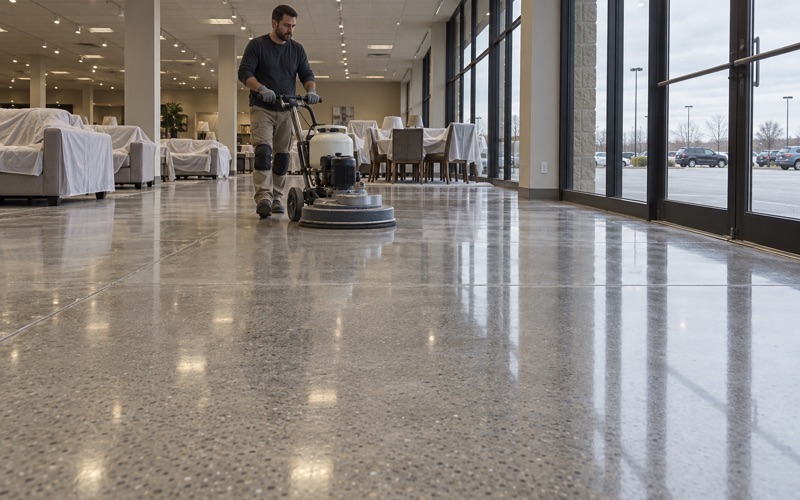
We write the product line, the number of coats and the finished thickness into the proposal, so the brewery can check the floor against the quote. We also name the texture. Slip resistance comes from the quartz aggregate broadcast and the topcoat chosen for it, and in a wet room we specify that texture deliberately rather than promising a nonslip floor in general terms.
Packaging, Cellar and the Practical Path in Mokena
Where the floor work starts
If a brewery can only close part of its floor at a time, the study points to the priority: the floor below packaging. That is where the most varied bacteria were found and where every finished beer passes. Cellar areas around fermenters and the sinks come next, since those were also places where souring organisms showed up.
We phase work around operating hours. Brothership’s posted hours run Wednesday through Sunday, which is typical for a small taproom; for any brewery we plan the noisiest grinding and the longest cures for the days the room is closed, with overnight and weekend windows when production cannot stop.
Preparing the slab and testing for moisture
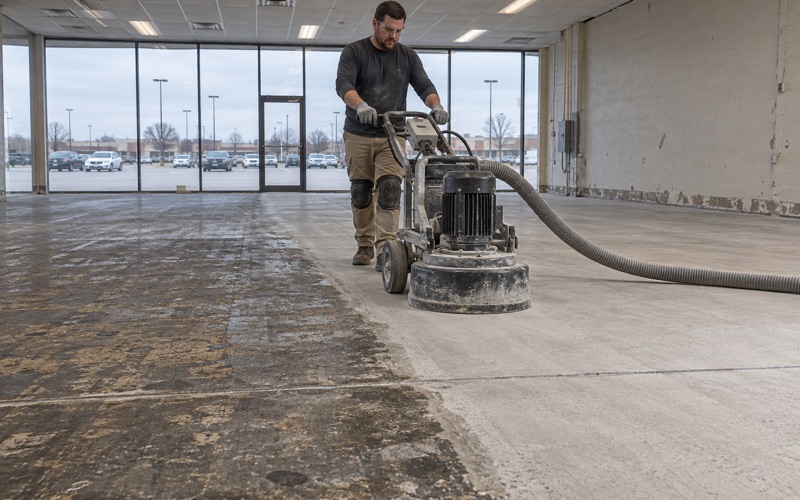
Every slab is opened by diamond grinding or shot blasting, never an acid etch. That gives the resin a measurable concrete surface profile to grip, which matters more in a wet room than anywhere else. Grinding dust is captured at the machine with a vacuum rather than rinsed toward a floor drain.
A moisture test is in the written scope before the price is final, using ASTM F2170 in-situ relative humidity probes or ASTM F1869 calcium chloride testing depending on the slab. Moisture coming up through concrete is the first thing we name as a warranty exclusion, and we explain what the warranty leaves out before the job is sold. Products are picked inside the Illinois VOC limits for floor and industrial coatings, which bind whoever applies them.
Registration, permits and who reviews what
Illinois licenses no general, flooring or coatings contractor, so the village’s own rules are the ones that count. Mokena’s Community Development Department, at 11004 Carpenter Street, registers contractors for a $150 fee with a certificate of general liability insurance at $500,000 each occurrence, proof of workers’ compensation at $500,000 each occurrence and a $10,000 surety bond. We check those requirements before a job is booked.
The village exempts finish work such as painting, tiling and carpeting from permits, but floor coating is not named on that list. The village asks anyone whose project is not listed to contact Community Development before starting, and we do that for commercial floors. On the health side, the Will County Health Department’s Environmental Food Safety program reviews and inspects food service and stores; whether a given brewery’s production room falls under that is a question for the department.
If you are planning a brewery, taproom or production floor in Mokena, we start with a site visit, a crack and coating map, and a moisture test. From there you get a written scope that names the system, the cove details and the finished thickness, so the floor you get is the floor you were quoted.
- 20+ Years on Concrete
- Moisture Tested Before Pricing
- Written Specs on Every Quote