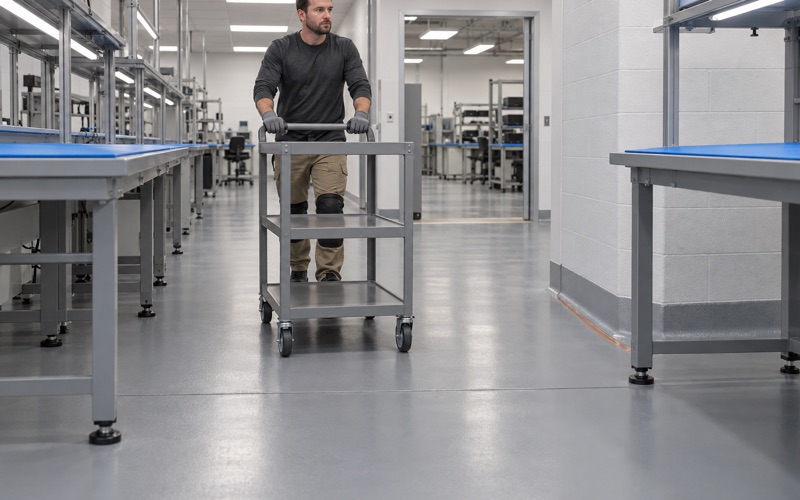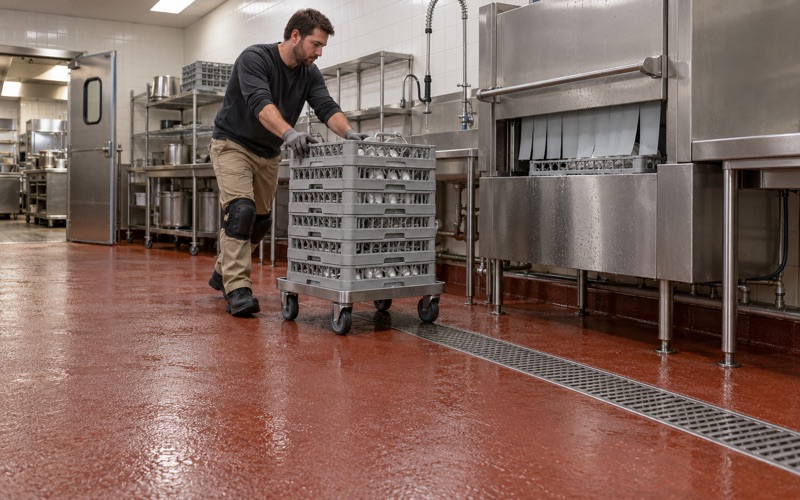
Orland Park Epoxy Flooring installs epoxy flooring in Midlothian for rooms where people work with their hands, and more than 20 years on the job have taught us that the right floor depends on what happens on each part of it. A garage bench, a hobby corner and a basement craft table ask far more of a floor than a sofa does. We plan coatings around that difference instead of treating every square foot the same.
Every job starts with the slab itself. We open the surface with a diamond grinder or a shot blaster, never an acid etch, and a moisture test is written into the scope before the price is settled. The proposal then names the product line, the number of coats and the finished thickness, so you can hold the finished floor up against the paper.
This page works through a question homeowners rarely ask out loud: which part of a room should be hard and sealed, and which part should stay soft? A public building project in the village makes the answer easy to see, so we start there.
A Library Workroom Becomes a Makerspace on Kenton Avenue
What the board approved
The Midlothian Public Library at 14701 Kenton Avenue is turning part of its staff workspace into a public makerspace. At its July 15, 2025, meeting, the library board heard Product Architecture + Design present the staff workspace remodel and makerspace design, along with a modified budget, and authorized the firm to draw bid documents.
On November 4, 2025, the board accepted a bid from KWCC Construction, not to exceed $621,400, for what the minutes call the staff workspace remodel and makerspace construction project. The total construction budget, including furniture, fees and village permit fees, came to $1,022,110. The library has posted that interior work runs from January into spring 2026.
A room that changes what it is for
The library’s 3D-printer page says printing is currently on hold until the new Maker Space is completed. That small notice says a lot about the project. A room that held desks, files and staff computers is being rebuilt for people who will cut, glue, paint and print, and those activities put very different demands on the floor beneath them.
We should be clear about what we do not know. We have not seen the makerspace’s equipment list or the floor finish its designers specified, and we have no part in the project. What it offers residents is a public example of a question every workshop owner eventually faces: once a room’s job changes, does its floor still fit the work?
The building around it
The library is a 14,914-square-foot building that opened in 1991, and a 2012 renovation moved the Children’s area to the front. Remodeling one interior zone of a working public building means rebuilding a defined footprint while the rest of the space keeps serving visitors. Homeowners face the same puzzle when one corner of a lived-in basement becomes a shop.
Looking for epoxy-flooring closer to Alsip? See Epoxy-Flooring in Alsip.
From Desks to Making: Zoning One Room by Activity
What changes when the desks leave
A desk room is forgiving. Rolling chairs, steady foot traffic and the occasional coffee spill are the worst most office floors see, which is why carpet and carpet tile are so common there. A making room is different: hammers and drill bits get dropped, wet glue lands and gets stepped on, and paint, sawdust and filament scraps pile up wherever someone has worked for hours.
Carpet traps that debris and holds the stains, and a dropped tool can snag or crush the pile. A hard, sealed surface lets the same mess be swept or wiped up at the end of the day. That trade-off shows up in university facilities standards, which list sealed concrete, epoxy, rubber and sheet vinyl for hands-on lab rooms and keep carpet tile to classrooms and offices.
Hard where people make, soft where they sit
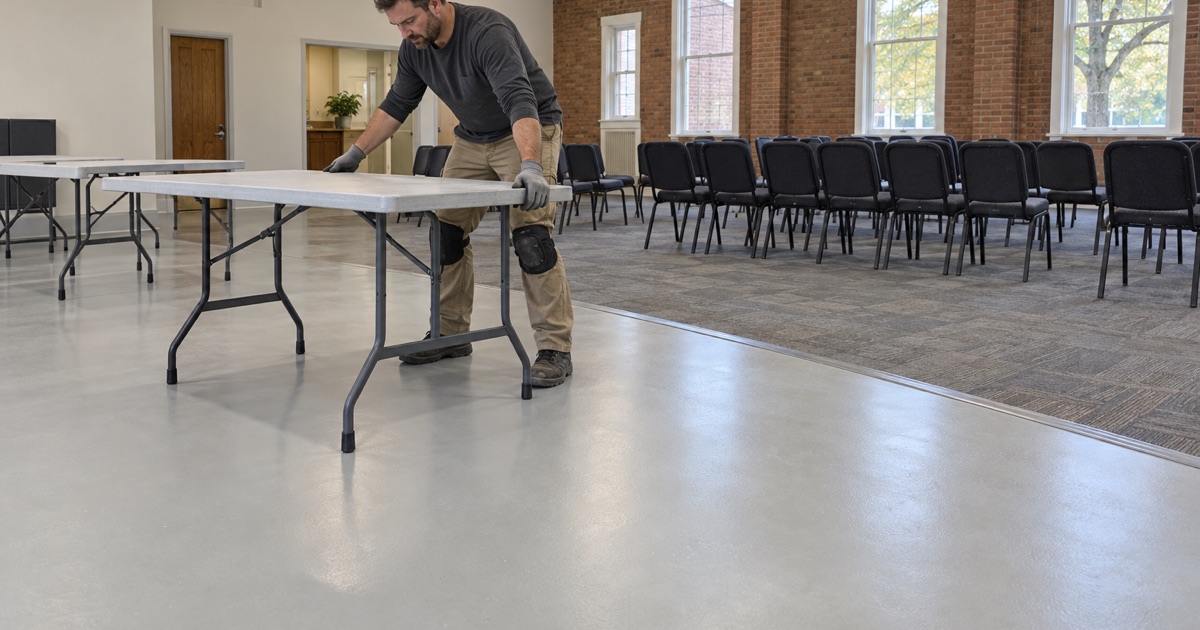
The useful lesson is that a single room rarely needs a single floor. Where people stand at a bench, the floor should be hard, sealed and easy to sweep. Where people sit to read, plan or wait their turn, carpet still earns its place. Drawing that line on the plan, before any material is ordered, is most of the design work.
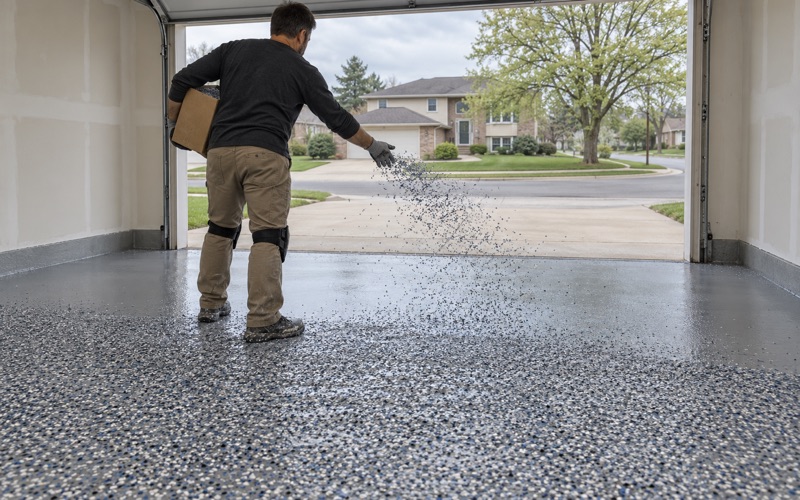
In a home the split usually falls along a wall, a doorway or the edge of a work area. A basement might carry a coated concrete zone around the workbench and laundry while carpet stays in the television corner. A garage might be coated wall to wall, with a rubber mat added only where someone stands for long stretches at a bench.
How we draw the boundary
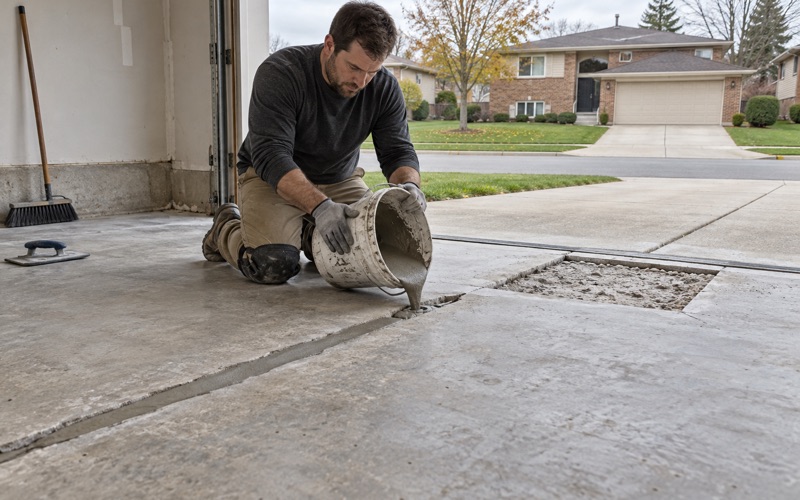
We map the slab before we map the zones. Cracks, spalls and old coatings get marked first, because a boundary that runs across a failing patch of concrete will show the flaw before long. If part of the slab needs repair or replacement before it should be coated, we say so plainly in the proposal rather than coating over the problem.
The coated edge needs a clean termination too. We grind a defined line, bring the coating right to it and leave a straight transition where carpet or another floor begins. The two surfaces then meet at a deliberate seam instead of a ragged one, and the carpet installer has a true edge to work against.
Dropped Tools, Glue, Paint and Scraps: What a Making Floor Takes
Impact and abrasion
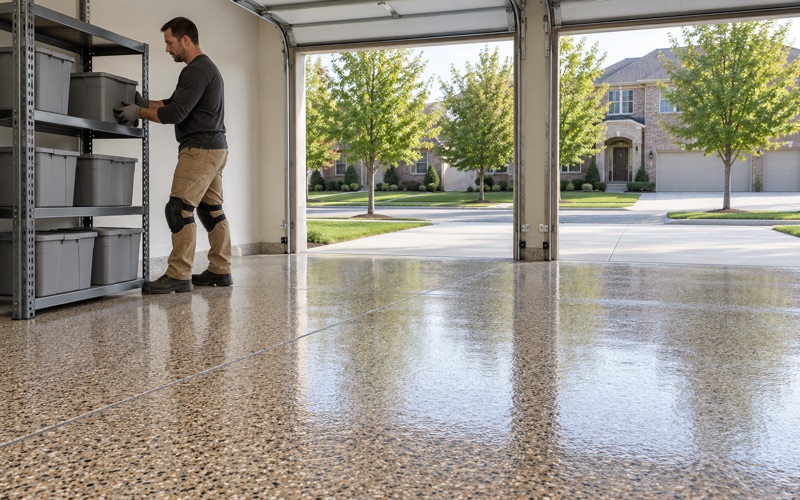
A workshop floor is judged by what lands on it. A thin roll-on paint will chip the first time a heavy wrench hits it, while a 100% solids epoxy built to a stated thickness takes far more abuse. For a shop that sees real impact, we often broadcast vinyl flake or quartz aggregate into the base coat, which adds body and hides minor scuffs.
The broadcast also sets the texture underfoot. A slip-resistant finish is specified by the aggregate and the topcoat used over it, not promised as a slogan. Where a hobbyist works with oils, water or fine dust that makes a smooth floor slick, we choose a coarser profile and explain up front how that texture cleans.
Glue, paint and cleanup
Adhesives, stains and craft paints are far easier to scrape from a sealed, nonporous floor than from bare concrete, which soaks them in. A polyaspartic or polyurea topcoat over the epoxy adds a hard, chemical-resistant skin. We pick products inside the Illinois limits on volatile organic compounds for floor and industrial coatings, because those limits bind whoever applies them.
Cleanup for a coated zone comes down to a broom, a dust mop and an occasional damp mop. That routine is the whole point of putting a hard surface where people make things. The room goes back to clean at the end of each project instead of carrying the residue of every project that came before it.
What the slab has to give us first
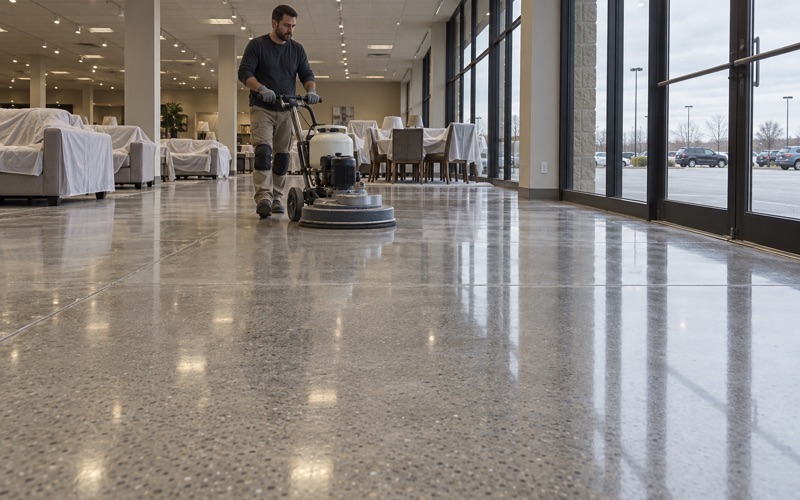
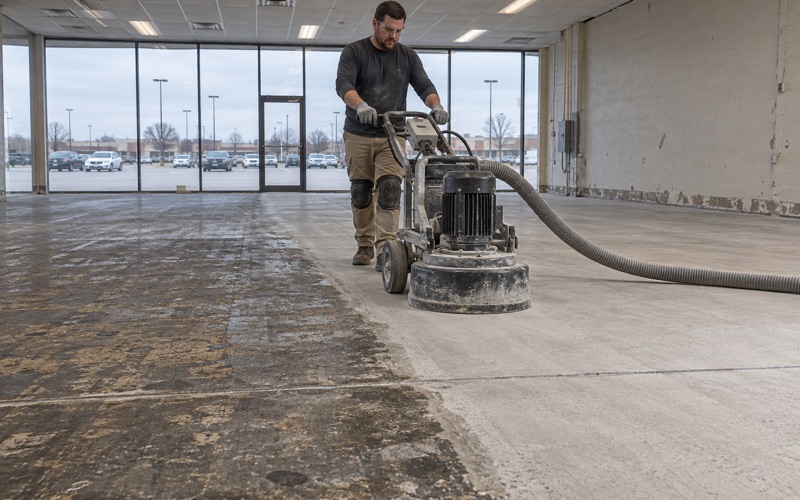
None of that works if the coating cannot grip. We profile the concrete to a measured ICRI concrete surface profile with diamond grinding or shot blasting. Our grinders run with a vacuum attached, so the dust is captured at the machine rather than rinsed across the floor toward a drain or out to the street.
Moisture is the other gate. We run tests such as ASTM F2170 in-situ relative humidity probes or ASTM F1869 calcium chloride testing before the price is final, and if the readings call for it, a moisture-mitigation primer goes into the scope. Moisture is also the first warranty exclusion we name, and we walk through the rest before anything is sold.
Hobby Rooms and Garage Workshops in Midlothian Homes
Where the home workshops are
Most of Midlothian’s housing is single-family: the Census counts 4,383 detached units in the village, and roughly three of every four households own their home. That puts a garage or a basement within reach of most residents who want a place to build, repair or craft. Those rooms are where the desk-to-making question shows up at home.
Garage workshops and winter salt
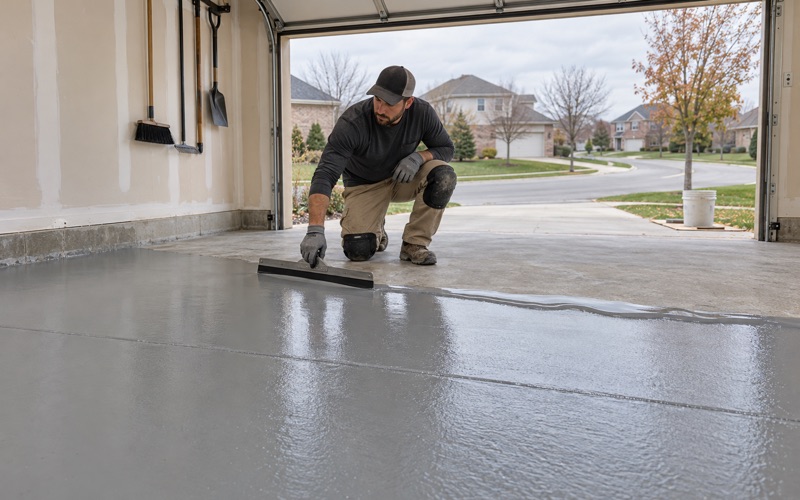
A garage that doubles as a shop has to carry a car as well as a workbench. Hot tires can lift a weak coating, and the brine and rock salt that ride in on tires all winter attack the surface. We choose garage systems with that salt load in mind and run the workbench zone in the same seamless coat, so slush has no seam to creep under.
Timing matters as much as product. Our cure schedules follow slab temperature and the dew point spread at the surface, not the calendar. An unheated garage in deep winter is told to wait for warmer conditions rather than coated on schedule and left to fail, and we would rather lose a week than redo a floor.
Basement hobby rooms
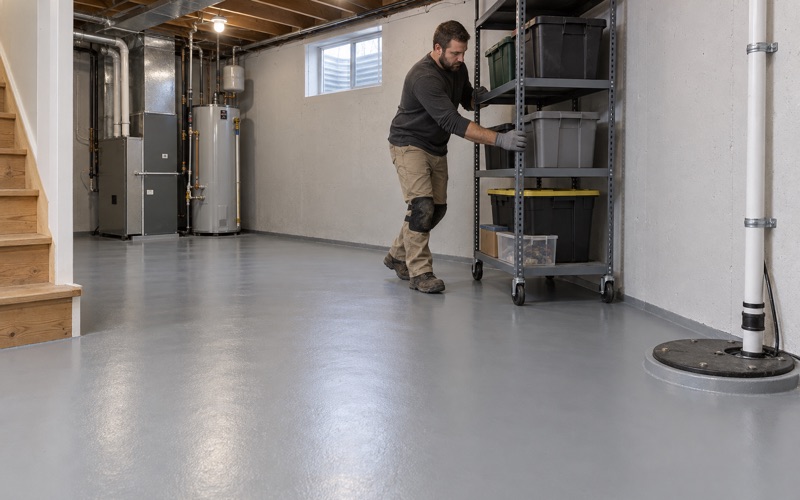
A basement craft room or sewing space is where zoning by activity fits best. The slab under a work table can be coated and sealed while a reading chair sits on carpet a few feet away. We test basement slabs for moisture before quoting, because a coating does not stop vapor pushing up from below, and we never sell a floor coating as radon reduction, since in Illinois that is licensed mitigation work.
Permits and paperwork
Every contractor working in the village needs an annual Village of Midlothian license, a $10,000 bond and a $1 million liability certificate naming the village. The Building Department at 14801 South Pulaski Road schedules inspections Monday through Friday with one business day’s notice. Illinois has no state flooring license, so we confirm the village’s rules before a job is booked.
Home jobs above the state threshold also get a written contract and the Home Repair: Know Your Consumer Rights pamphlet before any grinding begins. If you are planning a workshop zone in a Midlothian garage or basement, we can walk the room with you, mark where the hard floor should stop and put the scope, thickness and test results in writing.
- 20+ Years on Concrete
- Moisture Tested Before Pricing
- Written Specs on Every Quote