Orland Park Epoxy Flooring installs metallic epoxy floor systems in Orland Park, IL, serving surrounding cities including Palos Heights, Mokena, Worth, Palos Hills and Crestwood. A metallic floor is the most decorative coating we install and the least forgiving, and after 20+ years of floor work we treat its preparation as the real job.
Metallic epoxy uses fine pearlescent pigment suspended in clear resin. As the resin is rolled, spread and manipulated, the pigment drifts and settles into swirls, veins and depth that look like marble, polished stone or moving water. That effect depends on a flat, sound, dry slab, because every flaw underneath becomes part of the pattern.
The proposal names the products, the colors, the number of coats and the finished thickness, and it states any leveling work the slab needs. We test for moisture before pricing and show you a sample board before installation.
How a Metallic Epoxy Floor Is Built
Grinding Flat and Filling Every Flaw
We diamond grind the slab to open a real profile and knock down high spots. Then every crack, pit, spall and divot is filled and ground flush, because metallic resin flows into low areas and shows them as darker pools.
Some slabs need more than patching. When a floor is badly out of flat, we recommend a skim coat or a self-leveling underlayment before the decorative layers, and we write that into the scope rather than hoping the resin will hide it.
Primer and Dark Base Coat
A primer coat soaks into the ground concrete and seals the pores so air does not rise into the decorative layer. Without it, a porous slab can outgas and leave pinholes and craters in the finish.
Over the primer we roll a pigmented base coat, usually dark, that gives the metallic layer depth. The base color affects the final look as much as the metallic pigment does, so we choose it with you using the sample board.
The Metallic Layer
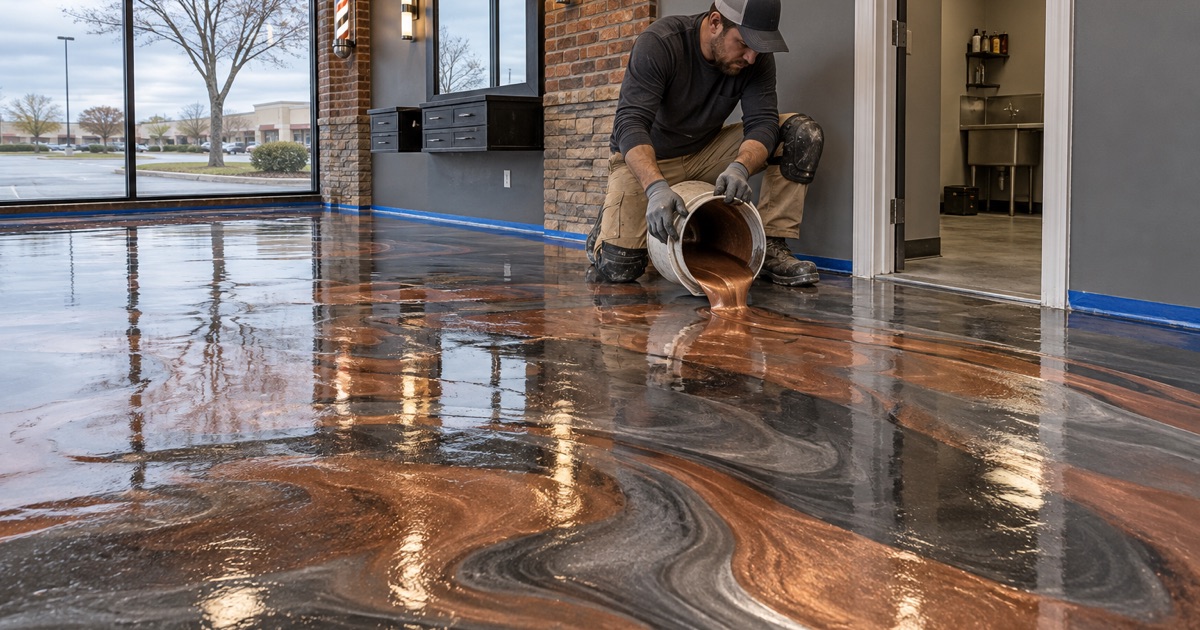
The metallic coat is mixed in measured batches, poured and spread across the floor, then worked with rollers, brushes, sprayed solvent or other tools to create movement. This is where installer skill matters most, because the pattern is formed in the minutes before the resin starts to set.
We plan the pour sequence around the room’s shape and doorways so wet edges meet cleanly. A room is usually poured in one continuous session to avoid visible seams between batches.
Clear Protective Topcoat
Metallic epoxy is protected with a clear topcoat, often an aliphatic urethane or polyaspartic. The topcoat adds scratch and chemical resistance and keeps the color from ambering where sunlight reaches the floor.
The topcoat also sets the final sheen and texture. A high gloss shows the depth of the metallic layer best, while a satin finish and a fine grit additive make the floor easier to live with in busy or wet areas.
Design Choices for a Metallic Floor
Colors and Pigment Blends
Metallic pigments come in silvers, golds, coppers, bronzes, blues, greens and many custom blends. Two or more colors can be combined in one pour for contrast and movement.
Colors look different on a small chip, a sample board and a full floor. We always pour a board with your exact combination and view it in the room’s own light before committing.
Pattern Styles and Movement
Installers create different looks by how they work the resin, from soft clouds and wide marbling to tight veining or a lava-like flow. Some owners want a calm, even floor, while others want strong contrast and movement.
We talk through the style before the pour and show examples of each technique. Since the pattern forms naturally, we describe the range you can expect rather than promising a copy of a photo.
Sheen, Texture and Slip Resistance
Metallic floors are usually glossy, which highlights the pigment but can be slick when wet. For kitchens, entries and anywhere water reaches the floor, we add a fine grit to the topcoat and may choose a satin sheen.
The texture is specified by the additive and topcoat used, not by a promise. We show you a textured sample so you can judge the balance between grip and appearance.
Residential and Commercial Metallic Floors
Finished Basements and Lower Levels
Many Orland Park homes have finished basements or split-level lower floors, and a metallic floor can turn those rooms into a showpiece. Basement slabs must be tested for moisture first, because vapor rising through the concrete is the most common reason a decorative floor blisters.
Where readings are high but manageable, a moisture-mitigation primer can go under the system. Where water is actively entering, the source has to be fixed before any decorative floor is considered.
Showrooms, Salons and Retail Spaces
Retail showrooms, salons and boutiques use metallic floors to stand out. The finish is seamless and easy to clean, and the clear topcoat holds up to foot traffic when it is maintained. Because a metallic floor takes several days and needs controlled conditions, we schedule commercial pours around closures and protect the floor from foot traffic until the topcoat has cured.
Offices, Lobbies and Event Spaces
Office lobbies, reception areas and event spaces benefit from a metallic floor’s look without the upkeep of stone or polished tile. A satin topcoat can tame glare under bright overhead lights. Heavy carts and furniture with metal feet will scratch any glossy floor, so we recommend protective pads and walk-off mats as part of the plan.
Garages, With Caveats
We can install metallic epoxy in a garage, but it is rarely the best choice. Brine, hot tires and gritty traffic wear a smooth metallic floor faster than a flake system, and scratches show clearly. If a metallic garage is the goal, we build a tougher topcoat, add texture and explain the maintenance it will need through winter.
What Can Go Wrong, and How We Prevent It
Roller Marks, Ridges and Pooling
A metallic floor shows every lap mark, ridge and low spot. Batches mixed too slowly, rolled in the wrong pattern or poured on an uneven slab leave visible defects that cannot be fixed without recoating. We prevent those with careful leveling, measured batches, a planned pour sequence and a crew experienced with metallic systems.
Pinholes and Outgassing
Porous concrete releases air when the temperature rises during a cure, and that air can push bubbles up into the wet resin. The result is pinholes or small craters in the finish. A proper primer coat, applied when the slab temperature is stable or falling, seals the pores before the metallic layer is poured.
Temperature and Moisture During Cure
Metallic epoxy needs a stable slab temperature and a safe dew point spread to cure evenly. Cold slabs slow the cure and can cause amine blush or a cloudy finish that dulls the metallic effect.
We measure slab temperature and dew point before mixing and keep the space conditioned through the cure. If conditions cannot be controlled, we wait.
Scratches, Cleaning and Recoating
A glossy metallic floor will collect fine scratches over time, especially where chairs slide, pets run and grit gets tracked in from outside. Those marks sit in the clear topcoat rather than in the metallic layer, which is what makes them repairable.
Dust mopping, a neutral cleaner and felt pads on furniture slow the wear considerably. When traffic lanes dull, the topcoat can be lightly abraded and recoated to restore the gloss without disturbing the pattern underneath, and we explain that maintenance cycle before you choose the floor.
Warranty Limits on Decorative Floors
Like every coating warranty, the coverage on a metallic floor excludes moisture coming up through the slab, and it does not cover the natural variation in pattern that makes each pour unique. We explain those limits before the job is sold.
Impact damage, chemical spills and traffic before the topcoat has cured are other common exclusions. Knowing them up front lets you plan furniture moves and room use around the cure schedule.
- 20+ Years on Concrete
- Moisture Tested Before Pricing
- Written Specs on Every Quote