Orland Park Epoxy Flooring has spent more than 20 years putting down epoxy flooring in Matteson and the rest of the south suburbs, and the jobs that turn out best are the ones where the layout is settled before the first coat. A coating is continuous by design. Once it cures, every bolt driven through it later is a break in that film.
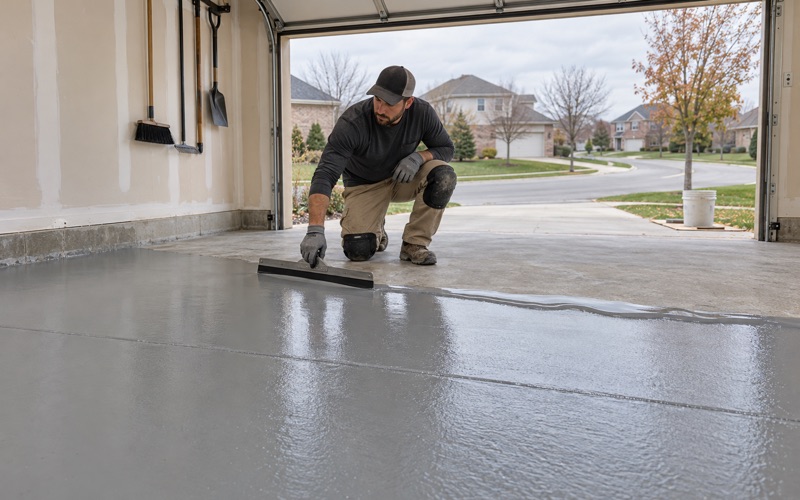
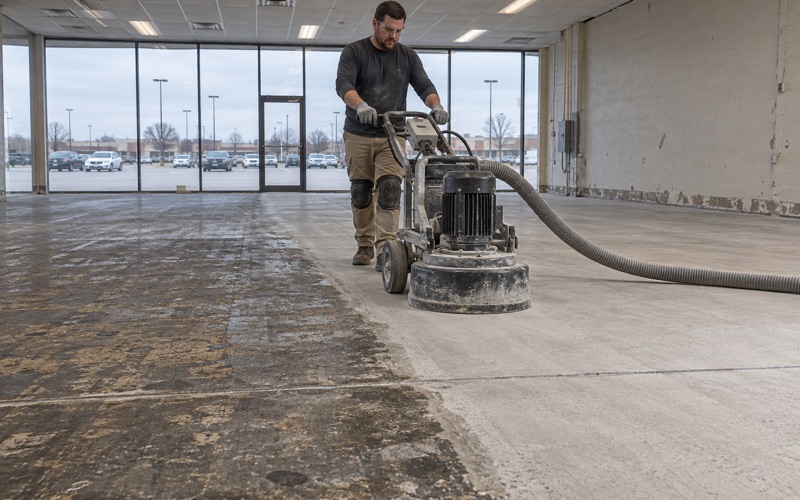
So our scope starts with two questions: what is already in the slab, and what will be fastened to it next. Old anchor holes, fixture scars, saw cuts and adhesive get found and mapped first, and the shelving, racks and wall storage get located before we grind. Then the slab is opened with a diamond grinder or a shot blaster, never an acid etch, so the coating has a real profile to hold.
Garages are most of that work here, along with shops and small commercial rooms that are changing hands or changing use. The written proposal names the product line, the number of coats and the finished thickness, so whatever ends up on the floor can be checked against the quote that sold it.
A Cicero Avenue Warehouse Club That Became a Fulfillment Center

One building, two very different floors
Matteson has a large-scale example of a floor changing jobs. Sam’s Club closed its warehouse-club store on Cicero Avenue in January 2018, and village leaders said the retailer had agreed to turn the empty building into a distribution center for internet orders. A Chicago Tribune headline a year later reported that the Matteson store was now filling online orders.
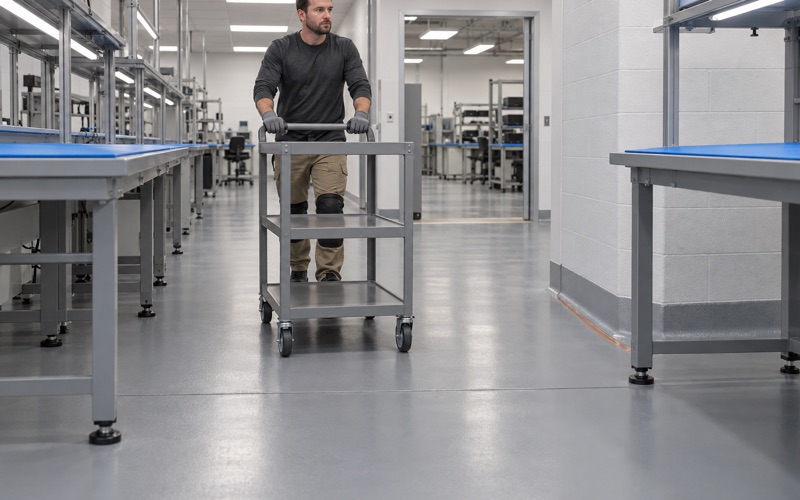
The village’s most recent annual financial report lists the Sam’s Club fulfillment center among its major employers, at about 150 people. The building stayed where it was. What changed was the job asked of the floor, from carrying shoppers’ carts past display fixtures to carrying pickers, new aisles of racking and order carts.
What we take from it, and what we don’t
How that floor was handled during the conversion was never published, and we had nothing to do with the project. We bring it up only because it shows, at a scale anyone driving Cicero Avenue can see, a lesson that applies to every floor we coat: a slab outlives the layout drawn on it.
The same thing plays out in a Matteson garage on a smaller clock. A workbench moves, a chest freezer leaves, a second car arrives, and the hardware that held the old arrangement leaves holes and stains behind. A new coating has to account for both the old layout and the next one, or it gets drilled through soon after it cures.
Looking for epoxy-flooring closer to Hazel Crest? See Epoxy-Flooring Services in Hazel Crest.
Same Slab, New Job: Anchor Holes, Fixture Scars and Old Cuts
Change of use on an existing slab
When a commercial room takes on a new tenant or a new purpose, the slab carries every decision the last occupant made. Racking anchors, display fixture bolts, glued carpet tile, partition tracks and saw cuts from old plumbing or electrical runs all sit under whatever goes on next. None of that disappears because the room has a new sign out front.
We walk the floor and map those marks along with cracks, spalls and any old coating before a price is final. If the space cannot close for the work, the phasing is set around opening hours, with overnight and weekend windows written into the schedule so a showroom, gym or clinic keeps running while its floor changes.
Filling anchor holes the right way
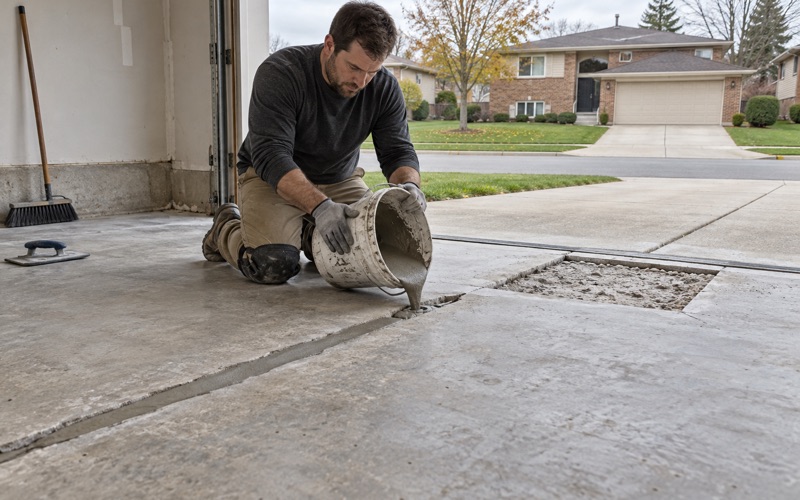
An anchor hole left open telegraphs straight through a thin coating as a dimple, and one filled with the wrong material can shrink, crack or stay soft under a wheel. We pull the old anchor or cut it off below the surface, clean out the hole, and fill it with an epoxy patching compound that bonds to the concrete around it.
Once the patch cures, it gets ground flat with the rest of the slab, so the repair and the original concrete take the primer the same way. Done in that order, a filled hole disappears under the finished floor instead of showing up as a soft spot or a ring months later.
Fixture scars are the outline left where a base plate or shelving foot sat for years, often with rust stain, sealer residue or a raised lip. Those come down with the grinder so the whole floor reaches one surface profile, checked against the ICRI CSP scale rather than judged by eye.
Adhesive, mastic and saw cuts
Carpet glue and tile mastic are not something a coating can sit on, because they soften under the resin and let go. We grind them off rather than dissolve them, and the dust is captured at the machine with a vacuum instead of being washed toward a floor drain or a storm inlet.
Old saw cuts are treated by what they are doing. A control joint that is still working gets carried through the coating, while a dead patch or a filled utility trench is ground level and bridged. Cracks that show the slab is moving get named in the proposal, and if a section needs repair or replacement before it should be coated, we say so plainly.
Plan the Shelving and Wall Storage Before the Garage Is Coated
Settle the storage plan first
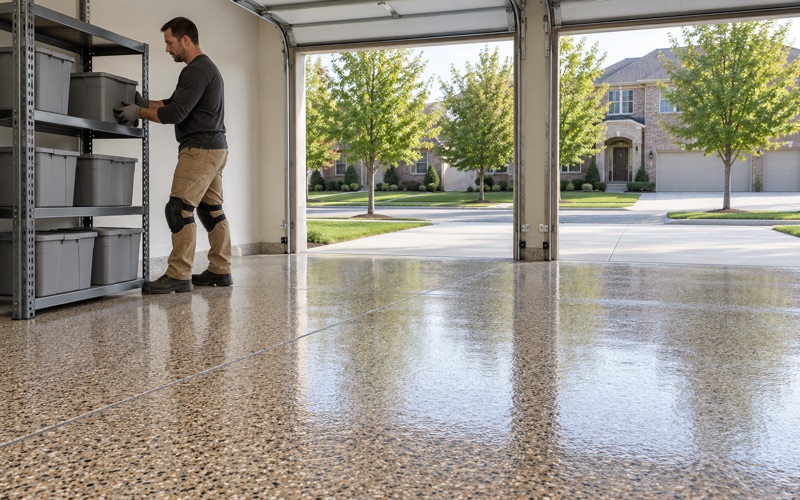
Most garage owners order the floor first and the storage second, and that order causes most of the damage we see on coated garages. Every slotted rack, freestanding shelf, ceiling lift or wall track that will touch the floor needs a location before we coat. Drilling a finished floor opens a raw edge in the film where water and brine can work underneath it.
We ask for a rough sketch: where the shelving runs, whether a workbench or cabinet base will be bolted down, and where a second freezer or a lift will sit. That sketch goes into the written scope, so the layout becomes part of the job rather than an afterthought drilled in on a Saturday.
Anchoring through a coated floor
When something truly has to be fastened to the slab, there are two clean ways to handle it. Anchors can be set and sealed before the topcoat so the coating wraps around them, or the locations can be marked in advance and each hole sealed with a compatible resin as soon as it is drilled.
Freestanding units are often the better answer. Shelving on leveling feet, or storage hung on the wall and fastened into studs, keeps the floor continuous. We would rather plan that with a customer up front than coat a floor that collects a dozen fresh holes the following weekend.
Systems for brine, salt and car traffic
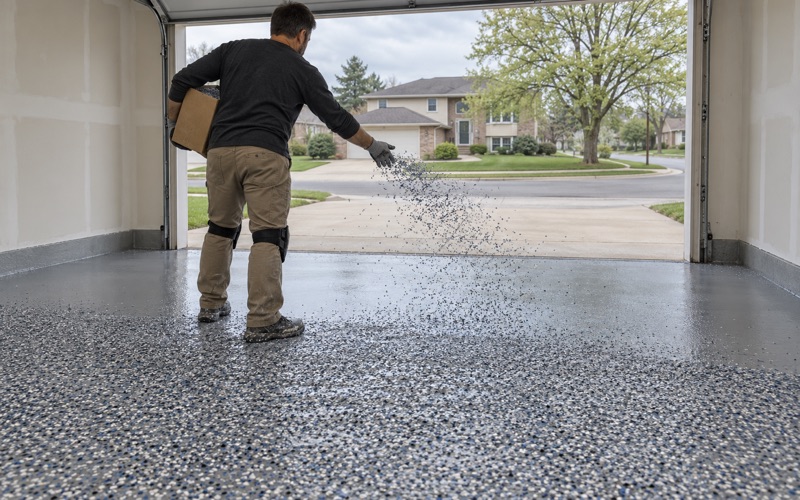
Whatever the layout, the floor has to handle a Chicago-area winter. Rock salt and calcium chloride ride in on tires and pool near the door, so we pick garage systems built for that exposure, commonly a 100% solids epoxy base with a vinyl flake broadcast and a polyaspartic topcoat that resists hot tire pickup.
The slip-resistant texture is set by the broadcast and topcoat chosen, and it is written into the proposal rather than promised as a slogan. Cure schedules follow slab temperature and the dew point spread at the slab surface, so an unheated garage in deep winter is told to wait for warmer conditions instead of being rushed.
Garages in Matteson’s 2000s Subdivisions
A village that grew fast
Matteson’s housing is younger than that of many south suburbs. Census figures put 2,430 of the village’s 7,631 housing units in the 2000 to 2009 decade alone, and 45.2 percent of homes here date from 2000 or later. Owner-occupied detached houses are the largest group, with a sizable share of attached homes as well.
Many of the garages we see in those subdivisions are attached or detached two-car and three-car layouts that have been through years of salt, storage and parked cars. They often carry the brackets and anchors of every arrangement their owners have tried, which is exactly the history this page is about.
What we check on a garage from that era
Before a price is final, a moisture test goes into the written scope, whether that is an ASTM F1869 calcium chloride test, ASTM F2170 relative humidity probes, or an ASTM D4263 plastic sheet check to decide which comes next. Moisture is also the first exclusion we name when we explain what a coating warranty does not cover.
We also look for the pegboard anchors, shelf brackets and old freezer pads that show how the garage was used. Each one is a hole to fill or a scar to grind before the new floor goes down, and each one is a clue to where the next storage plan should go.
Permits, paperwork and the village
Matteson is entirely in Cook County, and the village’s Building Services office licenses contractors, issues permits and performs inspections. Illinois has no state flooring license, so we check the village’s own contractor registration, bond and insurance rules before a job is booked, and we confirm permit needs with Building Services rather than assume them.
Home jobs over the state threshold get a written contract and the Home Repair: Know Your Consumer Rights pamphlet before any grinding starts. Products are chosen inside the Illinois VOC limits for floor and industrial coatings, which bind the person applying them as much as the company that made them.
- 20+ Years on Concrete
- Moisture Tested Before Pricing
- Written Specs on Every Quote