Orland Park Epoxy Flooring has spent more than 20 years on epoxy flooring in Markham and the rest of the south suburbs, and the question we start with is never which color a customer likes. It is what the floor has to survive. A slab that only sees a parked car can take a very different system than one that gets hosed down with hot water every week, and picking the coating before naming the load is how floors fail early.
That is why every proposal we write names the product line, the number of coats and the finished thickness, so the owner can hold the installed floor up against the quote. Before any price is final we map cracks, spalls and old coatings, and we run a moisture test as part of the written scope. When a slab needs repair or replacement before it should be coated, we say so plainly.
This page follows one demanding kind of floor, the wash bay, from an industrial example in town down to the ordinary garage where someone washes a truck indoors. The order of thinking is the same at both sizes, and it is the reason plain epoxy is not always the answer.
A Tank-Trailer Wash on 167th Street
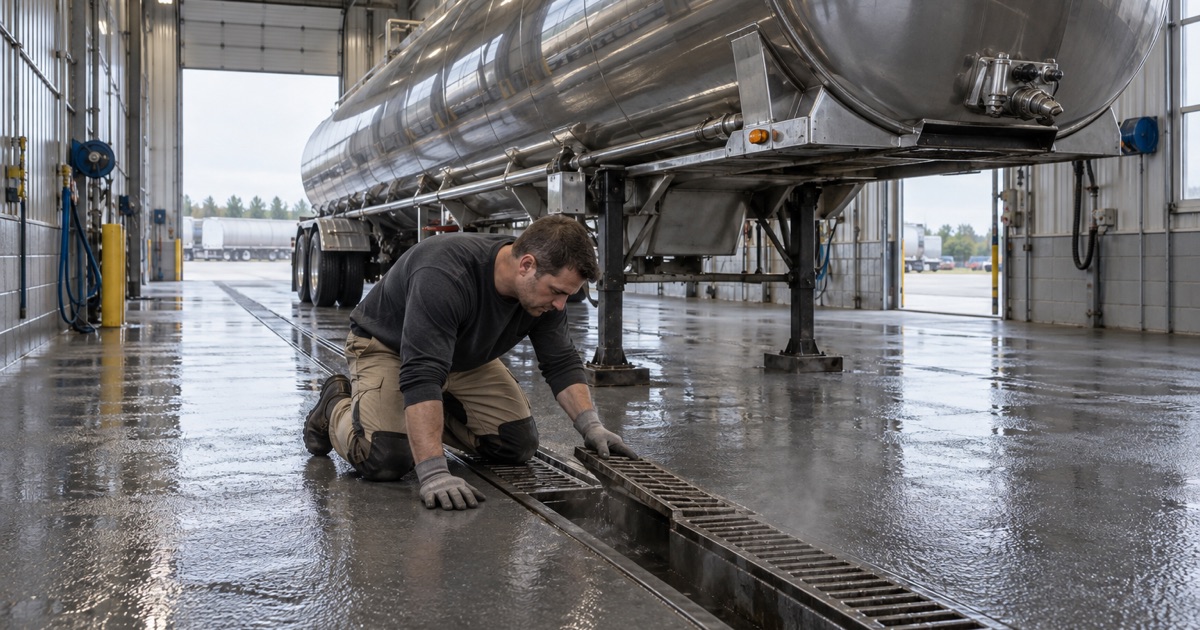
Markham has a working tank-trailer wash at 2316 West 167th Street, in Thornton Township in Cook County. It is the only Markham facility on the regional sewer district’s significant industrial users list, and it sits there under the federal category for transportation equipment cleaning. We have never worked on that floor, and we have not seen its bays or its coating, but it is the clearest local picture of how hard a wash floor can be.
A site with a chain of names
The property has changed hands several times. A 2007 trade report described the Brite Clean facility with five tank-cleaning bays and two repair bays. When Trimac bought Tank Wash USA in Markham in 2022, the release described six bays with chemical and food-grade capabilities and a team of 13 managers and wash-rack technicians. Current listings name it TankWash USA or Brite Clean Chicago, and the Trimac network lists it under National Tank Services.
We mention the names only so a reader can place the building, not to suggest any connection to it. What matters for a floor discussion is the kind of work done inside, because that work defines one of the toughest everyday loads a coated slab in this trade can face.
Inside the tank, then onto the floor
The federal rule behind that sewer listing, 40 CFR Part 442, covers wastewater from cleaning the interior of tanks used to transport chemical, petroleum or food grade cargos. It does not cover places that only wash the outside of a trailer. In other words, the business of a tank wash is getting whatever is left inside a cargo tank out of it, and that rinse has to land somewhere.
It lands on the bay floor. Hot water and steam go in, cleaning chemicals go in, and the heel, the last bit of the previous load, drains out with them. All of it runs under the tires of a loaded tractor and trailer. Part 442 is a wastewater rule and says nothing about floors, but the conditions it describes are exactly what a bay floor has to carry every shift.
Looking for epoxy-flooring closer to Matteson? See Epoxy-Flooring in Matteson.
Why Plain Epoxy Is Usually the First Casualty in a Wash Bay
A standard epoxy floor is a good system for a great many slabs. It bonds well to properly prepared concrete, it resists oil and many household chemicals, and it cleans up easily. In a garage that sees a car, a workbench and the occasional spill, it often does everything the owner needs. The trouble starts when heat arrives in large, sudden doses, over and over.
Thermal shock is the real enemy
Thermal shock is what happens when a floor surface heats or cools much faster than the concrete beneath it. A blast of hot water or steam on a cool slab makes the top layer expand while the slab stays put, and the stress lands right at the bond line. Do that a few times a day for months, and a rigid, thin coating starts to crack, lift or delaminate.
Plain epoxy is not built to flex with concrete through those swings. Installers and coating makers who work on tanker and truck wash floors keep naming the same loads: thermal shock, steam cleaning, chemicals and heavy vehicles. They also keep naming the same answer, which is a urethane cement or a similar resin system in place of the original epoxy.
Chemistry and tires on top of the heat
Heat rarely arrives alone. Cleaning agents and drained cargo residue can soften or stain a coating that was never chosen for them, and a softened surface wears faster under steel-belted tires turning in place. A floor can look fine for a season and then fail in the wheel paths first, which is exactly where nobody wants to stop work to make repairs.
No coating is proof against steam or chemicals, whatever a brochure says. What a careful scope does is match the system to the temperatures and the chemistry the owner actually expects, and write those limits into the proposal so nobody is surprised later.
Urethane Cement, Thickness and Slope to the Trench
Urethane cement is a dense, cement-filled resin system that tolerates heat and moisture far better than a thin epoxy film. It is troweled or screeded rather than rolled, so it goes down much thicker, and it bonds tightly to a slab opened with a diamond grinder or a shot blaster. That combination is why it shows up so often where a floor gets hot, wet and loaded.
It is not the right choice everywhere. Urethane cement costs more than a standard epoxy floor, it has a flatter, more utilitarian look, and it asks more of the crew during installation. For a slab that will never see hot water or heavy chemistry, it is usually more floor than the job needs, and we would say so rather than sell it.
How thick a wash floor goes
One Chicago tanker-wash case study, published by its installer without naming the facility, describes removing the existing epoxy and troweling a urethane cement at 3/8 inch over 3,500 square feet in a single weekend. The maker states its product handles spillages up to 150 degrees Celsius depending on specification. Those are the manufacturer’s figures and that case study is not the Markham site.
Thickness matters because it gives the floor body to absorb heat and impact before stress reaches the bond line. A thin coat has almost no margin. On any heavy wash floor we quote, the finished thickness is written on the proposal so it can be measured against what was promised once the work is done.
Slope and the trench drain
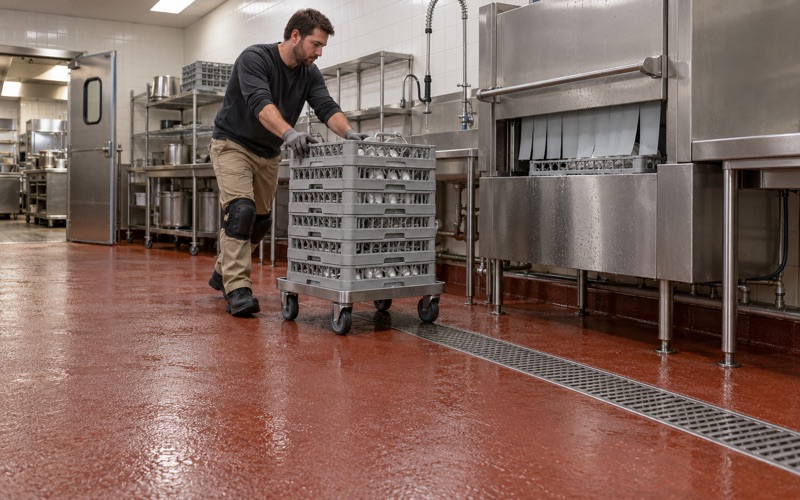
A wash floor has to move water, not hold it. Standing water keeps heat and chemistry sitting on the surface, and it pushes moisture toward every small defect. Wash bays are typically sloped toward a trench drain so the rinse runs off in one direction, and the coating has to follow that slope without thin spots at the edge of the trench.
Where the slab itself does not fall correctly, that is a concrete problem to solve before any resin goes down. We would rather tell an owner the slope needs correcting than lay a premium system over a floor that ponds. Dust from the grinding is captured at the machine with a vacuum, never rinsed toward the drain.
Washing a Truck or Equipment Indoors in a Markham Garage
Most of the floors in Markham are not industrial at all. The city is mostly owner-occupied detached houses, and the ordinary job here is a homeowner’s garage or basement. Yet plenty of garages get used the way a small wash bay is: a work truck, a trailer, a mower deck or a piece of equipment hosed down indoors, sometimes with hot water from a utility sink.
The same order of thinking, at house scale
A residential garage will not see steam on every shift, but it can still see hot water, degreasers and the weight of a loaded pickup turning on a wet floor. If that is how the space gets used, we say so in the scope and weigh a thicker, heat-tolerant system rather than defaulting to a thin decorative coat. A plain epoxy floor in a garage that only stores cars is a different conversation.
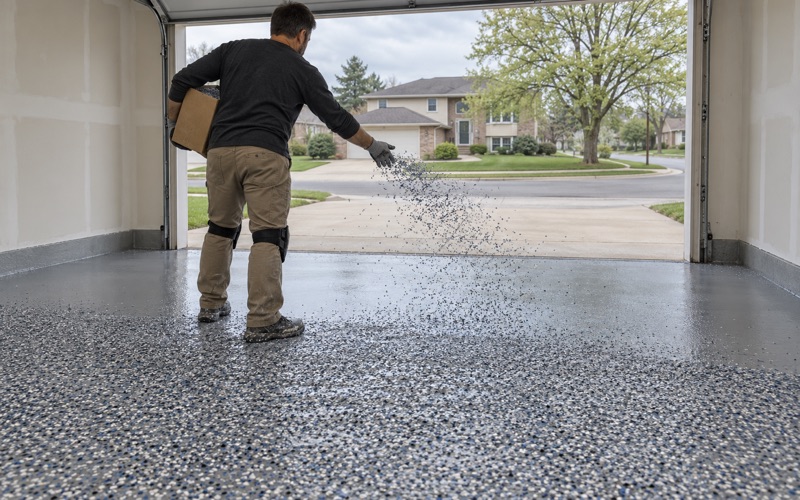
We also look at where the water goes. A garage floor that drains toward the overhead door behaves very differently from one where rinse water runs back toward the house wall. A textured broadcast and topcoat give real slip resistance on a wet floor, and we specify that texture by the materials used rather than promising it as a feature.
Moisture, cure and the warranty
The moisture test comes before the final price on a garage just as it does on a basement. Moisture is also the first exclusion we name when explaining what a coating warranty does not cover, and we explain those exclusions before the job is sold, not after. Cure timing follows slab temperature and dew point, and an unheated garage in deep winter is told to wait.
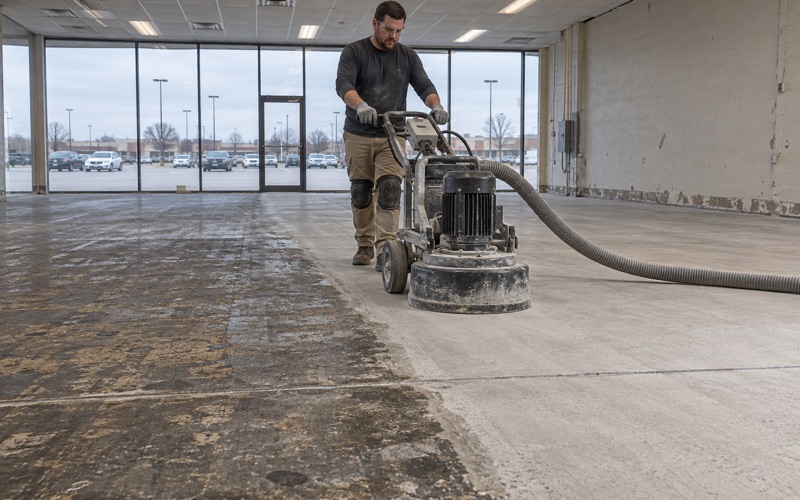
On a garage that doubles as a wash space, the testing matters even more, because the floor will be wet from above as well as from below. We open the slab with a diamond grinder or a shot blaster rather than an acid etch, so the coating has a real profile to grip. A thicker system laid over a weak or damp surface only fails more expensively.
Who signs off in Markham
Illinois licenses no flooring or coatings contractor, so local rules are what count. Markham’s Building and Housing Department handles permits, and bond sellers report that the city requires contractor applicants to file a $10,000 license and permit bond. We confirm the current requirements with that department before booking a job, and home jobs over the state threshold get a written contract and the Illinois consumer-rights pamphlet before any grinding starts.
- 20+ Years on Concrete
- Moisture Tested Before Pricing
- Written Specs on Every Quote