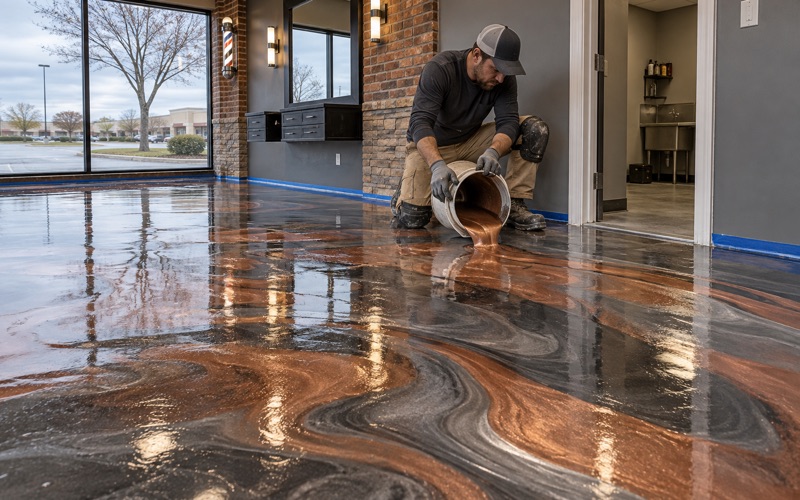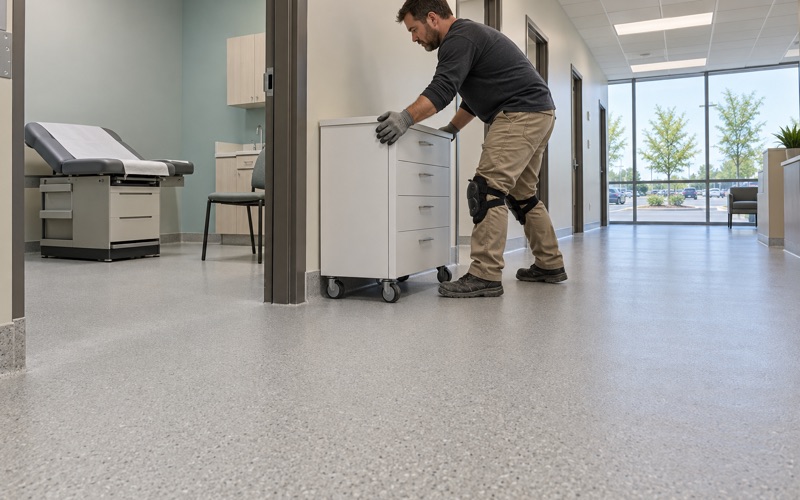
Orland Park Epoxy Flooring installs epoxy flooring in Lyons with more than 20 years in the trade behind each garage and shop floor we take on. The question we hear most here is why a coating that looked fine for a season peeled up under the tires. The usual answer is hot-tire pickup, a failure decided by how the floor was built long before the first car rolled back in.
Hot-tire pickup is not a mystery and it is not bad luck. It happens when warm rubber sits on a film that is too thin, poorly bonded or not fully cured, and the tire carries pieces of coating away when it leaves. Each of those causes sits inside the installer’s control, which is why we treat them as scope items rather than fine print.
This page walks through how that failure works, what we do about it at the slab, and how the same physics shows up in a service bay and in a one-car garage off a side street. Our proposals put the product line, the number of coats and the finished thickness in writing, so the floor you get can be checked against the floor you paid for.
Ogden Avenue, Route 66 and the Tire Trade
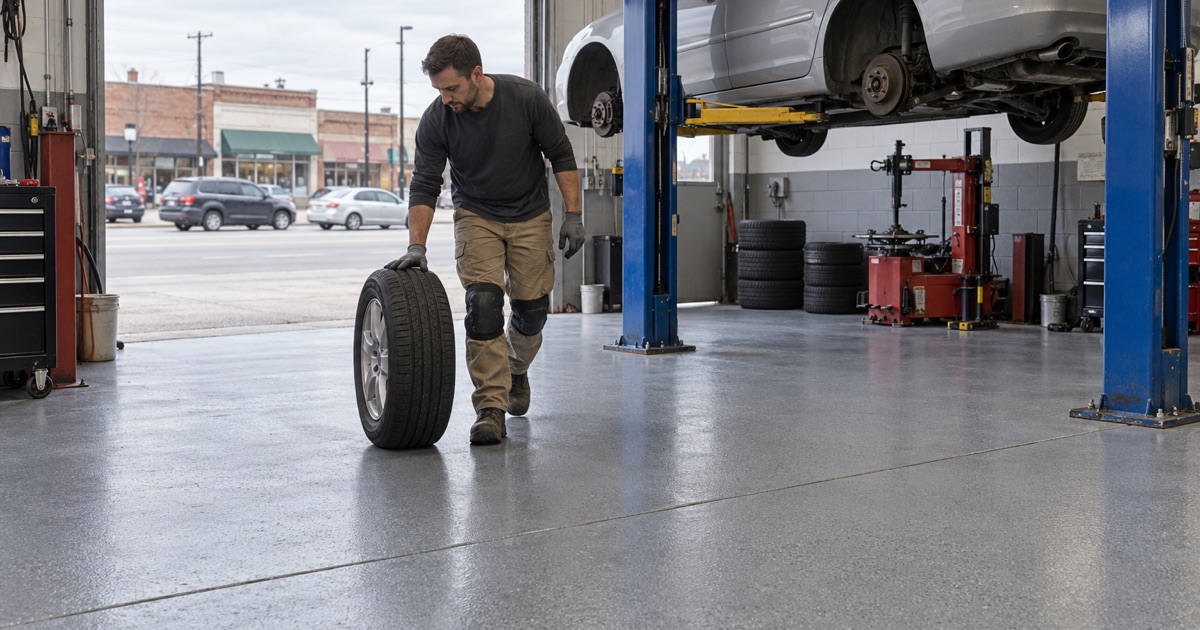
A Service Row on the Old Highway
Ogden Avenue through Lyons is a stretch of historic Route 66, and the village still points to that access when it describes itself to businesses. Along it sits a working tire-and-auto row. Midwest Tire & Auto at 8717 Ogden handles tires, oil changes, brakes and alignments, Vern’s Auto Service at 8644 Ogden does full-service repair, and NAPA and AutoZone parts stores sit nearby at 8623 and 8554 Ogden.
We have not worked for those shops and have not seen their floors, so we will not describe them. What the row tells us is the kind of traffic floors in Lyons see. Cars come in off a busy arterial, some after a run on I-55 or I-294 nearby, and pull straight into a bay or a garage while their tires are still carrying road heat.
Why a Tire Bay Is a Hard Test for a Floor
A tire shop is the most demanding version of a problem every garage owner shares. Vehicles arrive warm, park in one spot, get lifted, lowered and rolled out, and the next car takes the same place. Wheels are pulled and tires are stacked on the floor. A coating there takes concentrated heat and rubber contact many times a day, not twice.
That is why tire storage areas and service bays are where a weak coating shows itself first. A floor finish can look good on the day it is installed. The real test comes weeks later, when the paths where tires stop begin to dull, then lift at the edges, then come away in patches the shape of a tread. By then the cause was already set at installation.
Looking for epoxy-flooring closer to Manhattan? See Epoxy-Flooring in Manhattan.
What a Hot Tire Does to a Coating
Heat That Arrives With the Car
Tires warm up as they flex against pavement, and highway driving warms them more. One coating seller puts road-heated tire temperatures at upwards of 140 degrees Fahrenheit. That is a vendor figure describing tires in general, not a reading taken on Ogden Avenue, but it explains why the problem tracks with parking habits. A hot tire parked on the same square foot day after day concentrates that heat in one place.
Heat on its own softens many coatings slightly, and a properly built system recovers as it cools. The trouble starts when the heat repeats on a film that has little margin to begin with. Each cycle works the bond between coating and concrete, and a weak bond gives a little more each time until the tire finally pulls a piece up as the car backs out.
Plasticizer and a Softened Film
The second part of the explanation is chemical. Tire rubber contains plasticizers that keep it flexible, and coating makers say those compounds migrate out of hot rubber into whatever surface the tire is sitting on. Plasticizer that moves into a thin or undercured film softens it from the top down, so the coating turns tacky under the tread at the moment the tire is pressing into it.
This is a trade explanation from coating manufacturers and contractors, not test data gathered in Lyons, and we present it that way. It matches what the failures look like, though. Lifted coating usually comes up stuck to the tire with rubber marks on its face, and the bare concrete underneath tells the rest of the story about how well the coating was holding on.
A Bond That Was Never Good Enough
Most people in the trade blame the floor, not the resin, when hot-tire pickup appears. The common causes are inadequate surface preparation, a film that is too thin and moisture coming up through the slab. Makers sell specific products as resistant to hot tires, and those products help, but no resin makes up for a coating laid over a smooth, dusty or damp surface.
We tell customers plainly that no coating is immune to hot tires. What we can do is remove the conditions that make pickup likely. That means a slab opened to a real profile, a system thick enough to carry heat and plasticizer without softening through, and a cure that is complete before a warm tire ever touches it.
Prep, Thickness and Cure: What a Contractor Controls
Grinding or Blasting to a Real Profile
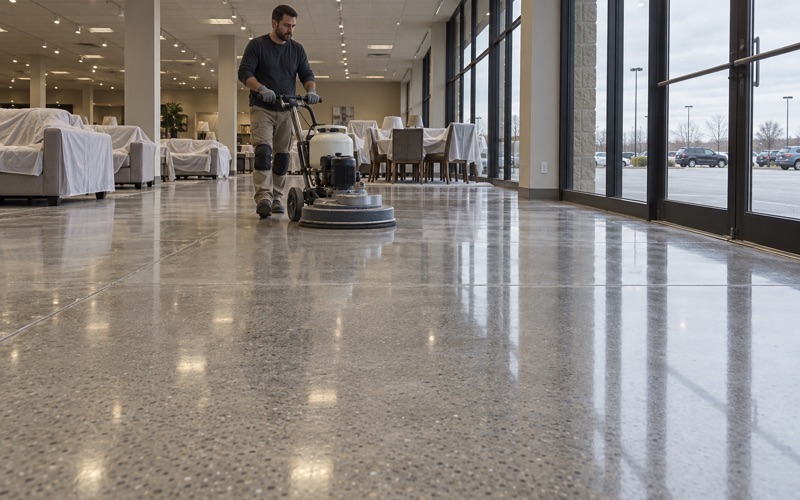
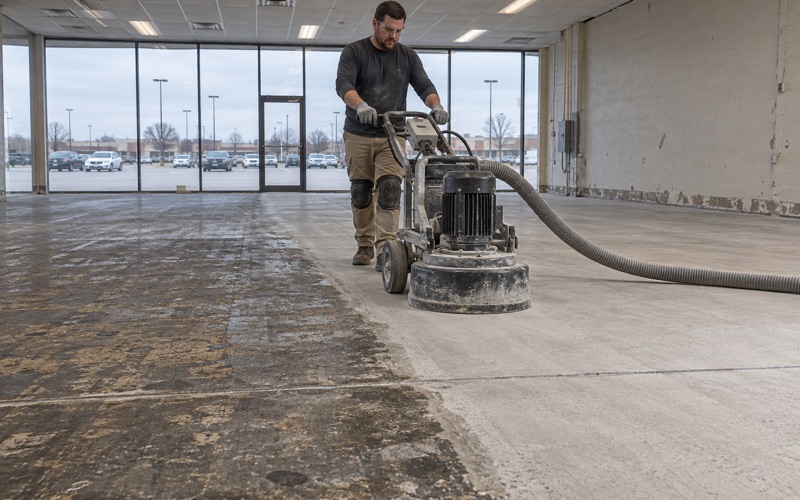
We open every slab with a diamond grinder or a shot blaster, never an acid etch. Grinding and shot blasting cut through laitance, sealers and old coatings and leave a measurable surface texture, described on the ICRI CSP 1-10 concrete surface profile scale. A coating needs that texture to grip mechanically, and a tire pulling at the film is pulling against exactly that grip.
Before we price a job, cracks, spalls and any old coating are mapped. A coating that already peeled under tires has to come off completely, because new material bonded to loose old material fails at the old layer. When a slab needs repair or replacement before it should be coated, we say so instead of coating over it. Grinding dust is collected at the machine with a vacuum rather than washed toward a drain.
Film Build Named in the Proposal
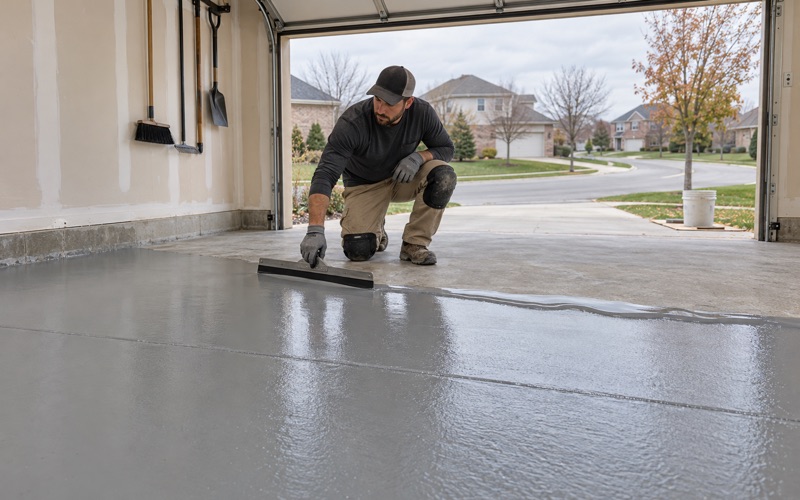
Thin films are one of the most common reasons a garage coating lifts. A single coat from a kit leaves little material between the tire and the concrete, and plasticizer reaches the bond line quickly. Because our proposals name the product line, the number of coats and the finished thickness, the build on the floor can be measured against the quote rather than taken on trust.
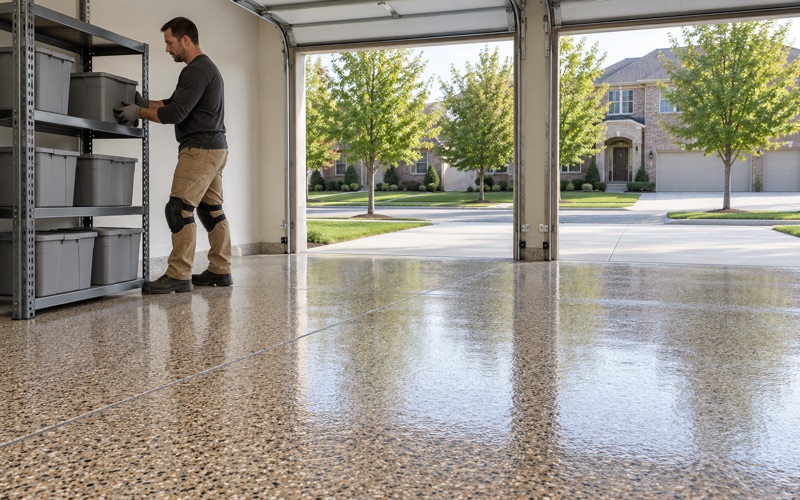
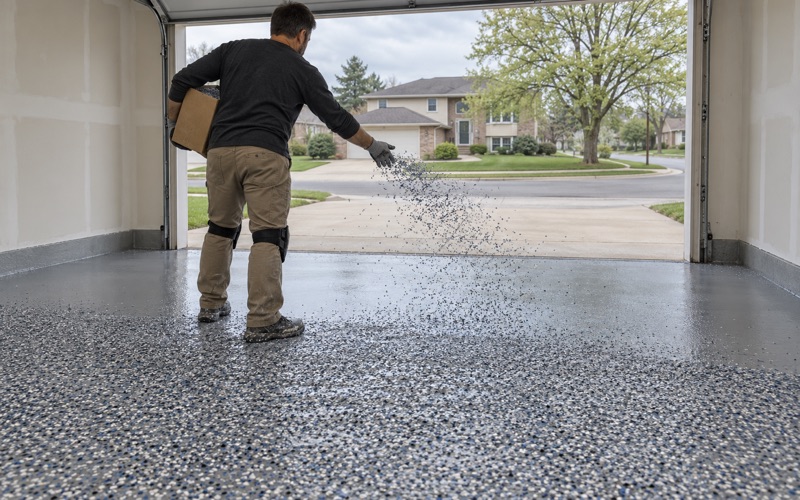
For floors that take hot tires, that often means a 100% solids epoxy base, a vinyl flake or quartz aggregate broadcast for body and texture, and a polyaspartic or polyurea topcoat. The broadcast adds thickness and slip resistance, and the topcoat is the layer that meets the tire. The right combination depends on the slab, the traffic and the budget, and we specify it rather than promise it.
Full Cure, Not a Dry-to-Touch Surface
A coating can feel dry to the touch long before it reaches full cure. Driving on it too early is one of the fastest ways to start hot-tire pickup, because an undercured film is soft enough for plasticizer and heat to work into. We give each customer a written return-to-service time and ask that cars stay out until it passes, even when the floor looks finished.
Cure speed follows slab temperature and the dew point spread at the slab surface, not the calendar. A cold slab cures slowly, and moisture condensing on the surface can leave amine blush on epoxy that weakens the next coat’s bond. In deep winter an unheated garage may be told to wait for warmer conditions, because a floor rushed into the cold is a floor set up to fail later.
Hot-Tire Pickup in a Lyons Home Garage
The Car That Parks in One Spot
The same mechanism plays out in an ordinary Lyons garage. Of the 4,390 housing units in the village, 2,765 are single-family detached houses and 1,131 were built in 1939 or earlier. The daily car tends to park in the same place every night. It comes home warm, its tires sit on the same two patches of floor for hours, and those patches take the heat and plasticizer a tire bay sees all day.
That is why we look at the tire paths first when we inspect an existing coating in Lyons Township. A floor that has lifted only where the car stops tells a different story from one failing everywhere. Localized pickup points to bond and thickness, while widespread peeling usually points to moisture or contamination under the whole slab, and the repair plan is different for each.
Moisture as the Hidden Partner
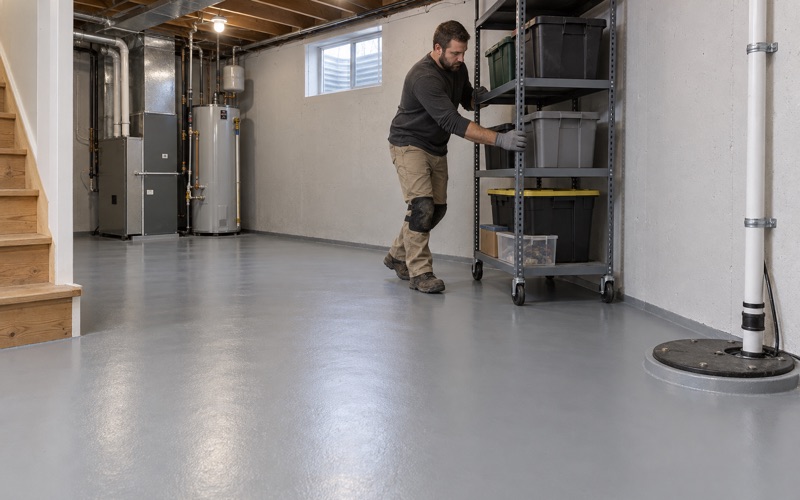
Moisture rising through an older slab weakens a coating’s bond from below while the tire works on it from above. Our written scope includes a moisture test before the price is final, using the ASTM D4263 plastic sheet test, ASTM F1869 calcium chloride testing or ASTM F2170 in-situ relative humidity probes, depending on the slab. Where readings run high, a moisture-mitigation primer goes into the system.
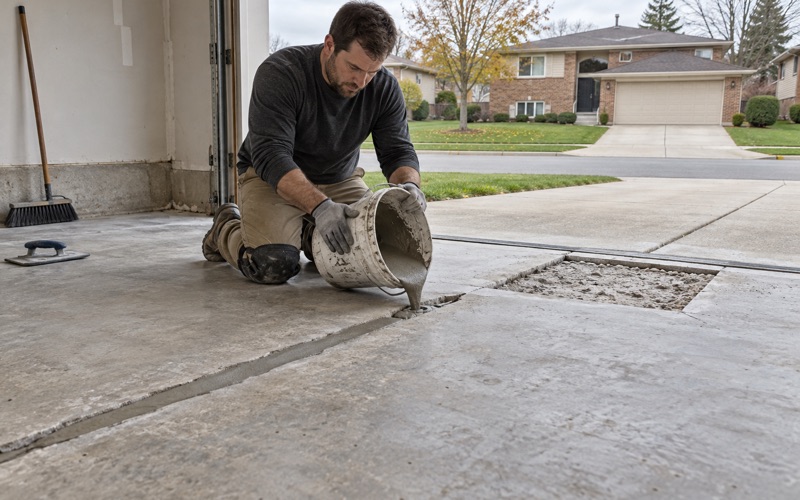
An older garage slab rarely comes with paperwork describing what lies beneath it. We check for a vapor retarder, a floor drain and the slope toward the door on site rather than assuming any of them. A garage that has never been coated still gets the full process, because old concrete can hold sealers, curing compounds or paint that block a good bond.
What a Warranty Does and Does Not Cover
A warranty is only as useful as what it excludes, so we explain the exclusions before the job is sold. Moisture is the first one we name, because a coating pushed off by water vapor is not a covered defect. Some products carry hot-tire resistance in their warranty language, and we read those terms with the customer rather than treat them as a promise the floor will never lift.
Illinois has no state flooring license, so we check the Village of Lyons Building Department’s current contractor license requirements, along with bond and insurance rules, before a job is booked. Home jobs above the state threshold get a written contract and the Home Repair: Know Your Consumer Rights pamphlet before any grinding starts. Then the work follows the order this page describes: open the slab, test it, build the film and let it cure.
- 20+ Years on Concrete
- Moisture Tested Before Pricing
- Written Specs on Every Quote