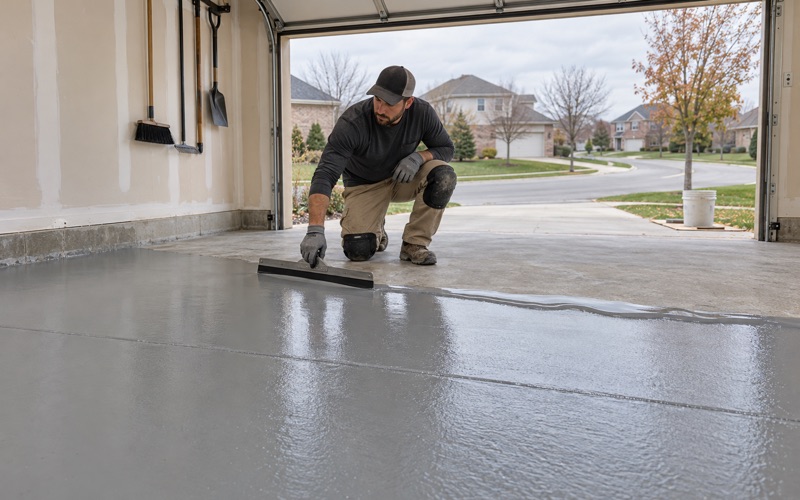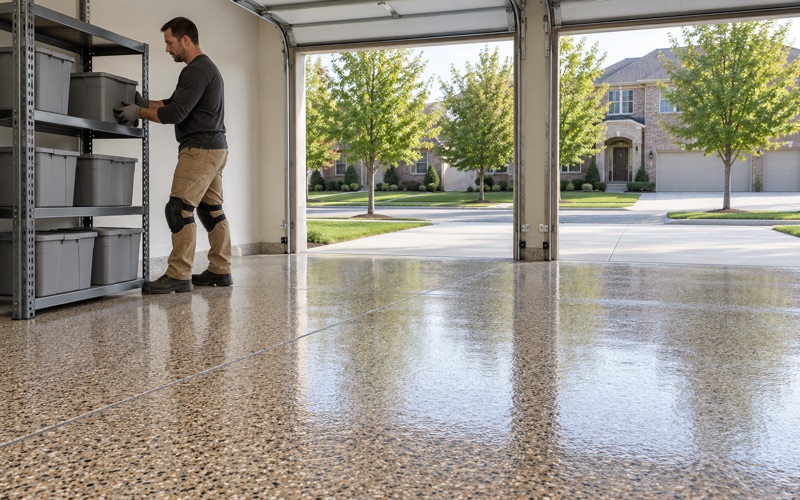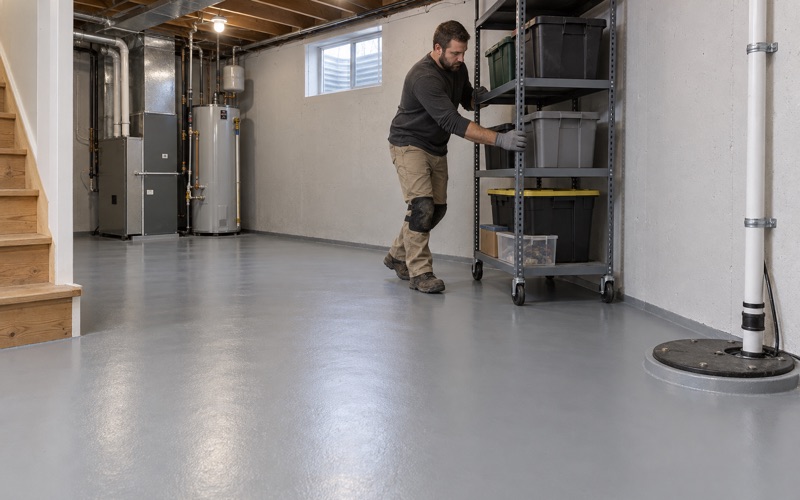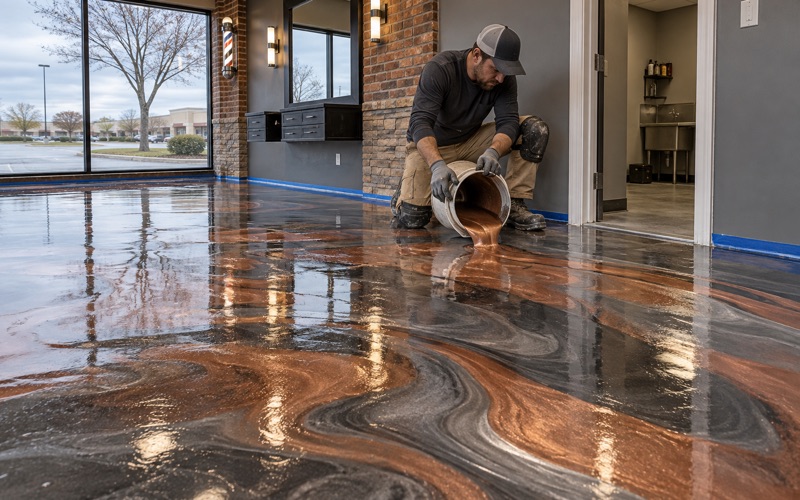
Orland Park Epoxy Flooring has spent more than 20 years installing epoxy flooring in Lemont homes and businesses, and the first question we ask about a slab is never the color. It is what the concrete is doing underneath the surface: where it has cracked, whether those cracks are still moving, and how its joints were cut and treated.
A coating is the last layer of a floor repair, not the first. We map cracks, spalls and old coatings before we price anything, and we say plainly when a slab needs repair, or even replacement, before it should be coated. The proposal then names the product line, the number of coats and the finished thickness, so the floor can be checked against the quote.
That order of work, structural problems first and surface treatment second, is easy to state and easy to skip. Lemont happens to have a public example of it written into a village contract, and it is worth reading closely before any garage, shop or basement floor gets a coat of anything.
The Village Garage on River Street and Its Repair List
The 2025 contract for the downtown deck
The Village Parking Garage sits at 320 River Street downtown, a village-owned structure with over 260 spaces. In June 2025 the Lemont Village Board approved a $115,000 contract with Berglund Construction for repairs there, the low of three bids against an engineer’s estimate of $203,715. Public Works Director Ralph Pukula said the work was needed to keep the garage functional.
We had no part in that project. We did not bid it, inspect the deck or work alongside the contractor, and we have not seen the garage’s own deck system or a survey of its cracks. What interests us is the scope itself, because it is public, it is specific, and it reads like a checklist for any slab that moves.
Four line items, not one
The approved work named four separate things: concrete sealer, epoxy crack injection, storm drain repair and joint sealer. Read together, that list says a concrete slab has several distinct failure points and each one gets its own remedy. Nobody wrote a single line reading coat the deck and called the job finished.
Drainage is on the list for a reason. Water that sits on a slab works its way into every crack and joint, so a floor that does not shed water to a working drain keeps feeding its own problems. A home garage is a smaller version of the same arrangement, with the overhead door, the driveway or a floor drain doing the work of the storm inlets.
Why the sequence matters more than the products
The order in a list like that is the part most property owners never see. Cracks are filled or sealed, joints are treated, drainage is made to work, and only then does a surface treatment have something sound to protect. Reverse that order and the treatment ends up sealing over a problem that keeps working underneath it.
This is the same discipline we apply on a two-car garage. Repair comes first, the coating comes last, and the written scope shows each step as its own line so the owner can see what is being fixed and what is only being covered.
Looking for epoxy-flooring closer to Chicago Ridge? See Epoxy-Flooring in Chicago Ridge.
Sealer, Crack Injection and Joint Sealer Are Three Different Jobs
What a penetrating sealer actually does
A penetrating sealer soaks into the top of the concrete and closes off its pores, which slows water and the chloride ions that water carries. Trade guidance on parking decks, published in the Hoffmann Architects Journal in 1994, describes these sealers as low cost and thin, roughly 2 to 4 mils, and notes they need re-application every few years.
That same guidance names their most limiting quality: an inability to bridge cracks in the concrete, especially cracks that develop after the sealer has gone on. A sealer lives inside the surface of the slab. When the slab splits, the sealer splits with it, and the new crack is open to water from the first day. The journal treats sealers as best suited to a short-term measure in a low-traffic area.
Epoxy crack injection for cracks that have stopped
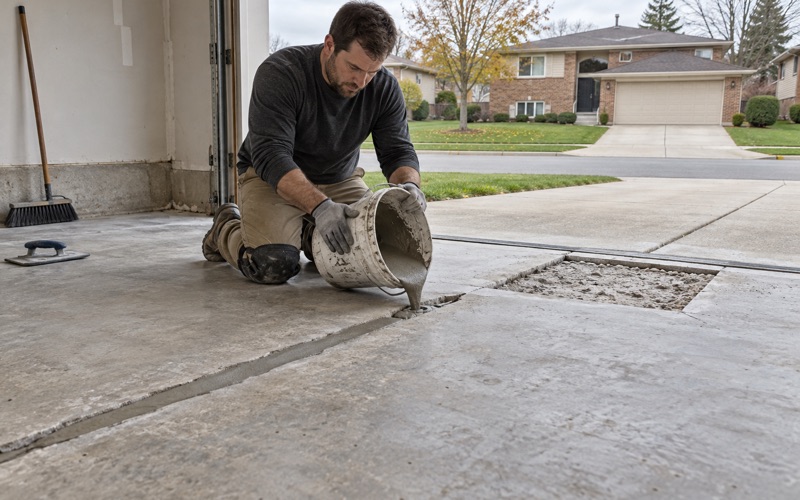
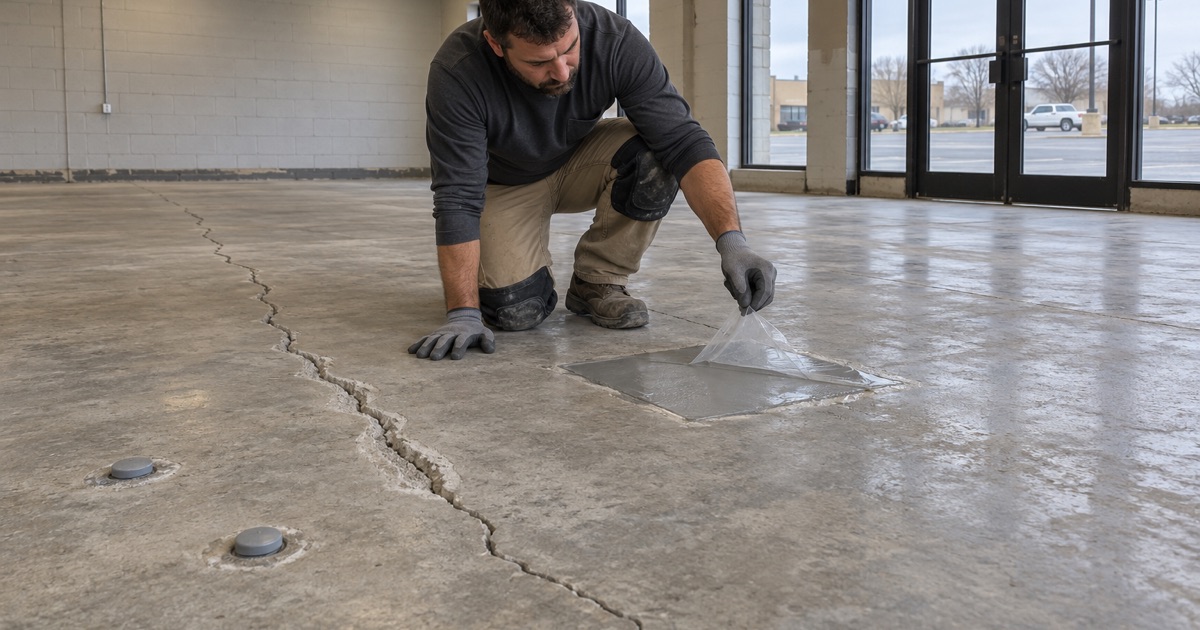
Epoxy crack injection is a repair, not a finish. Resin is pushed into the crack so the two faces bond back together and the void is filled from inside rather than bridged from above. It suits a crack that has finished moving, the kind left behind by early shrinkage or by settlement that has since stopped.
Before we inject or fill anything, we want to know whether the crack is still active. A crack that opens and closes over the year will break a rigid repair the same way it broke the concrete, so that judgment comes before any material is chosen, and we write down which cracks we read as static and which we do not.
Joint sealer where the slab is meant to move
Control joints and construction joints are places where the concrete was designed to move. Filling them solid with a hard coating defeats their purpose, and the coating then tends to crack along the joint line, which is exactly where the slab was told to crack in the first place.
A joint sealer is a flexible material that stays soft enough to take that movement. On a garage or shop floor we treat joints as their own detail in the scope: cleaned out, sealed with a material suited to the joint, and carried through the coating rather than buried under it.
Rigid or Elastic: Matching the System to Cracks That Move
What the elongation numbers mean
The same trade journal compares deck systems by how far they can stretch before they fail. Urethane systems elongate 350 to 450 percent, while epoxy systems elongate 0 to 10 percent. That gap is the whole argument in two numbers: a urethane can follow a slab as it moves, and an epoxy holds its shape.
Holding its shape is exactly what makes epoxy useful. A 100% solids epoxy builds a hard, dense film that stands up to abrasion, dropped tools and the drips a working floor collects. It also means the epoxy will not forgive a slab that keeps shifting underneath it, so the crack map decides the system before any brochure does.
Where a rigid epoxy system belongs
The journal places epoxy-based systems over protected interior decks with minimal temperature swings and static cracks, and it states flatly that rigid sealing systems should not be used in any structure suffering from dynamic, active and ongoing movement. That guidance is general and written about parking structures. It is not a diagnosis of the River Street garage or a comment on what the village chose.
Scaled down to a basement or a garage, the rule still reads well. A protected slab with steady temperatures, whose cracks have stopped, is a sound place for an epoxy system. A slab with active movement needs that movement handled first, or a more elastic system chosen for it, and we would rather say so before the sale than after the first winter.
Routing and sealing a crack that still moves
Elastomeric traffic membranes can bridge cracks under 1/16 inch, according to the same source, but larger and dynamic cracks must be routed and sealed first. Routing means cutting the crack open into a clean, even channel so a flexible sealant has sidewalls to bond to, instead of a hairline it cannot enter.
We follow the same logic on a coated floor. A moving crack is routed and sealed before any coating goes over it, and we tell the owner the finished surface may show a line there over time. Putting that in writing beats having the owner discover it after the job is paid for.
The Same Questions for a Lemont Garage Slab
The slabs most Lemont floors sit on
Most garage floors in Lemont sit on fairly recent concrete. Census estimates put 63 percent of the village’s housing as built since 1990, and about 15 percent of it is single-family attached, which in practice means a large share of townhome garages alongside detached homes.
Slabs from the 1990s through the 2010s are young enough that many carry only shrinkage cracks, and old enough that some may have picked up a sealer, paint or an earlier coating along the way. Each of those changes what has to come off before a new system can bond, and each is something we look for on the first visit.
Grinding, testing and mapping before the price is final
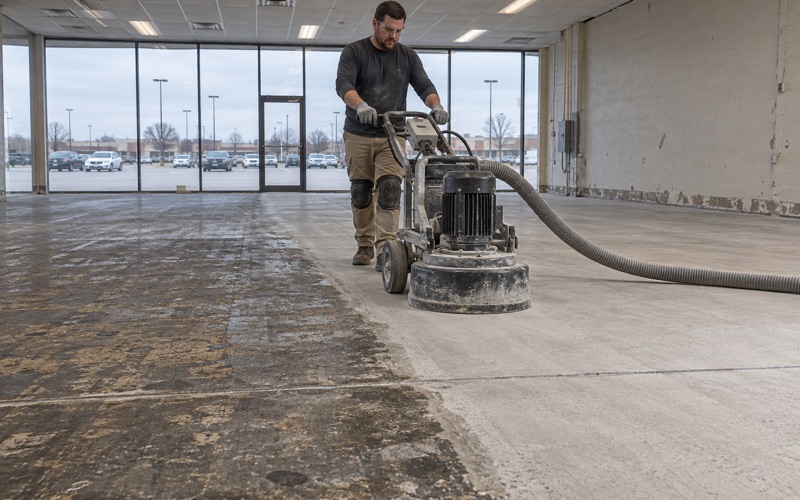
Every slab we coat is opened with a diamond grinder or a shot blaster, never an acid etch, so the coating grips a real profile on the ICRI concrete surface profile scale. Grinding dust is pulled into a vacuum at the machine rather than rinsed toward a floor drain or out to the street.
A moisture test is written into the scope before the price is settled, using methods such as ASTM F1869 calcium chloride testing or ASTM F2170 relative humidity probes. Moisture is also the first exclusion we name when we walk an owner through what a coating warranty does not cover, so nobody learns about it from a peeling floor.
Who signs off, and when to wait
Illinois licenses no general, flooring or coatings contractor, so the rules that matter are local ones. We could not read Lemont’s contractor registration terms online, so we confirm license, bond and insurance requirements with the Village of Lemont Building Department before a job is booked. Home jobs over the state threshold get a written contract and the Home Repair: Know Your Consumer Rights pamphlet before any grinding starts.
Cure schedules follow slab temperature and dew point, not a date on the calendar, and an unheated garage in deep winter is told to wait. A coating is a wear surface and a stain barrier, not waterproofing, and it does not stop water moving through a slab. We never sell one as radon reduction either, because in Illinois that is licensed mitigation work.
- 20+ Years on Concrete
- Moisture Tested Before Pricing
- Written Specs on Every Quote