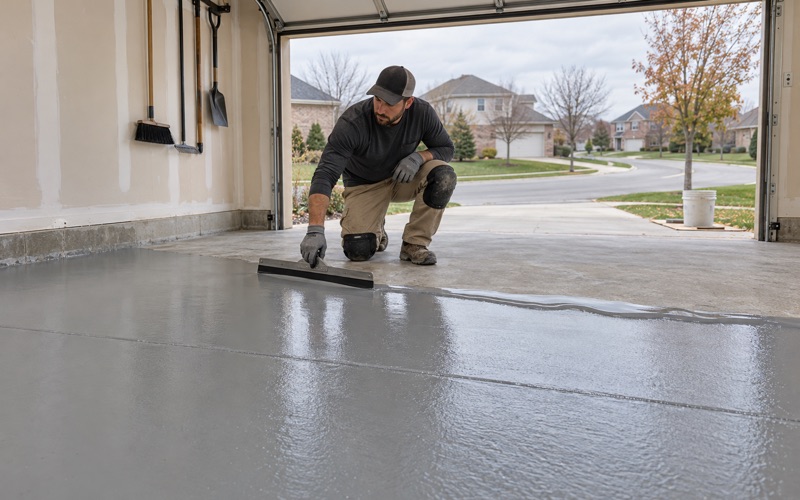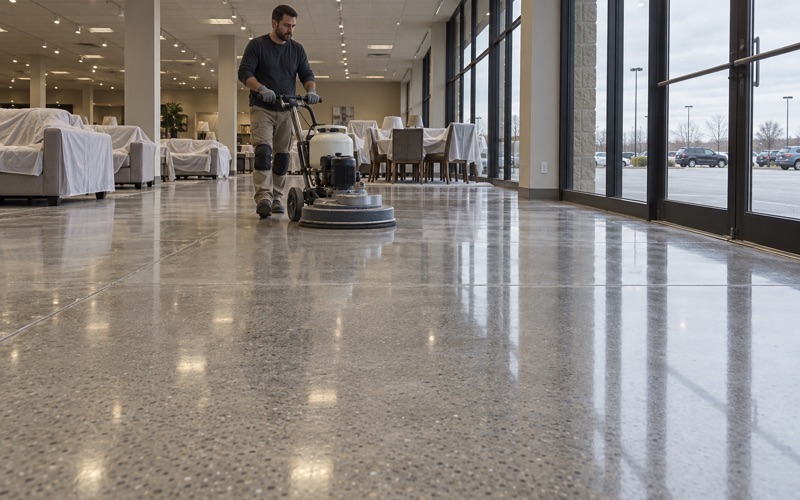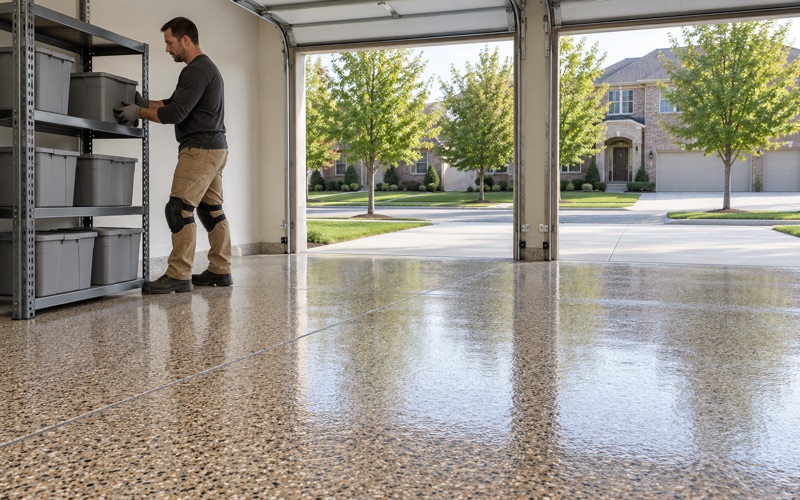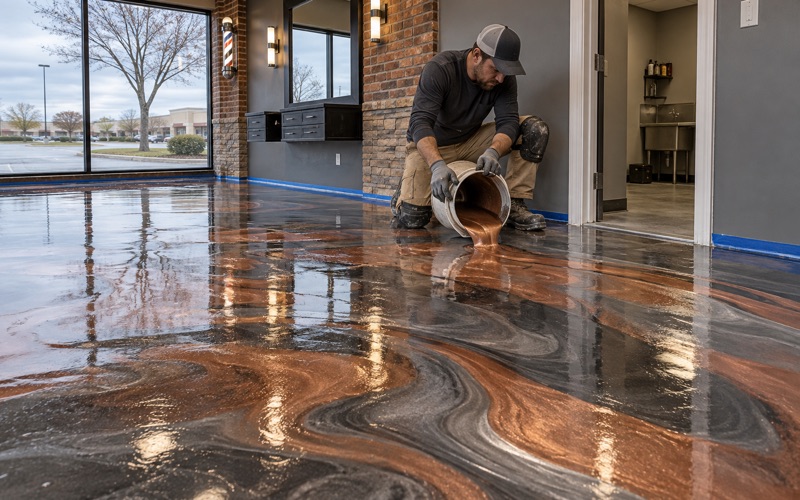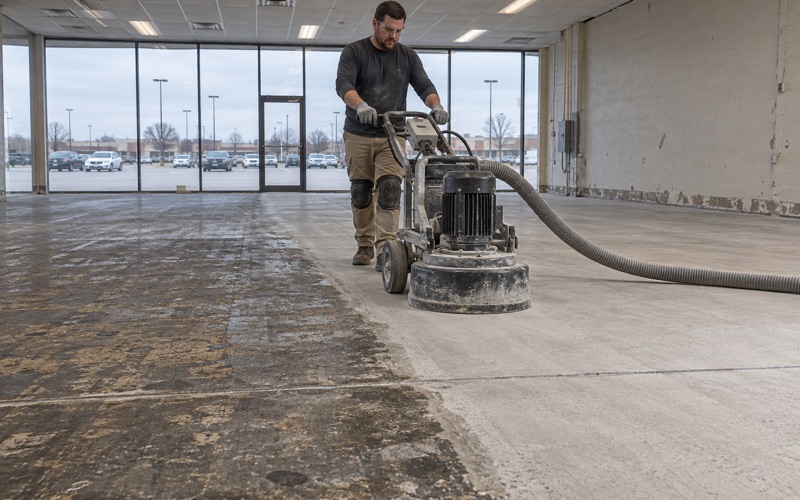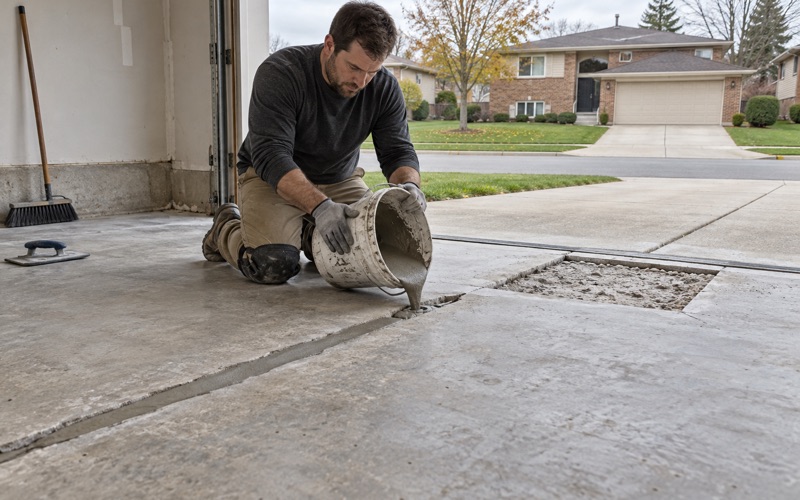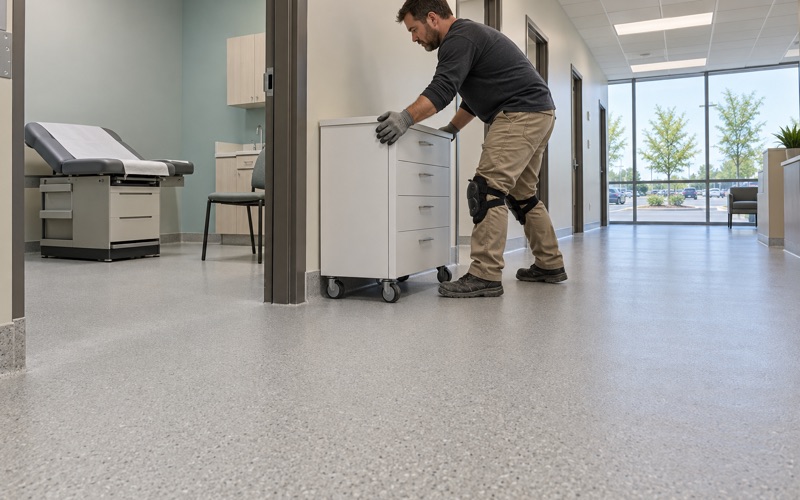
Orland Park Epoxy Flooring has spent more than 20 years installing epoxy flooring in La Grange and across the suburbs, and a good share of that work has been in rooms where food is made by hand. A bakery floor is one of the hardest small floors to get right. It is not the traffic or the weight that wears it down, but the cleaning, repeated every day without exception.
This page is about that cleaning and the floor it calls for. The rules that govern how a food floor is cleaned are written into the FDA Food Code, which Illinois has adopted in its 2022 edition, and they say more about the right coating than most product brochures do. Read them first and the system almost chooses itself.
We will walk through what those rules require, when the cleaning happens, and how we build a seamless floor that lets flour go down the mop bucket instead of into the slab. Nothing here makes a kitchen compliant on its own; the floor is one piece of a routine the owner runs.
A Scratch Bakery on Harris Avenue
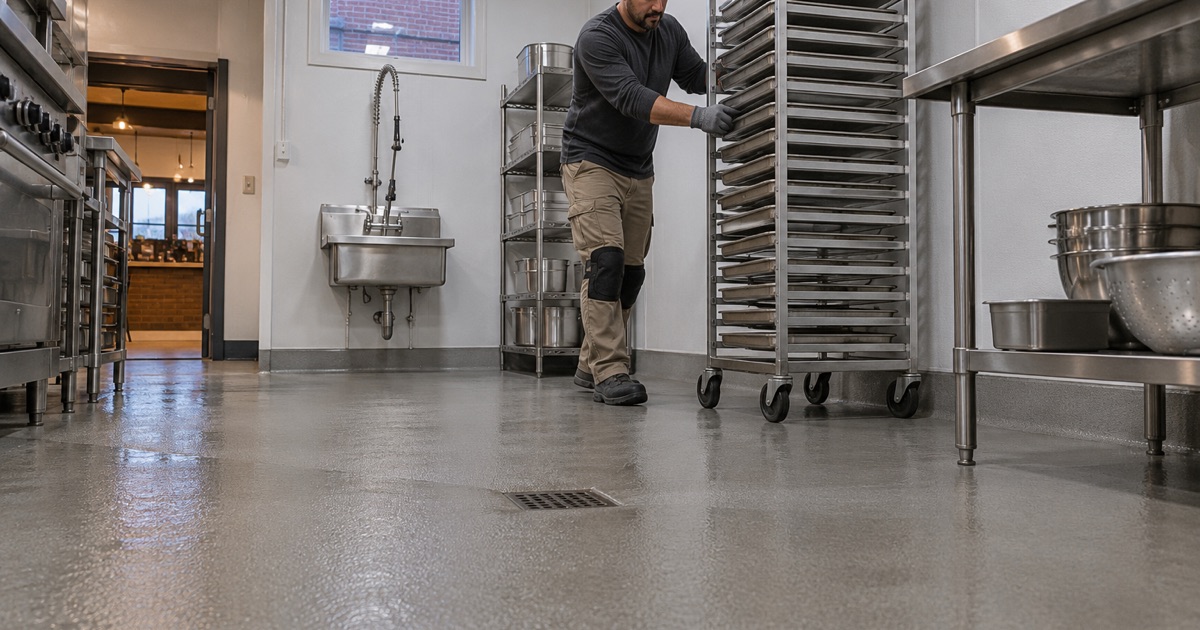
What a downtown bakery puts on the floor
The Bellbird Bakeshop at 15 West Harris Avenue, in downtown La Grange, is a good picture of the kind of room we mean. NBC Chicago reported in January 2026 that Maree and Erik Hecimovich took over the space in late 2024 and now offer 20 pastries and several kinds of bread, including a buckwheat croissant. We have no connection to the shop and have never seen its floor.
What the report does make clear is the scale of a scratch operation in a small storefront. Laminated doughs, bread shaping and pastry work all mean flour on the bench, flour in the air and flour settling on everything below. In a compact downtown space there is no separate production plant to absorb that dust; the bakery and its floor are the same room.
Why flour behaves badly on bare concrete
Dry flour is fine powder, and it finds every pore in an open concrete slab and every recess in a grout line. On its own it is a dust problem. Add a little water from a mop, a spill or a proofing cabinet, and it turns into a paste that dries hard, bonding into the texture of the surface and the joints between tiles.
Once flour paste has set in pores or grout, a mop slides over it rather than lifting it. Each cleaning leaves a thin layer behind, and over months the floor darkens and roughens where the paste has built up. That residue is the real enemy of a bakery floor, and it is the reason the surface needs to be sealed and seamless rather than merely hard.
Small storefronts, short shutdowns
A downtown bakery rarely has a second room it can move into while the floor is redone. The work has to fit around a schedule the owner already runs, which is why we plan bakery jobs around closing days and weekend windows rather than asking a shop to go dark for a week.
That planning starts with the hours. The Bellbird Bakeshop, for example, is listed as open from 8 o’clock in the morning to 3 o’clock in the afternoon, Wednesday through Sunday. Hours like those shape both the daily cleaning and any window we would have to work in.
Looking for epoxy-flooring closer to Lyons? See Lyons Epoxy-Flooring.
No Dry Sweeping: The Dustless Cleaning Rule
What section 6-501.13 actually says
The Food Code is direct about how floors in a food establishment may be cleaned. Section 6-501.13(A) allows only dustless methods of cleaning, and it names them: wet cleaning, vacuum cleaning, mopping with treated dust mops, or sweeping with a broom and a dust-arresting compound. An ordinary dry broom that throws flour back into the air is not on the list.
The reasoning is plain once you picture a bakery. Dry sweeping lifts fine flour and whatever has settled with it, and that dust lands back on benches, racks and open product. A dustless method traps it on the mop, in the vacuum or under the compound, so the room gets cleaner instead of simply redistributing what was on the floor.
What that means for the surface underneath
Every one of those dustless methods works best on a smooth, closed surface. Wet cleaning needs water to sheet across the floor and carry soil away, not soak into it. A vacuum needs a surface with no open pores holding the dust. A treated dust mop needs to glide, not catch on raised aggregate or chipped grout.
The same code, in section 6-101.11, asks that floors in food areas be smooth, durable and easily cleanable, and nonabsorbent where they are subject to moisture. A coated floor with no joints or pores is the version of that requirement that holds up to daily mopping. Bare concrete and worn tile both fight the method the rule requires.
No sawdust or granular absorbents
Section 6-501.17 adds a second limit. Sawdust, wood shavings, granular salt, baked clay, diatomaceous earth and similar materials may not be used on floors, except for a small amount put down immediately before spot-cleaning a liquid spill. The old habit of scattering an absorbent and leaving it is out.
That rule matters to the floor choice because some owners use absorbents to manage a surface that stays damp or greasy. A floor that does not hold liquid in the first place removes the temptation. Spills bead and wipe up, so the absorbent stays in the closet for the rare spill it is still allowed to handle.
Who reads the rule in La Grange
For a food business in La Grange, the local health authority is the Cook County Department of Public Health, which serves suburban Cook County apart from a few communities that run their own departments. The owner answers to that department for how the shop is cleaned and kept. We do not, and our floor is not an inspection result.
What we can do is build a surface that makes the required routine easy to carry out every day. No coating carries a federal approval for that purpose, and none makes a kitchen pass on its own. We say so in the proposal, before anything is sold.
After Closing: When the Floor Gets Cleaned
The least-food-exposed window
Section 6-501.12(B) sets the timing. Apart from cleaning that a spill or other accident makes necessary, cleaning has to happen during periods when the least amount of food is exposed, such as after closing. Routine floor cleaning is meant to wait until the cases are emptied and the product is put away.
For a bakery that closes in the early afternoon, that window opens once the last tray is cleared. The floor has been collecting flour since before dawn, and it now gets its full wet clean. Tomorrow the cycle repeats, so the surface sees a soaking mop and scrub at least once a day, every day the shop is open.
What a daily wet clean asks of a coating
Repeated water, scrubbing pads and cleaning products are a wear test that never ends. A thin film or a single-coat paint lifts at its weakest point and lets water under the edge, where flour paste follows. A properly built system needs real thickness, a strong bond to the concrete and a topcoat chosen to stand up to scrubbing.
That is why our proposals name the product line, the number of coats and the finished thickness in writing, so the owner can check the floor against the quote. In wet food areas we often look at urethane cement or a 100% solids epoxy base under a hard-wearing topcoat, chosen for the cleaners the shop actually uses.
Letting the floor drain and dry
After a wet clean, water that sits in a low spot leaves a ring of paste when it dries. On an existing slab we look for those low areas before coating and correct them where we can, so the mop water moves toward a drain or a squeegee path rather than pooling under a rack.
We also map cracks, spalls and old coatings first. Flour paste loves a crack as much as a grout line, and a coating laid over an untreated crack will open along it. If the slab needs repair before it should be coated, we tell the owner so before the price is final.
A Floor That Sheds Flour Paste
Opening the slab properly
A bakery floor fails from the bottom up when the coating never gripped the concrete. We open every slab with a diamond grinder or a shot blaster, never an acid etch, to reach a measured ICRI concrete surface profile the system is designed for. Grinding dust is captured at the machine with a vacuum, not washed toward a drain.
Before any of that, we test for moisture as part of the written scope, using ASTM F2170 relative humidity probes or calcium chloride tests under ASTM F1869. Moisture rising through a slab can lift a coating from below no matter how well it was installed. Where readings are high, a moisture-mitigation primer goes in first, and moisture is the first warranty exclusion we explain.
A cove closed to 1 mm
The corner where the floor meets the wall is where flour collects first and leaves last. Section 6-201.13(A) of the Food Code asks that floor and wall junctures be coved and closed to no larger than 1 mm where floors are not water-flushed. A square corner with a gap behind a rubber base is exactly the crevice a mop cannot reach.
We build an integral cove from the same resin as the floor, running it up the wall and sealing the top edge so nothing gets behind it. The result is a curved, continuous joint that a mop follows in one stroke. Around equipment legs and the base of shelving we detail the same way, so every edge is closed rather than left as a seam.
Texture that still cleans
A bakery floor gets slick with flour and water, so it needs some grip. The trouble is that a heavy texture holds paste in its valleys, defeating the whole point of a smooth floor. The Food Code itself allows antislip floor coverings where they are needed for safety, so the balance is a matter of choosing the right finish.
We specify slip resistance by the actual broadcast and topcoat, such as a fine quartz aggregate locked under a sealing coat, rather than promising it as a slogan. The aim is a texture fine enough for a mop to clean in one pass and coarse enough to keep a baker steady at the bench.
Planning the job around the shop
A small bakery cannot close for long, so we phase the work around its existing closed days and plan cure schedules by slab temperature and dew point rather than by the calendar. The proposal sets out each step, the products and the reopening time, so the owner knows exactly when the floor is back in service.
The floor then becomes part of the daily routine the owner already runs. With pores sealed, joints eliminated and the cove closed, the after-closing wet clean lifts the day’s flour and rinses it away. That is the measure of success for a bakery floor: it looks the same at the end of the year as the day it opened.
- 20+ Years on Concrete
- Moisture Tested Before Pricing
- Written Specs on Every Quote