Orland Park Epoxy Flooring has put more than 20 years into epoxy flooring in Justice and across the southwest suburbs, and the floors that teach us the most are the ones customers never see. They sit in rooms where solvent, detergent and standing water are part of every shift. A coating in a room like that is judged by whether it is still bonded and cleanable a year later, not by how it photographs on day one.
This page is about one kind of working floor: the kind found where soiled industrial textiles are received, sorted and washed. That work has a real address in this village, and it shapes how we think about the shops that send their towels out. Whether the room is a laundry’s intake area or the corner of a truck shop where used rags wait for pickup, the questions are the same.
What chemicals land on the slab, how often is it wet, and how fast does it have to be back in service? We answer those before we name a product, and the answers decide whether a room gets 100% solids epoxy, a urethane cement, or a polyaspartic topcoat over a broadcast. The rest of this page walks through why.
An Industrial Laundry on Cork Avenue
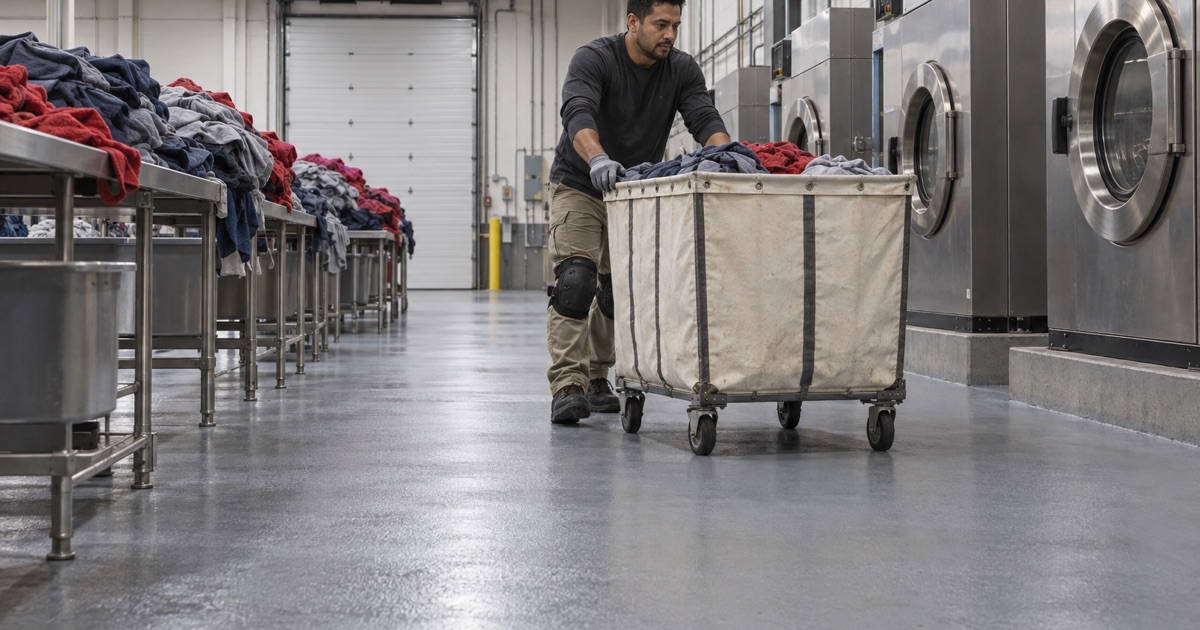
Justice is not a manufacturing town by its own account. The village describes itself as home to hundreds of small businesses with no major industries, plus several truck repair shops and body shops in its industrial park. One address stands apart on a regional list, though, and it explains why this page exists.
A significant industrial user on the district’s list
The Metropolitan Water Reclamation District’s list of significant industrial users, as of September 1, 2026, includes a Cintas Corporation entry at 8201 South Cork Avenue, Justice, the only Justice entry on that list. A significant industrial user discharges process wastewater to the district’s sewers under a pretreatment permit. Cintas lists the same address as Cintas Uniform Services of South Chicago, serving Orland Park and neighboring towns.
We have no relationship with that plant, and we have not seen its floors. What we can say is what the company publishes: uniform rental, work and chef uniforms, cleanroom apparel and facility services, plus a Justice job posting for a wash alley operator who loads industrial washers in sequence and checks weights, mixes, temperatures and water levels. Those duties describe the conditions a laundry floor of that kind has to live with.
Shop towels and the federal wipes rule
Industrial laundries commonly handle shop towels, and a federal rule explains why those towels matter to the shops that use them. Under 40 CFR 261.4(a)(26), solvent-contaminated wipes sent out for cleaning and reuse are excluded from solid waste if the generator keeps them in non-leaking, closed containers labeled Excluded Solvent-Contaminated Wipes and accumulates them no more than 180 days.
When the wipes leave, they must contain no free liquids, and any free liquids removed are managed as hazardous waste. The generator records the name and address of the laundry, and the laundry’s discharge has to be regulated under the Clean Water Act. We are not giving compliance advice here, and a coating does not make anyone compliant. The rule simply tells us where solvent ends up on a floor.
Looking for epoxy-flooring closer to Harvey? See Harvey Epoxy-Flooring.
The Soil-Sort Floor: Oil and Solvent Residue Underfoot
In a laundry that takes in soiled shop towels, the first floor to see them is the soil-sort or intake area. Bags and containers are emptied, towels are separated from aprons and other goods, and whatever residue the towels still carry meets the slab. Even towels with no free liquids leave oil and solvent film behind on concrete that is walked, rolled and swept all day.
Solvent resistance comes from the system
A chemical-resistance chart is a starting point, not an answer. Resistance depends on the resin, the number of coats, the finished thickness and how fully the floor cured before service. For a sort floor we usually look at 100% solids epoxy built to a real thickness, or a urethane cement where heat, impact or wet cleaning push past what a thin epoxy can take.
Our proposal names the product line, the coat count and the finished thickness, so a facility manager can hold the floor up against the paperwork later. If the room sees a specific solvent family, we want its name before we pick a topcoat, because a polyaspartic that handles one cleaner well may soften under another. Guessing at that is how sort floors end up stained and peeling at the busiest aisle.
Prep that gives the coating something to hold
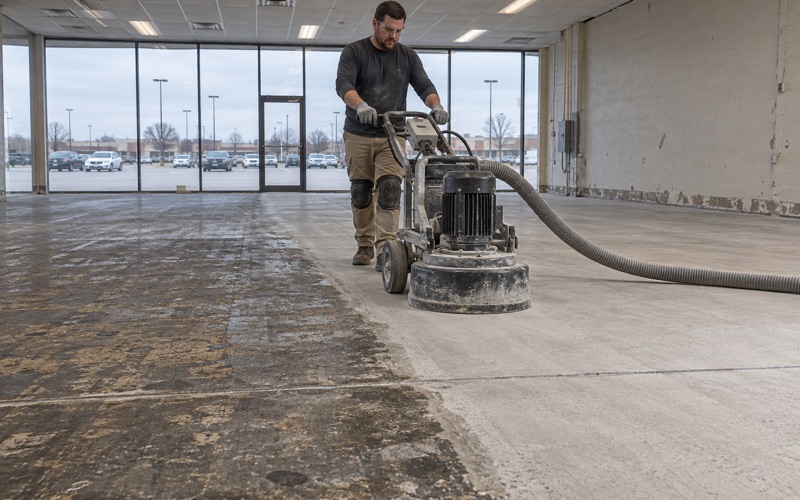
Concrete that has absorbed oil for years does not bond to anything until the contamination is dealt with. We open every slab with a diamond grinder or a shot blaster, never an acid etch, and aim for the ICRI concrete surface profile the system calls for. Oil-soaked areas may need repeated grinding or degreasing before they will take a primer at all.
Before pricing we map cracks, spalls and old coatings, and we will say plainly when a section of slab needs repair or replacement rather than a coating. Grinding dust is captured at the machine by a vacuum instead of being washed toward a floor drain. In a building whose drains feed a permitted discharge, that habit matters more than usual.
Footing on a floor that is never quite clean
Sort areas are swept constantly, and a high-gloss floor with a film of oil on it is a slipping hazard. We specify texture by the broadcast and topcoat, typically quartz aggregate at a grade matched to how the floor is cleaned, rather than promising slip resistance as a slogan. Too coarse a texture holds lint and residue, and too fine a texture stops helping once the floor is greasy.
The Wash Alley: Heavy Washers, Water and Detergent
Past the sort floor is the wash alley, where industrial washers are loaded by weight and run by mix, temperature and water level, as the Justice posting describes. A floor there carries heavy machines and laundry carts, takes repeated splash of hot water and detergent, and is seldom fully dry. It is a floor chosen for cleanability and wet footing, not looks.
Heat, detergent and constant water
Standard epoxy softens as temperature climbs, and a floor flooded with hot wash water or exposed to steam cleaning can outrun it. That is where urethane cement earns its place, because it tolerates thermal shock and wet service better than most thin film systems. Around drains and machine bases we pay close attention to edges and terminations, since water finds the seam a coating left open.
Detergent chemistry matters too. Strong alkaline cleaners and the residue they leave are part of the daily routine in a wash area, and a topcoat has to resist them without dulling into a surface that holds soil. We ask which cleaners are used and how the floor is washed down before we name the topcoat, and the answer can change the system entirely.
Moisture from below as well as above
A slab that stays wet on top can also be pushing moisture up from underneath. A moisture test is written into our scope before the price is final, using ASTM F2170 in-situ relative humidity probes or ASTM F1869 calcium chloride testing depending on the slab. High readings may call for a moisture-mitigation primer, and moisture is the first exclusion we explain in any coating warranty.
Cure around a working shift
A wet production room rarely closes for long. We phase the work in sections around operating hours, use overnight and weekend windows where a space cannot shut down, and follow slab temperature and the dew point spread at the surface rather than a calendar date. A floor returned to hot water before it cures fails early, and amine blush on a cold slab is a common culprit.
What It Means for a Shop Floor in the Justice Industrial Park
The other half of the shop-towel story sits in the village’s industrial park, where the village counts several truck repair shops and body shops. Shops like these commonly send solvent-wiped towels out to an industrial laundry rather than throwing them away. The towels pass through one small corner of the shop floor first, and that corner is worth a closer look.
The towel station and its container
Under the wipes rule, used towels wait in closed, labeled containers for up to 180 days. Where those containers sit, the floor sees solvent drips from towels dropped in, from lids opened and closed, and from containers dragged out for pickup. A solvent-resistant epoxy at that station, sealed tight where the floor meets the wall, keeps a spill from wicking into bare concrete.
We are not telling any shop how to store its towels; that belongs to the shop and its waste and laundry vendors. Our job is the slab under the container. A smooth, sealed surface at the station also lets a drip be wiped up before it spreads, which is a practical benefit rather than a compliance claim.
The path to pickup
Towel containers travel from the station to a door, usually on a dolly or a hand truck, and that route takes wheel loads and scraping the rest of a small shop floor may not. We look at the path when we scope a job and build it to the same thickness as the station, rather than letting the system taper off at the edge of a work area.
What goes in the written scope
Every quote we write for a Justice shop names the system, the coats, the finished thickness, the moisture test and the cure schedule. If the slab needs repair first, the quote says so. We also pick products inside the Illinois VOC limits for floor and industrial coatings, because those limits bind the person applying the coating, and we tell owners in writing what the warranty does not cover.
For an owner weighing a floor at a towel station, a parts area or a full bay, that paperwork is the point. It lets you check the floor against the promise years after the crew has gone. That is the standard we hold whether the room handles soiled textiles all day or simply holds the bin where a shop’s used towels wait.
- 20+ Years on Concrete
- Moisture Tested Before Pricing
- Written Specs on Every Quote