Orland Park Epoxy Flooring installs industrial epoxy flooring in Orland Park, IL, serving surrounding cities including Palos Heights, Mokena, Worth, Palos Hills and Crestwood. Orland Park itself is a retail, auto and medical town with no industrial district, so most of our industrial work is in the warehouses, shops and plants across the surrounding suburbs, where 20+ years of floor work has taught us that wheels and chemicals decide the system.
An industrial floor takes punishment a home garage never sees: forklift and pallet jack wheel loads, dropped parts, hydraulic fluid, solvents, cleaning chemicals and constant traffic in the same lanes. A coating that fails there does more than look bad. It creates trip edges, dust and downtime while the floor is repaired. The right system starts with a hard look at what actually happens on the floor every day.
Every proposal names each layer by product, the finished thickness, the surface profile we will reach and the texture. Large floors are usually shot blasted, edges are ground, and the slab is tested for moisture before pricing. Dust is captured at the machine, and the work is phased around production rather than the other way around.
Loads, Wheels and Chemicals
Forklift and Pallet Jack Wheel Loads
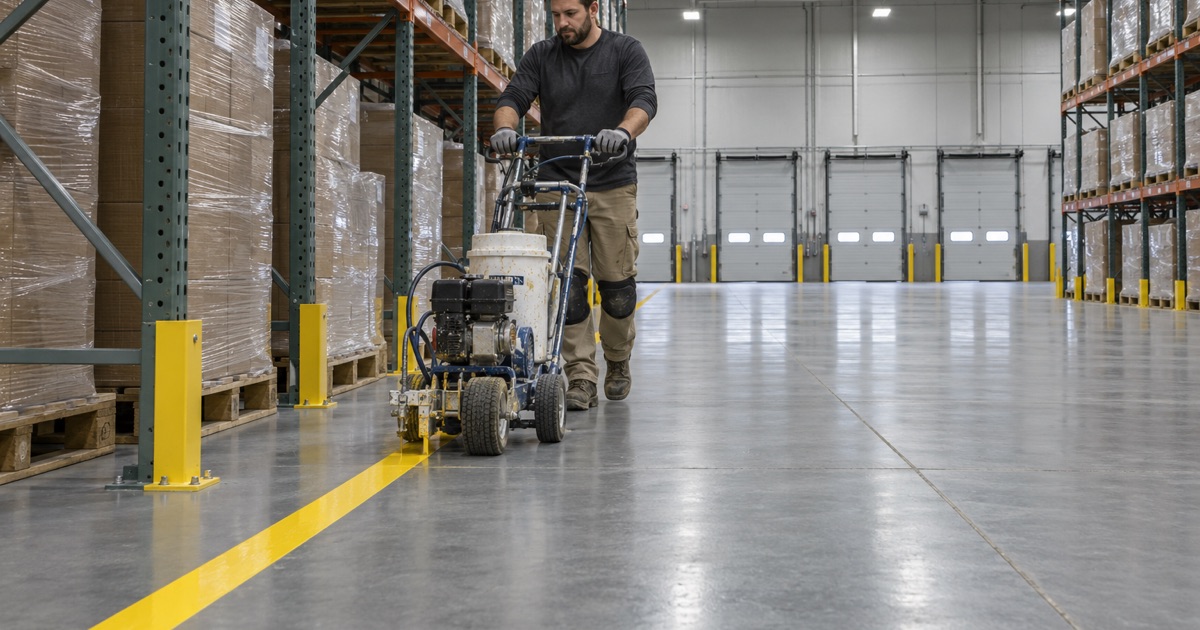
Hard polyurethane and nylon forklift and pallet jack wheels concentrate weight on a small contact area, and they grind at the floor every time they turn in place. Thin coatings wear through in the turning areas and lanes first. We look at wheel type, load, turning patterns and traffic volume, then specify a thicker, higher-build system where those loads are heaviest.
Chemical Exposure and Spills
Industrial floors meet oils, hydraulic fluid, coolants, solvents, acids, caustics and cleaning chemicals. Each coating has a published chemical resistance range, and not every epoxy resists every chemical. We ask for a list of what reaches the floor, compare it with product data, and choose a novolac epoxy, urethane cement or other topcoat where standard epoxy would soften or stain.
Impact, Dropped Parts and Abrasion
Shop floors and assembly areas take dropped tools, steel parts and dragged pallets. A thin, brittle coating chips under that impact. Thicker slurry or trowel-applied systems, often with a broadcast of quartz aggregate, absorb more abuse and resist abrasion from grit and wheels. We match the build to the worst impact the floor will see, not to an average day.
Building an Industrial System
Shot Blasting and Edge Grinding
Shot blasting is our usual preparation on large industrial floors. It is fast, recovers its own dust and leaves a uniform, rougher profile that suits thick coatings and urethane cement. Edges, corners and areas around equipment are diamond ground. Oil-soaked areas are degreased and tested, and any contaminated concrete that will not clean up is cut out and patched before coating.
High-Build Epoxy and Urethane Cement
For dry floors with heavy traffic, a high-build epoxy system with a quartz broadcast or a trowel-applied mortar gives the thickness and toughness the floor needs. For wet process areas, hot water washdowns, freezers and floors with thermal shock, urethane cement is often the better choice. Many plants use both, with each zone getting the system that suits its conditions.
Joints, Cracks and Trench Drains
Control joints and cracks are where industrial floors fail first, because wheels chip unsupported edges. We fill joints with a semi-rigid filler, repair spalled edges with a structural patching material and decide which joints must stay open for movement. Coatings are carried neatly into trench drains and floor sinks so liquids flow off the floor rather than under the coating.
Safety, Markings and Texture
Slip Resistance for Wet and Oily Floors
Industrial floors are often wet, oily or dusty, so texture is part of the specification. We set it with the aggregate broadcast and topcoat, using more texture in wash areas, loading docks and process zones and less where carts and cleaning equipment need a smoother surface. The texture is defined in writing so it can be checked against the finished floor.
Aisle Striping and Safety Zones
Aisle lines, pedestrian walkways, hazard hatching and equipment outlines can be built into the coating system. Coated markings last far longer than paint or tape and do not peel at the edges where forklifts cross them. We lay out markings from your drawings or with your safety team so the finished floor supports how the building already operates.
Scheduling, Air Quality and Recoats
Phasing Around Production
Most plants and warehouses cannot stop for a week. We divide the floor into zones, plan access and staging, and coat in sequence over nights, weekends or planned shutdowns. Fast-curing systems shorten the return to service where a zone must reopen quickly, and the cure time for each zone is written into the schedule before work begins.
VOC Limits and Ventilation
Illinois limits VOC content in floor and industrial maintenance coatings, and the Chicago area falls inside the 2015 ozone nonattainment area. Those rules bind the person applying the coating, so we choose products inside the limits and plan ventilation in occupied buildings. Odor-sensitive areas can be isolated or scheduled when they are empty.
Recoating Worn Lanes
Even a well-built industrial floor wears in its busiest lanes over time. When the base system is still bonded, worn areas can be abraded and recoated without removing the whole floor. We note the traffic lanes in the original scope so you know where to expect wear and when a recoat will likely make sense.
- 20+ Years on Concrete
- Moisture Tested Before Pricing
- Written Specs on Every Quote