Orland Park Epoxy Flooring brings more than 20 years of epoxy flooring work to Hinsdale, and the question we hear most often here is not about color. It is about what a floor does when it is wet, and what it still looks like after a few hundred rounds of cleaning chemistry. Those two pressures pull a coating in opposite directions, and choosing a system means deciding where between them a particular room should sit.
Grip comes from texture, and texture is harder to clean. A smooth, glossy coat wipes down in one pass but turns slick under a film of water or soap, while a coarse surface holds a shoe and also holds dirt. We treat that balance as something to specify in writing, by naming the broadcast aggregate and the topcoat in the proposal, rather than as a word on a brochure.
Below we walk through a building coming to the village where that balance is spelled out in state rules. Then we bring the same reasoning home, to the mudroom, the laundry, the garage entry and the basement wash area, where homeowners face a smaller version of the same decision.
A Six-Room Surgery Center Coming to Ogden Avenue
From Westmont to 550 West Ogden Avenue
Illinois Bone and Joint Institute’s Salt Creek Surgery Center is relocating from 530 North Cass Avenue in Westmont to 550 West Ogden Avenue in Hinsdale, a move of about two miles. The state review board logged it as HFSRB project 25-029, with a project cost of $23,127,636. The new address geocodes inside the village, in Downers Grove Township, DuPage County.
The plan, as The Hinsdalean described it in December 2025, is a 1 1/2-story building serving as an outpatient ambulatory surgical center with six operating rooms, about 65 employees and roughly 50 patients a day. Trustees approved the exterior appearance and site plan in January 2026, ground was broken in May, and the opening is scheduled for late summer 2027. Until then it is a construction site, not a working surgery center.
A New Medical Building With Parking Underneath
The building carries its main parking on the lower level, inside the structure, with 55 spaces there plus a surface lot and access by three driveways off Monroe Street. Accounts differ slightly on the count under the building. We mention it only to complete the picture of a new medical building that stacks cars below clinical rooms.
We have no role in this project. We have not read a floor plan, finish schedule or contractor list for the building, and nothing on this page describes what will actually be installed there. We use it because an orthopedic operating room makes the wet-floor problem unusually clear, and because the state rule behind it is short enough to quote in full.
Why an Orthopedic Room Is Different
The site was formerly occupied by Hinsdale Orthopaedics Associates, which joined the IBJI network, and the move expands the institute’s local surgical capacity from four operating rooms to six. Orthopedic surgery brings one procedure in particular that changes what a floor has to tolerate, and that procedure is the reason this building anchors the page rather than some other address in town.
Looking for epoxy-flooring closer to La Grange? See Epoxy-Flooring Services in La Grange.
Arthroscopy: Saline in the Joint, Saline on the Floor
How Distension Fluid Reaches the Floor
In arthroscopy, sterile fluid such as saline is supplied to the surgical site as a distension medium, which holds the joint open so the surgeon can see and work through small portals. That fluid has to leave the joint somewhere. US Patent 5,032,184 puts it plainly: waste fluids of various types find their way to the floor of the operating room.
The volumes are not trivial. Perioperative trade press describes one shoulder scope filling at least three 15-liter canisters, and quotes a nurse manager saying, “Every one of us has slipped on arthroscopy fluid.” Absorbent mats help, but the same patent points to the rather significant amount of fluid that falls to the floor beyond the mat periphery.
Slip and Contamination at the Same Time
The patent names two hazards in one passage. Operating room personnel are likely to slip and fall, and the possible contamination of the fluid presents an additional hazard. A wet kitchen floor is a slip question, while a wet operating room floor is a slip question and a cleaning question at the same moment, and the cleaning that follows is aggressive.
Surgical teams manage the fluid first, with closed direct-to-drain systems, floor suction devices, absorbent mats and drapes with collection pouches. The floor is what remains when those measures do not catch everything. That makes it a safety surface in its own right rather than a background finish chosen for appearance.
What That Asks of a Floor System
No coating stops a person from falling or stops an infection, and we never describe one that way. What a resinous floor can offer is a defined texture under foot and a seamless face with no grout lines or open seams for fluid to settle into. Both of those are choices made during specification, and they compete with each other.
The more aggressive the texture, the better a wet shoe sole holds. The smoother the face, the faster a mop or scrubber clears contaminated fluid and cleaning residue. A designer working on any wet-cleaned room has to decide where the floor should land between those two ends, and the state of Illinois has written down both sides of that decision.
Illinois’ Two Floor Sentences, and the Texture Trade-Off
What 205.1400(k) Says
Illinois writes its finish requirements for ambulatory surgical treatment centers into 77 Illinois Administrative Code 205.1400. Subsection (k) says floor materials shall be easily cleanable and have wear resistance appropriate for the location involved. Then come the two sentences that matter for a wet room.
Under (k)(1), in all areas frequently subject to wet cleaning methods, floor materials shall not be physically affected by germicidal and cleaning solutions. Under (k)(2), floors that are subject to traffic while wet shall have a nonslip surface. Subsection (d) adds that thresholds and expansion joint covers sit flush with the floor surface so wheelchairs and carts roll across without a lip.
What the Rule Does Not Say
The rule names no floor material and approves no product. It describes performance instead: resist the chemicals, offer grip when wet, clean easily and wear appropriately for the room. A coating by itself does not make any facility compliant, and it would be wrong to suggest that epoxy, urethane or any other system is what the state requires.
That framing is useful well beyond surgery centers. It turns a vague request for a safe floor into two testable properties, chemical resistance and wet grip, plus a cleanability goal that pulls against the second one. We write residential and commercial proposals the same way, with each property tied to a named product layer.
Texture Versus Cleanability Under Repeated Disinfection
A nonslip surface needs relief, meaning aggregate standing proud of the film so a sole has something to bite. Relief also gives residue somewhere to sit, so a mop has more work to do on every pass. A floor mopped with disinfectant many times a week rewards the smoothest surface that still grips when wet.
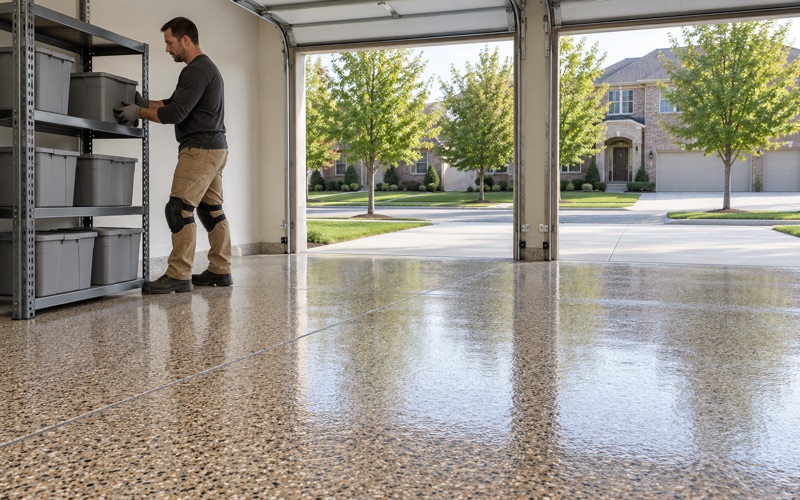
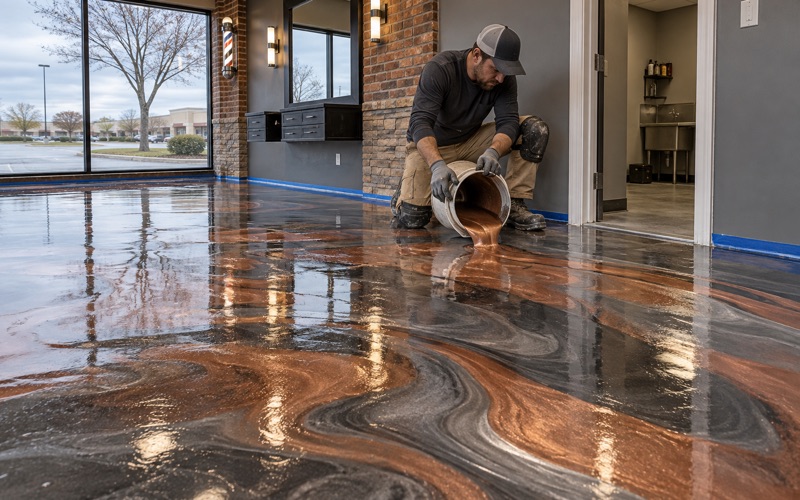
That is why we specify texture by its parts. A quartz aggregate broadcast gives a coarse, durable grip, and the grade of the quartz and how heavily the topcoat covers it set how aggressive the finished surface feels and how readily it releases dirt. A finer aggregate mixed into the topcoat gives a gentler profile that cleans faster, and the proposal names which one we chose and why.
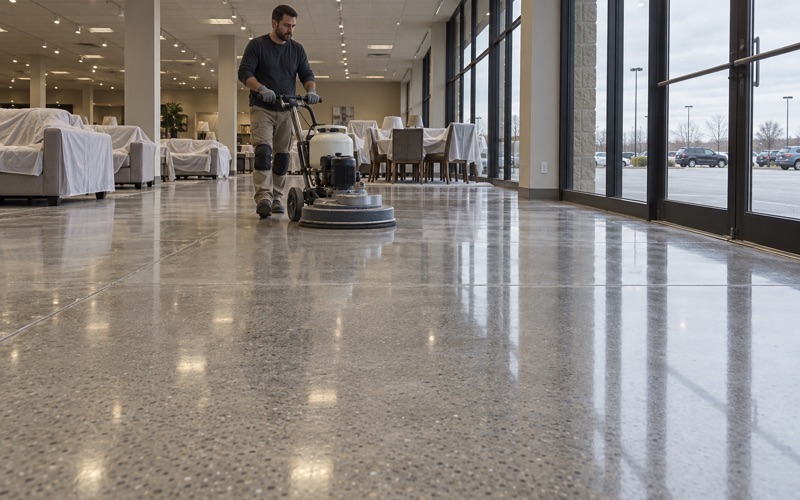
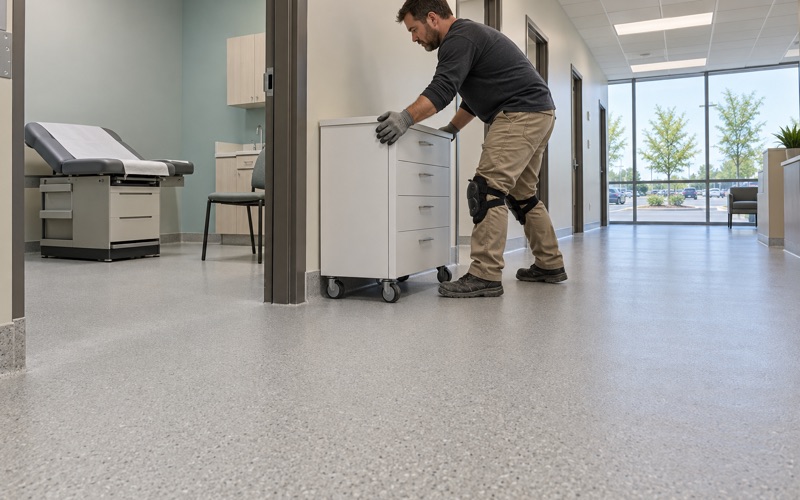
Chemical resistance is the other half. A topcoat in a wet-cleaned room has to stand up to the solutions actually used there, so we ask for the cleaning product list before choosing a system rather than after. Clinic and other commercial floors are phased around opening hours, with overnight and weekend windows when a space cannot close.
Where the Same Trade-Off Shows Up at Home
Most of our Hinsdale work is residential, which fits a village where 89.9 percent of occupied homes are owner-occupied. Nobody pumps saline onto a laundry room floor, but houses have their own wet rooms where the same question applies: how much grip is needed, and how much cleaning will the surface see.
Mudrooms and Garage Entries
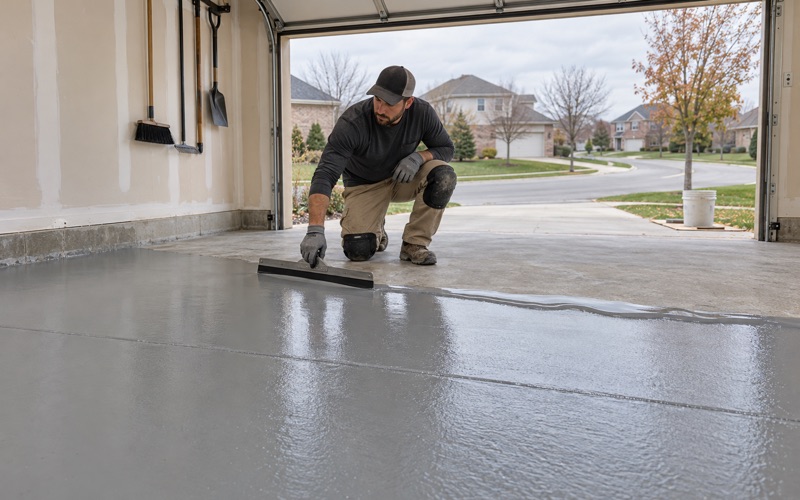
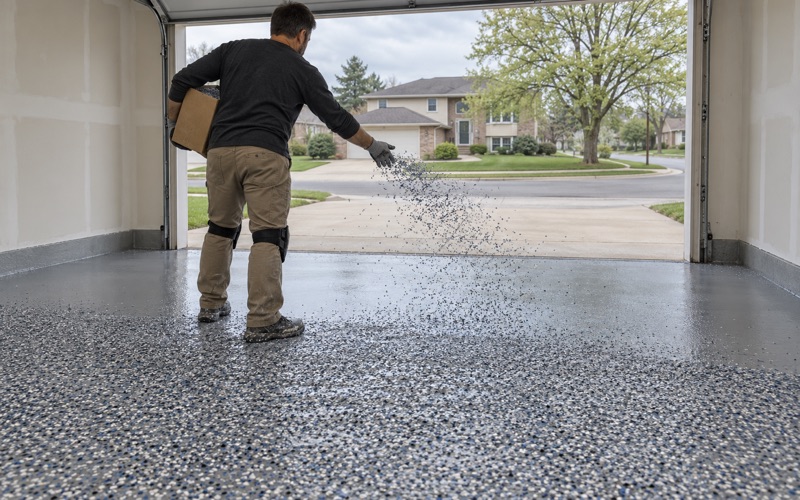
A mudroom, or the step from the garage into the house, takes snowmelt, brine and rock salt off boots all winter. A glossy coating looks sharp there in July and feels slick in January. We usually broadcast aggregate into the topcoat along the walking path, and on the garage side we choose a system built to hold up to the deicing salts that ride in on tires.
The texture goes where people walk wet, not across every square foot. A band of grip by the door and a smoother field under storage shelving gives the homeowner both properties exactly where each one earns its place. It also keeps the smoother areas quick to sweep and mop between seasons.
Laundry Rooms and Basement Wash Areas
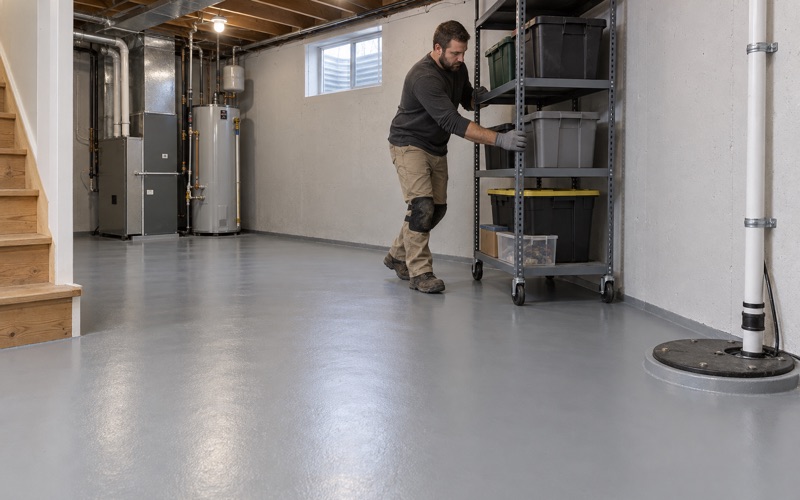
Laundry rooms and basement wash areas see detergent, bleach, standing water from a failed hose and the occasional overflow. Those rooms are cleaned with chemistry too, just far less of it than a clinical room. The same logic holds: a seamless coat with a modest texture, a topcoat matched to the cleaners in use, and a coved edge at the wall where water tends to collect.
Basement floors also bring moisture up from below, which is a separate problem from water on top. A moisture test is written into the scope before the price is final, and moisture is the first exclusion we name when we explain what a coating warranty leaves out. That conversation happens before the job is sold, not after a blister appears.
What Every Hinsdale Proposal Carries
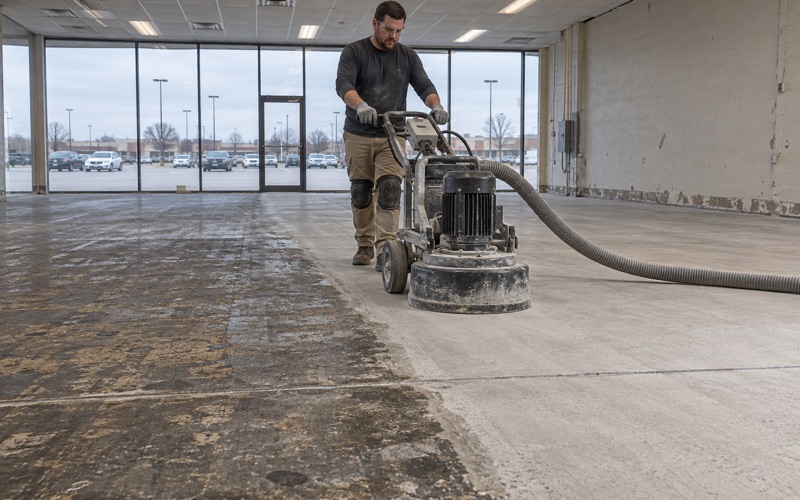
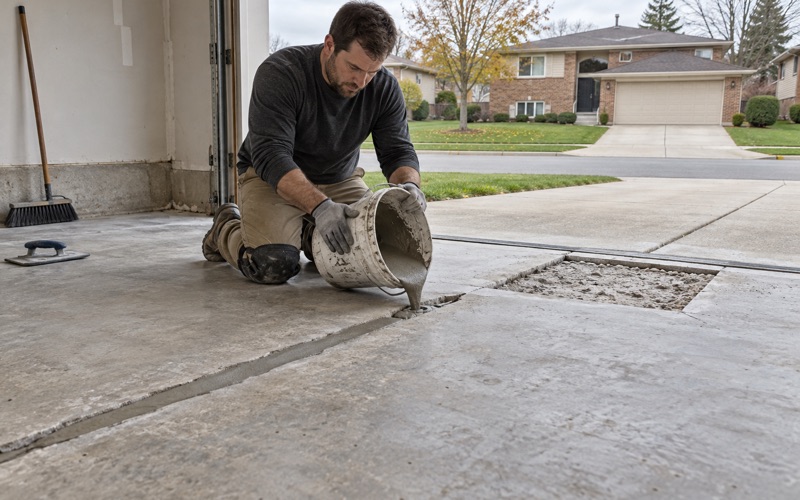
Each slab is opened mechanically with a diamond grinder or a shot blaster, never an acid etch, so the coating has a real profile to grip, and the grinding dust is captured at the machine with a vacuum. Cracks, spalls and old coatings are mapped first. If a slab needs repair before it should be coated, we say so plainly.
The written proposal names the product line, the number of coats and the finished thickness, so the floor can be checked against the quote. Illinois has no state flooring license, so we confirm the village’s own contractor license, bond and insurance rules before booking. Home jobs over the state threshold get a written contract and the Home Repair: Know Your Consumer Rights pamphlet before any grinding starts.
- 20+ Years on Concrete
- Moisture Tested Before Pricing
- Written Specs on Every Quote