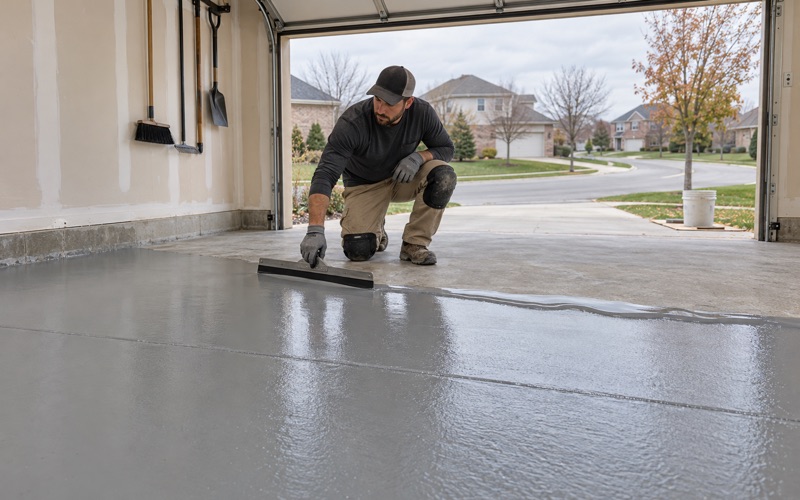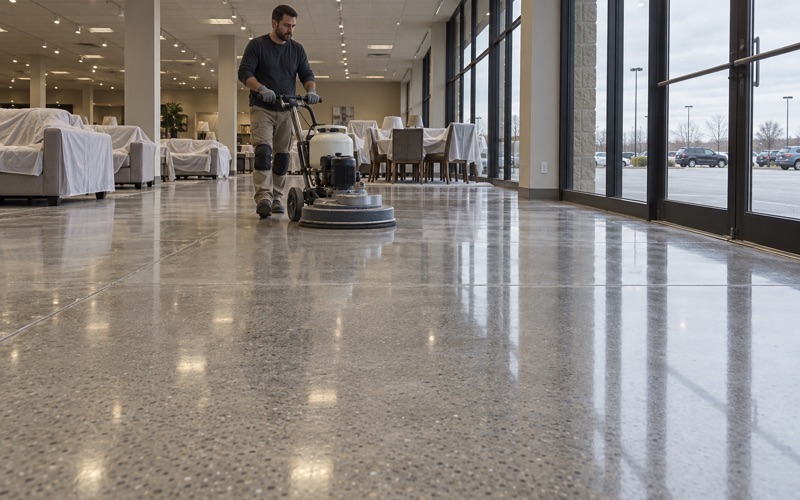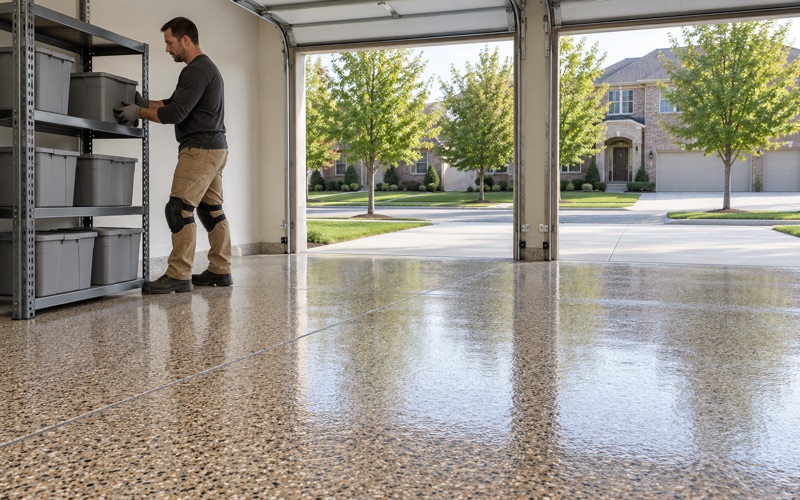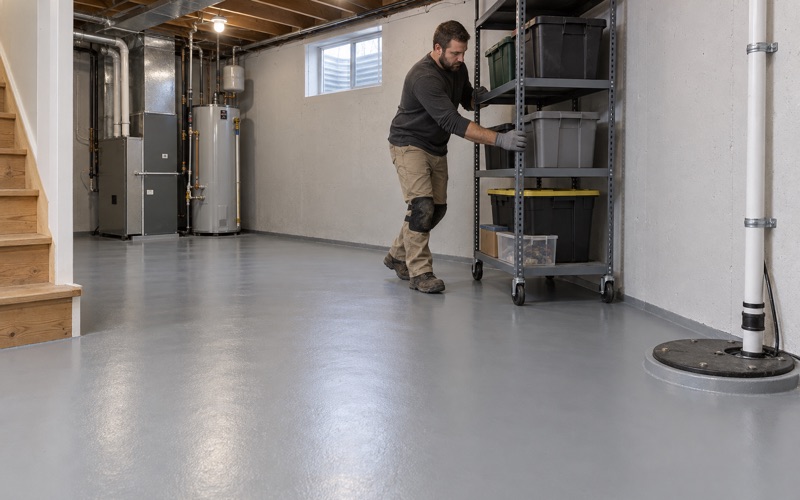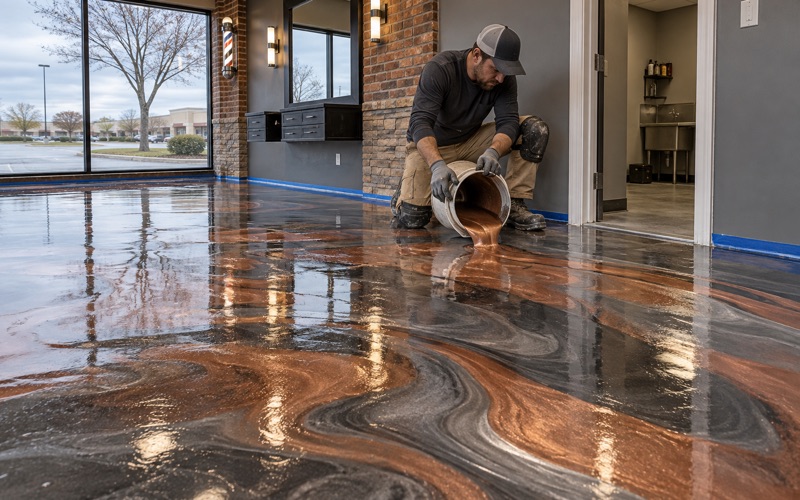
Orland Park Epoxy Flooring has spent more than 20 years grinding, testing and coating concrete, and our epoxy flooring in Hickory Hills is planned around what a room actually spills. A garage collects brine off tires, and a basement collects water vapor from below. A room with a resin 3D printer in it collects something stranger: drips of liquid plastic that harden where they land, followed by solvent wipes.
This page is about that last kind of floor, in a clinic and in a house. We explain what one printing resin’s own paperwork says about spills, what that asks of a coating, and how we build a floor that can be scraped and wiped for years without opening a seam. Every proposal names the product line, the coat count and the finished thickness, so you can hold the finished floor up against the quote.
We start every slab with a diamond grinder or a shot blaster rather than an acid etch, and a moisture test sits inside the written scope before the price is fixed. Those two steps decide more about a print-room floor than the color chart ever will.
A Dental Office on Roberts Road That Prints Its Own Parts
One practice, one printer, one safety data sheet
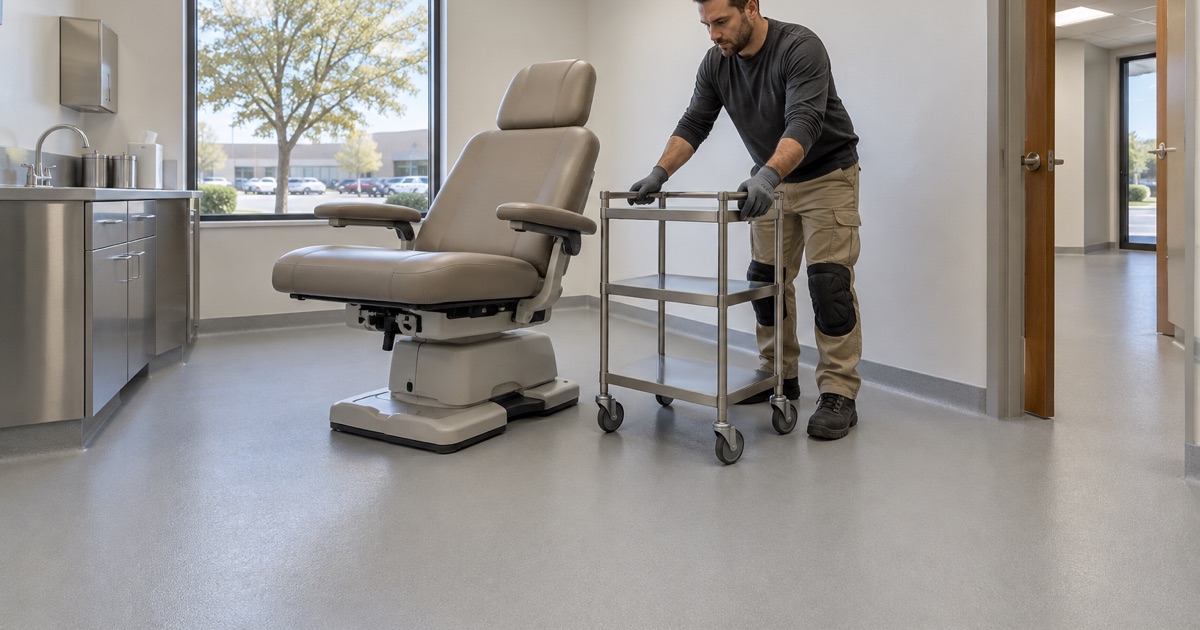
Chairside printing has moved into ordinary dental offices, and Hickory Hills has a documented example. A practice directory lists Emma Fuller, DMD, at 9055 S. Roberts Road, a two-dentist general, cosmetic, restorative and implant office whose listed technology includes a SprintRay 3D printer, CEREC and CBCT. The address geocodes inside the city, in Palos Township, Cook County.
We use the practice as a local reference point, not as a customer. We have not seen its rooms, where the printer sits or what floor runs under it. What makes it useful is that the printer maker publishes safety data sheets for its resins, and those documents describe in plain words what a spill on a floor is supposed to look like.
What Section 6 says to do with a drip
SprintRay’s NightGuard Flex safety data sheet, SDS-001 revision 3, effective April 28, 2023, covers a photopolymer made of methacrylic acid esters and photoinitiators. Its spill instruction is unusual for a liquid. Light, not air, is the curing agent, so the sheet tells the reader to let the room’s own light do the work.
The wording is direct: exposure to sunlight or artificial light will cause the resin to polymerize, so spread the paste to maximize the surface area, and once the material is hard, pick it up and place it into a container for disposal. In other words, the approved cleanup leaves a thin film of resin curing on the floor on purpose. Whatever the floor is made of becomes the mold for that film.
Section 13, the alcohol bottle and the hazard line
Section 13 names the cleaner outright: the recommended cleansing agent is Isopropyl Alcohol 91%, and packaging is to be rinsed with alcohol while leftover material is cured before disposal. The sheet also lists the resin as nearly insoluble in water. That matters on a floor, because a wet mop pushes uncured resin around rather than lifting it.
The hazard statements include H317, ‘May cause an allergic skin reaction,’ and Section 8 recommends use in an enclosed process area, with boots among the protective equipment. We quote those lines rather than interpret them. Health questions belong to the sheet and to the people trained on the resin, while our part is the surface the resin lands on.
Looking for epoxy-flooring closer to Markham? See Markham Epoxy-Flooring.
Cured Beads and Alcohol Wipe-Downs: Two Tests for the Floor
Put the two halves of that safety data sheet together and a print-and-wash corner asks two things of its floor. It has to let go of a hardened bead of plastic without tearing, and it has to take isopropyl alcohol over and over without softening, hazing or lifting at an edge.
The scrape test
A drop of light-cured resin grips whatever texture it cures into. On bare concrete it keys into the pores, and on a heavily broadcast floor it wraps around the chips or the sand, so getting it up means prying against the floor itself. A dense, smooth topcoat gives a plastic scraper an edge to slide under, so a cured bead can come free in one piece.
That is a tradeoff, not a free choice. The smoothest film is also the slickest when wet, and a clinic floor still has to be walked by staff all day. We specify slip resistance by the broadcast and topcoat we use rather than by a slogan, and near a printer we usually keep the texture fine enough for a scraper to ride over.
The alcohol test
Ninety-one percent isopropyl alcohol is a strong solvent, and around a wash station it is used routinely, not once a year. Wiped down daily, the topcoat meets it again and again, and a film that softens will start to hold dirt and dull in a ring around the station. A coat that cured with amine blush on its surface is a weak start, so we check for blush and remove it before the next coat goes on.
We will not promise that any coating shrugs off that alcohol indefinitely, because no resistance figure for that resin or that alcohol strength was in our sources. What we do is choose topcoats whose manufacturer publishes a chemical-resistance chart, read the isopropyl alcohol line with you, and lay a test panel you can wipe yourself before the full floor goes down.
Why a seam is the real failure point
Liquid resin flows before it cures. A floor with a joint, a seam between sheets or a gap at the wall gives a drip a channel to run into, and once room light reaches it there, it hardens where no scraper can follow. Over months those cured slivers build into a ridge that catches dirt and snags the mop.
Building a Seamless, Scrapeable Floor Beside a Print Station
Opening the slab and measuring what is under it
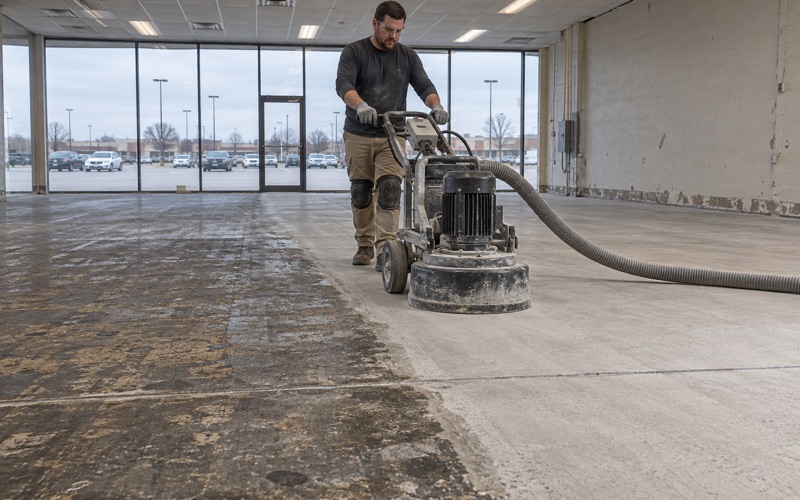
A print-room floor fails at the bond before it fails anywhere else, so preparation is where we spend the time. We open the concrete by diamond grinding or shot blasting to the ICRI concrete surface profile the primer calls for, and the grinder runs with a vacuum attached so dust is captured at the machine rather than rinsed toward a drain.
Moisture testing is written into the scope before the price is final. Depending on the slab, that means ASTM F2170 in-situ relative humidity probes, ASTM F1869 calcium chloride tests, or at least an ASTM D4263 plastic sheet test. If the numbers call for a moisture-mitigation primer, the quote says so, and the warranty discussion starts with moisture as the first exclusion.
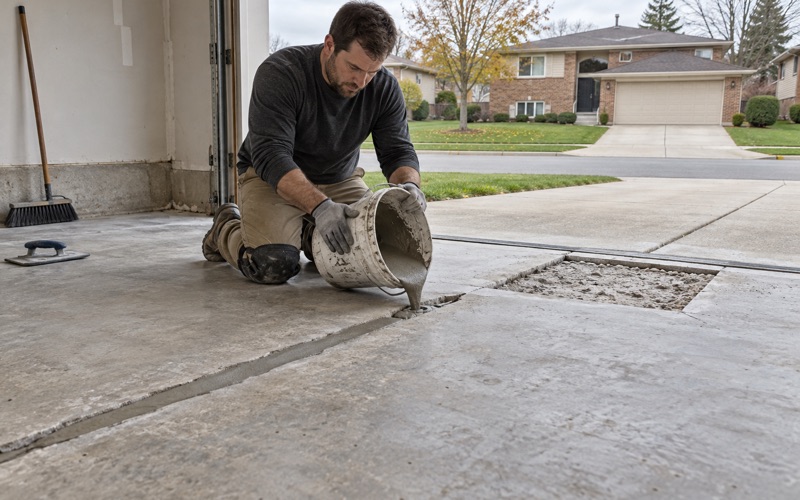
We map cracks, spalls and any old coating before quoting, because a crack bridged with a thin film will usually show back through. If a slab needs repair, or replacement, before it deserves a coating, we tell you that instead of selling a floor over it.
One continuous film, up the wall
Seamless is the whole point near a printer. A 100% solids epoxy body coat laid as one continuous film over repaired concrete leaves liquid resin nothing to run into. Where the floor meets the wall, a coved base carries the coating up a few inches, so a drip that reaches the edge lands on coating instead of in a gap.
The topcoat that takes the scraping
Over the body coat, a polyaspartic or polyurea topcoat is the layer that meets the scraper and the alcohol rag. We pick the line from published chemical-resistance data, keep products inside the Illinois VOC limits for floor coatings in 35 Illinois Administrative Code Part 223, and name the product, the number of coats and the finished thickness in the proposal.
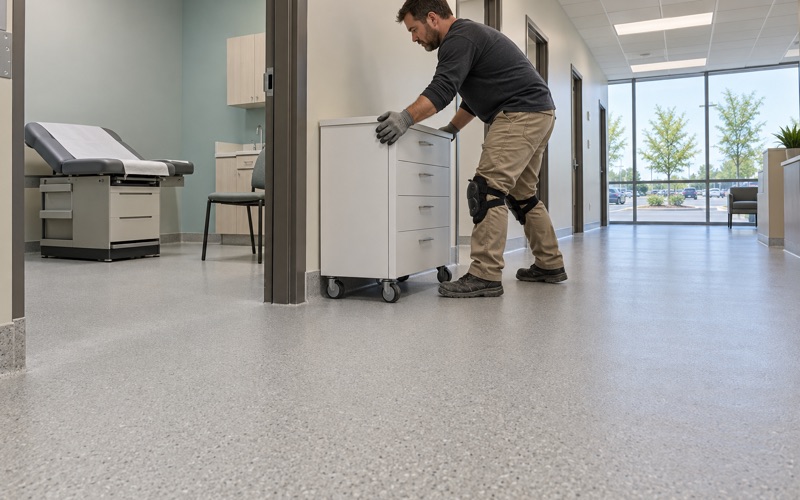
Clinics rarely close for a floor. We phase the work around patient hours, using evenings and weekends, and cure times follow slab temperature and dew point rather than a calendar. The room reopens when the coating is ready, not when a schedule says it should be.
Hobby Resin Printers in Hickory Hills Basements and Garages
Resin printing is not only a dental tool. Desktop resin printers have spread into home workshops for models and miniatures, and in a city where most homes are detached houses, a basement corner or a garage bench is a likely spot for one.
A print corner in the basement
A basement print station brings the same two tests home: hardened drips to scrape, and alcohol wash tubs that slop over. Basement slabs add moisture from below, so before we coat one we test it. If vapor emission runs high, we either specify a moisture-mitigation primer or say plainly that the corner should stay uncoated for now.
A coated floor with a coved edge also makes drips visible instead of hiding them in carpet or under a loose mat. One more line we draw clearly: a basement coating is not radon reduction, because in Illinois that is licensed mitigation work, and we never sell a floor as a substitute for it.
A workbench in the garage
In a garage the printer shares the floor with winter. Rock salt and calcium chloride brine ride in on tires, so the garage system we build is chosen for deicer exposure as much as for resin, and hot tire pickup is handled through primer and topcoat choice. An unheated garage in deep winter is told to wait, because cold concrete near the dew point will not cure a coating properly.
Booking the work in Hickory Hills
The City of Hickory Hills Building Department, on West 95th Street, licenses contractors at $100 per calendar year, January through December, with no half-year option. The application needs a certificate of insurance naming the city, and a copy goes to the homeowner or business owner before work begins. No bond is required.
Illinois itself licenses no flooring or coatings contractor, so the city license is the one that binds, and we confirm it before a job is booked. Contractors haul their own debris here, because the city’s hauler does not collect it. Home jobs over the state threshold get a written contract and the Home Repair: Know Your Consumer Rights pamphlet before any grinding starts.
- 20+ Years on Concrete
- Moisture Tested Before Pricing
- Written Specs on Every Quote