Orland Park Epoxy Flooring has spent more than 20 years on epoxy flooring in Hazel Crest and the rest of the south suburbs, and the jobs that teach us the most are rooms asked to do something they were never built for. A floor laid for desks and quiet foot traffic behaves very differently once it hosts dinners, dances and meetings that end with a mop and a deadline.
That is the kind of floor this page is about: a space whose use changed, where the coating has to survive spilled drinks, rolling carts and dragged furniture, then come clean fast enough for the next group. We plan those floors around turnover, not around how they look on the first day.
Our approach does not change with the size of the room. We open the concrete mechanically, test it for moisture before the price is final, and put the product line, coat count and finished thickness in writing so you can hold the finished floor up against the quote.
From an Office Park to a Village Hall on 183rd Street
Hazel Crest is a village in Cook County, a south suburb of Chicago with 13,382 residents at the 2020 census. Its government now works out of a building that started life as something else entirely, and that history is a good way to explain how we think about floors.
The building at 3601 West 183rd Street
In 2019 the village opened the Vernard L. Alsberry Jr. Municipal Center as its new village hall. According to the village’s Fall 2019 newsletter, the site was the former Hazel Crest Professional Office Park building, bought the previous year from the South Suburban Land Bank and Development Authority.
Plans to retrofit and renovate the space were approved before an October groundbreaking. The finished building holds offices such as Building and Inspectional Services, Water, and Human Resources, along with elected officials and what the newsletter calls banquet and meeting facilities. The address sits in the Rich Township part of the village rather than Bremen Township, which covers most of Hazel Crest.
What an office floor was designed to carry
An office park is planned around people walking between desks, a few rolling chairs and the occasional delivery. The concrete under a space like that was never asked to shrug off a spilled tray of punch or a loaded cart crossing it twenty times in an evening.
When any office space becomes an event space, the slab is usually sound but the finish over it is often the wrong tool for the new job. We are not describing the municipal center’s own floor, which we have not seen and have no part in. We are describing the question every owner of a converted room should ask before the first booking.
Converted office space often hides carpet glue, tile mastic or a thin sealer under whatever finish is showing. Those layers have to come off before a coating goes down, because a resin floor is only as strong as the weakest film beneath it. We find them during the walk-through and price their removal openly instead of discovering them halfway through the job.
Looking for epoxy-flooring closer to Bridgeview? See Bridgeview Epoxy-Flooring.
A 160-Seat Ballroom and What an Event Night Leaves Behind
The village rents a Ballroom at the municipal center with a listed capacity of 160 people and seating for 160. Any room of that size, wherever it is, sees a predictable pattern of wear that a floor has to be chosen for.
Spills that soak in or wipe up
Soda, coffee, wine and sauce all hit the floor at a banquet, often under tables where nobody sees them until cleanup. On bare or poorly sealed concrete, sugary and oily spills wick into the pores and leave dark rings that a mop only spreads around.
A 100% solids epoxy base sealed under a polyaspartic or polyurea topcoat gives liquid nothing to sink into. The surface stays on top of the spill, so the crew removes it instead of chasing a stain that keeps coming back after every event.
Cleaning chemicals matter as much as the spills themselves. Degreasers and sanitizers used after a catered meal can soften or haze a weak finish over months of rentals, so we match the topcoat to the products a crew actually uses and tell you which ones to avoid.
Catering carts and rolling loads
Catering carts, beverage stations and bus tubs on casters put concentrated weight on small wheels. Hard rubber and steel casters can scuff a soft finish and grind grit into it, especially along the path from the kitchen door to the serving line.
We size the coating system to that traffic. A thicker build of epoxy with a hard, chemical-resistant topcoat holds up far better than a thin roll-on paint, and the proposal states the finished thickness so you can confirm what was installed.
The heaviest wear tends to concentrate in a few lanes: the kitchen door, the bar, the stage edge and the path to the trash room. We look at those lanes first and, where the traffic justifies it, add build or broadcast there rather than coating the whole room to the same spec and hoping the busy paths keep up.
Table and chair drag
Banquet chairs and folding tables get dragged, stacked and pushed across the floor at the start and end of every rental. Metal glides and unprotected legs carve fine scratches that collect dirt and dull the finish over time.
A quartz aggregate or vinyl flake broadcast locked under the topcoat hides that wear and spreads the load. It also lets us tune the texture, which matters once the floor is wet, as the next section explains.
Five-Hour Rentals and a Floor That Turns Over Clean
The Ballroom’s Saturday rental is a five-hour block. Whatever the length of a booking, a hall that hosts back-to-back events needs a floor that can be cleaned completely, quickly, and without special products.
Cleanup between bookings
The floor that serves a busy rental schedule is the one a crew can squeegee, mop and dry in a short window. Seamless coatings with no grout lines and no open pores make that realistic, because there is nowhere for residue to hide.
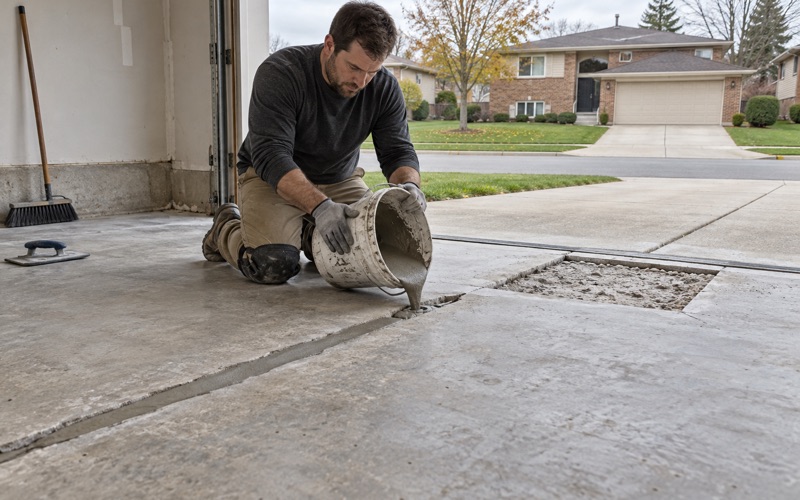
We pay attention to where the floor meets the wall and the base of fixed equipment, since that is where spills collect. Edges, saw cuts and old repairs are mapped before we start, and a slab that needs patching is patched before it is coated, not covered over.
We also leave owners with a plain cleaning routine: what to sweep, what to mop with, how much water to use and when to scrub. A coated floor rewards a simple, repeated routine far more than an occasional deep clean, and a written routine is easier to hand to whoever runs the next setup.
Staff on a wet floor
The people setting up and clearing a hall are working on that floor too. Federal rules at 29 CFR 1910.22 require employers to keep walking-working surfaces clean, orderly and, as far as feasible, dry, and free of hazards such as spills.
That rule covers employees, such as staff turning the room between events, not the guests or renters themselves. For an owner, the practical takeaway is simple: a floor that cleans fast and dries fast makes it easier for a crew to keep their own workspace safe.
Texture specified, not promised
A glossy coating can be slick when wet, while an aggressive texture traps dirt and fights the mop. We set slip resistance through the broadcast media and the topcoat we choose, and we write that choice into the scope.
For a dance floor or dining area, that usually means a fine broadcast that still cleans easily. For a service corridor or kitchen path, we may step up the texture where wet traffic is heaviest.
We can lay a small sample board with the chosen broadcast and topcoat so you can feel it underfoot and try your own mop on it. That is a far better test than a brochure photo, and it settles the gloss-versus-grip question before the room is committed.
A Village That Converts Buildings
The 2019 office conversion was not the first time Hazel Crest made a new home for its government out of an older building. Police and the Public Works crew stayed at the former village hall at 3000 West 170th Place, where senior activities and community events are still held.
The 1984 school that became a village hall
That earlier municipal center was itself a 1984 adaptation of an elementary school building. A school hallway, an office suite and a ballroom ask for three different floors, and a building that has been reused more than once may carry layers of old finish from each life.
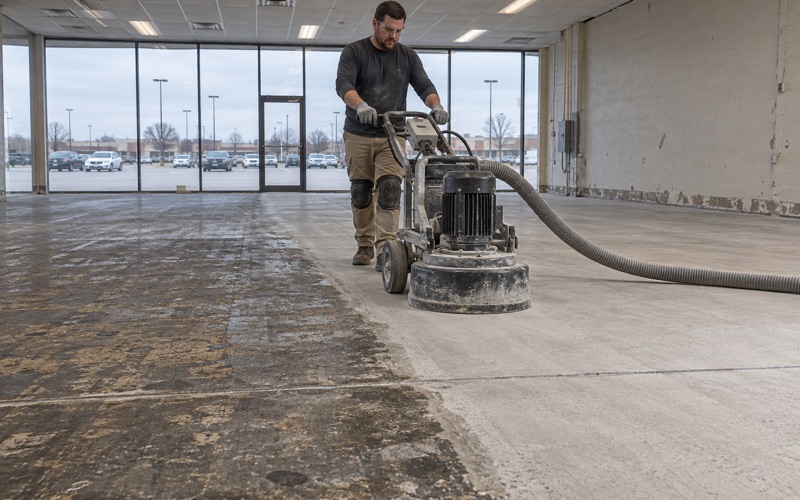
That is why we grind or shot blast to bare concrete rather than acid etching. Old coatings, sealers and adhesives are removed until the slab reaches a measurable concrete surface profile, so the new system bonds to concrete instead of to someone else’s leftover product.
Before the price is final, we also test the slab for moisture with methods such as ASTM F2170 relative humidity probes or ASTM F1869 calcium chloride kits. A floor that has served several purposes over the decades can surprise anyone, and a written test result is a better basis for choosing a primer than an assumption.
Working around a booking calendar
Any room that rents out cannot simply close for a week. We phase banquet, meeting and gym floors around the schedule, using overnight and weekend windows where a space has to stay open on weekdays.
Cure times follow slab temperature and dew point, not the calendar, so we tell you plainly when a topcoat needs another night before tables go back down. Grinding dust is captured at the machine with a vacuum, which keeps it out of floor drains and out of the rest of the building.
What we check before the job is booked
Illinois issues no state license for flooring or coating contractors, so local rules decide what applies. In Hazel Crest, the Building Department is the office to ask whether a floor project needs a permit, and we confirm the village’s contractor registration, bond and insurance requirements before scheduling.
We also pick products inside the Illinois VOC limits for floor coatings and explain what the coating warranty excludes before you sign, starting with moisture. If a room’s slab is not ready to coat, we say so up front rather than sell a floor that will fail.
- 20+ Years on Concrete
- Moisture Tested Before Pricing
- Written Specs on Every Quote