Orland Park Epoxy Flooring installs epoxy garage floor systems in Orland Park, IL, serving surrounding cities including Palos Heights, Mokena, Worth, Palos Hills and Crestwood. After 20+ years on garage slabs, we build every floor the same way: grind the concrete open, test it for moisture, repair what is broken and only then put down a coating built up to the thickness written in the proposal.
A garage floor fails in predictable places. The coating lets go in the wheel tracks where warm tires park, it flakes near the door where brine sits all winter, and it blisters where moisture pushes up through a slab that was never tested. Each of those has a cause we can find before we start, which is why the slab check comes before the price.
The proposal names the product line, the number of coats and the finished thickness, and it lists what the warranty excludes, starting with moisture. If the slab needs crack repair or should be replaced instead of coated, you hear that before any money changes hands.
Garage Slabs in Orland Park Homes
Attached Garages That Share a Wall With the House
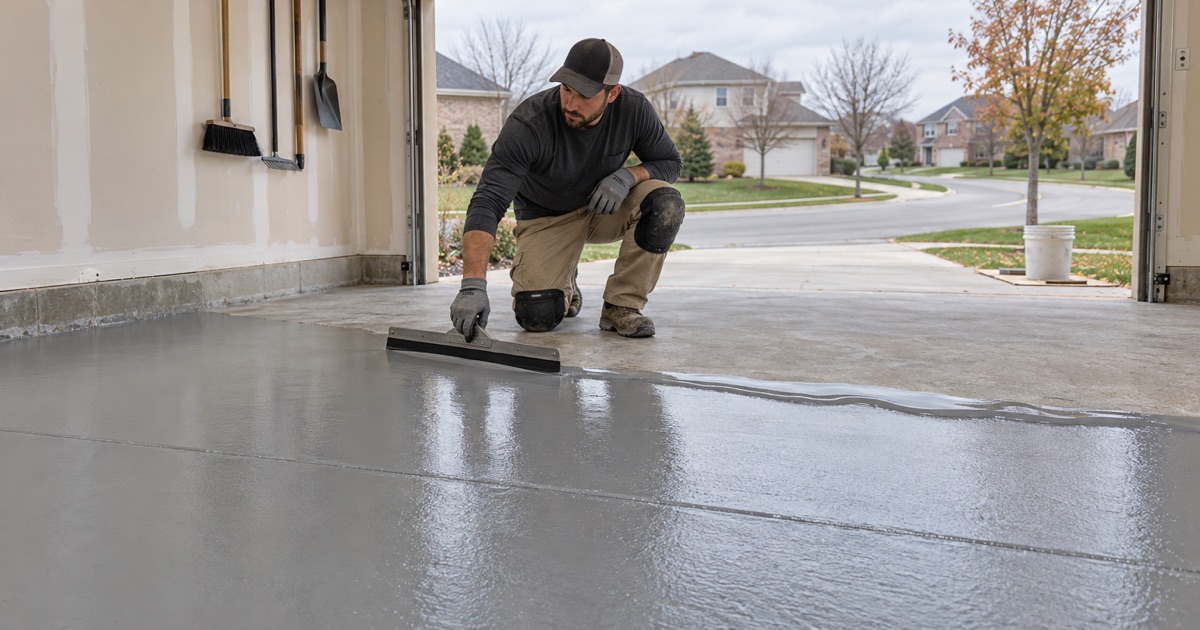
In a Cook County Assessor sample covering much of the village, 92.9 percent of the houses with a garage have an attached one, and attached garages of three cars or more number in the thousands. An attached garage means the grinding happens a door away from the kitchen or mudroom, so we run every machine with a vacuum at the grinder head.
We seal the house door, ventilate to the outside and keep the dust captured rather than swept or washed toward the floor drain. Coating odor is planned for too, with the garage door cracked and fans pushing air out while the base coat goes down and cures.
A Thick, Sloped, Reinforced Slab
Orland Park’s amended garage rule calls for a 5-inch reinforced concrete floor sloped toward the overhead door. That is good news for a coating, because a thick slab with mesh or fiber is less likely to crack apart, but the slope changes how we work the material.
Self-leveling products want to run downhill on a pitched floor, so we choose base coats with the right body for a slope and work them in sections. The slope also carries meltwater and brine to the door, which is where we pay the most attention to edge finishing and topcoat thickness.
Townhouse Garages and Association Rules
Townhouses are a real share of the village’s housing, and many townhouse garages sit inside an association’s rules as well as the owner’s choice. Some associations restrict exterior work hours, contractor parking or what can be visible from the drive.
We ask about those rules before scheduling, so the job fits the association rather than drawing a letter halfway through. For shared driveways we plan staging and cure time so neighbors can still get in and out.
Building an Epoxy Garage Floor That Stays Bonded
Diamond Grinding to a Real Profile
A new garage slab is usually troweled smooth and often sealed, and an older one may carry paint, a store-bought coating or oil stains. None of that holds a coating, so we diamond grind the whole floor to a concrete surface profile the primer can soak into.
Acid etching is the method most kits use, and it leaves a shallow, inconsistent surface with residue in the pores. Grinding takes longer and costs more, and it is the single biggest reason a professional garage floor outlasts a weekend kit.
Crack, Joint and Spall Repair
Before coating we map every crack, spall and pitted area and decide how each will be treated. Stable cracks are filled with a rigid repair material and ground flush, spalled edges are rebuilt, and pitted surfaces near the door are patched so the coating has a sound base.
Control joints get their own decision. Some owners want them filled and coated over for a seamless look, while others prefer them honored so slab movement does not crack the finish, and we explain the tradeoff before choosing.
Base Coat, Flake Broadcast and Topcoat
Most of our garage systems start with a 100% solids epoxy base that soaks into the ground concrete and builds real thickness. Vinyl flake is broadcast into the wet base, then the excess is scraped and vacuumed off once it cures.
A polyaspartic or polyurea topcoat locks the flake in and takes the wear. It resists ultraviolet light, abrasion and chemicals better than an epoxy topcoat would, which matters at the door line where sun and brine both hit the floor.
Winter Brine, Hot Tires and Cure Timing
Rock Salt and Calcium Chloride
Every winter, cars carry rock salt and calcium chloride brine into the garage, and it pools along the low side of the slab near the door. On bare concrete that brine soaks in, and repeated freezing and thawing breaks the surface into scale and pits.
A dense, well-bonded coating keeps the brine on top, where you can squeegee it out. We specify topcoat thickness and chemical resistance with that winter load in mind, rather than choosing a system designed for a dry interior floor.
Hot Tire Pickup
Tires come off the road hot and soft, and they can grab a thin or poorly bonded coating and pull it up when the car leaves. That is hot tire pickup, and it is the most common way a cheap garage coating fails.
The fix is not a single product but the whole build: a ground profile, a base that penetrates the concrete, enough total thickness and a topcoat rated for the job. We check each of those against the proposal before the floor is handed back.
Cold Slabs, Dew Point and Cure
Chicago Midway Airport averages 106.3 nights a year at or below 32 degrees in the 1991-2020 normals, and an unheated garage tracks the outdoors closely. Epoxy on a cold slab cures slowly, and moisture condensing on concrete near the dew point can leave amine blush or a cloudy finish.
We measure slab temperature and the dew point spread at the surface before mixing. When the numbers are wrong and cannot be fixed with heat, the floor waits for warmer weather, and we tell you that up front rather than after a failed cure.
Choosing Finish, Color and Texture
Flake Blend and Chip Size
Flake blends range from quiet grays and tans to high-contrast mixes, and chip size changes how busy the floor looks. Larger chips read bold from across the garage, while smaller chips read finer and hide dust more evenly.
We bring physical samples and lay them on your actual slab, because a chip blend looks different under one ceiling fixture than it does in a brochure. Full broadcast to refusal gives the most even color and the most texture.
Texture for Wet Winter Floors
A smooth topcoat over a flake floor can turn slick when snowmelt and brine cover it. We control that with the broadcast itself and with a grit additive in the topcoat, and we set the texture before the job rather than promising slip resistance in general terms.
The tradeoff is cleaning: more texture grips better and takes a little more scrubbing. We help you pick the point on that scale that suits how the garage is used.
Sheen and Sunlight at the Door
The strip of floor just inside the overhead door gets the most sunlight, and epoxy alone will amber there over time. A UV-stable topcoat keeps the color even from the door line to the back wall.
Gloss levels also matter. High gloss looks crisp on day one and shows every tire mark, while a satin finish hides wear longer, and we show both before you decide.
- 20+ Years on Concrete
- Moisture Tested Before Pricing
- Written Specs on Every Quote