Orland Park Epoxy Flooring handles epoxy flooring in Forest Park for owners who want the coating decision made on evidence, backed by more than 20 years of opening slabs and reading what they hide. Before we quote a commercial floor, we want to know what the concrete is sitting on, because that answer changes the moisture test, the joint plan and the coating itself.
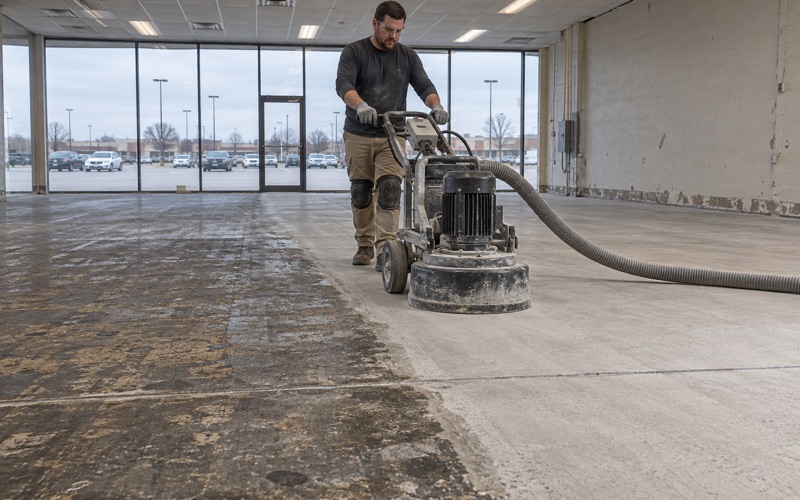
Every slab we coat is opened with a diamond grinder or a shot blaster rather than an acid etch, so the primer has a measurable ICRI surface profile to grip. The moisture test goes into the written scope before the price is final, and the proposal names the product line, the coat count and the finished thickness so you can hold the floor up against the paper.
That habit matters most in a retail or grocery build-out, where a floor that looked ordinary on the drawings can turn out to be something else once the old finish comes up. The sections below walk through one recent example in the village and what it teaches about planning any commercial floor coating here.
A Grocery Store in a Former Bed Bath & Beyond
From soft goods to cold cases
Bed Bath & Beyond occupied the building at 215 Harlem Avenue from 2004 and closed there in March 2023, leaving the space empty. According to the Forest Park Review, Aldi then set out to turn it into a grocery store, with a scope that took in roof and ceiling repairs, minor electrical upgrades, a new delivery space, a redesigned facade and the installation of refrigerators, freezers and cashier stations.
A soft-goods store and a grocery ask very different things of a floor. Shelves of towels and cookware put light, spread-out loads on the concrete, while refrigerated cases add heavy point loads, condensate, cold surfaces and a cleaning routine that runs every night. The floor that served the first tenant was never asked those questions.
The basement nobody had on the plans
In July 2024 the Review reported that the opening was delayed because, in the words of Steve Glinke, director of the village’s department of public health and safety, “contractors found a basement under the building that was not on their plans.” A new engineering design followed, prepared by Aldi and property owner Aries Capital and reviewed by the village’s engineering firm, and it was expected to take up to two months.
The store did open, with a ribbon cutting on November 7, 2024 and more than 100 people in line. We had no part in that project and have no knowledge of how the floor over that basement was built or finished. What interests us is the question the delay raises for anyone planning a coating on a commercial floor in this village.
Why a coating crew should care
A coating is a thin film that depends completely on the concrete beneath it. It is not waterproofing and it does not fix structure, so the floor has to be understood before anyone grinds it. When the drawings are silent about what is underneath, the safe assumption is that nobody knows yet, and the first job is to find out.
On a commercial job we ask for the original drawings, any later permits and a look at the floor from below if there is a below. That walk is usually short, and it decides how the rest of the scope gets written.
Looking for epoxy-flooring closer to Palos Heights? See Epoxy-Flooring in Palos Heights.
Slab on Grade or a Deck Over a Void
What a slab on grade does
A slab on grade is poured directly on compacted fill and soil. It loses moisture through its top face only, because the bottom sits against the ground, and moisture can keep moving up into it from below for as long as the building stands. That one-way drying is why a slab on grade can look dry on top and still carry a damp core.
Most garage floors and many retail floors are built this way, so our moisture testing starts from that assumption until something says otherwise. Under a slab on grade, a vapor retarder meeting ASTM E1745 makes a large difference to how a coating performs, so we ask whether one was placed and look for evidence when nobody can say.
What changes when there is a room underneath
A floor over a basement is a structural deck, a slab spanning supports with open air below it. It dries from two sides, top and bottom, so its moisture profile is different, and it flexes and moves under load in ways a slab resting on soil does not. The cracks it develops tend to follow its supports and spans rather than shrinkage alone.
None of that makes a deck a bad floor to coat. It means the crack plan, the joint treatment and the coating choice are made for a suspended floor, and the person who designed the deck has the final word on any loads, saw cuts or anchors. We coat floors; we are not engineers and we do not offer structural opinions.
Finding out before the grinder starts
When the answer is unclear, we look for an access hatch, a stair, a mechanical room or utility penetrations that run down into open space rather than into the ground. We ask the owner to confirm with the building’s engineer or the village’s records before we commit to a test method. Guessing at this step means every later number in the scope rests on the guess.
Two-Sided Drying and Where the Moisture Probe Goes
ASTM F2170 probe depth
Our preferred commercial moisture test is ASTM F2170, which reads relative humidity inside the concrete with in-situ probes set in drilled holes. The standard sets the depth by how the slab dries: 40 percent of slab thickness for a slab drying from one side only, such as a slab on grade, and 20 percent for a slab drying from two sides, such as an elevated slab with open air below.
Put the probe at the wrong depth and the reading describes the wrong layer of concrete. A deck tested as if it sat on grade gets probed too deep, and a slab on grade tested as if it were a deck gets probed too shallow, which can make a wet slab read as ready. The depth is a decision, not a default.
How many holes, and what else we run
F2170 also calls for at least three test holes in the first 1,000 square feet and one more for each additional 1,000 square feet, so a large retail floor needs a real test plan with a site map. We note every location in the proposal so each reading can be tied back to the floor. Where it helps, we add ASTM F1869 calcium chloride testing at the surface or a quick ASTM D4263 plastic sheet check.
Those readings are compared against the coating maker’s published limits and the ASTM F710 thresholds for the floor system under consideration. When a slab reads too high, a moisture-mitigation primer under a 100% solids epoxy is one option, and waiting is another. Either way, moisture is the first exclusion we name in the warranty discussion, before the job is sold.
Why the numbers belong in writing
A test that happens after the price is set tends to get skipped when the schedule tightens. That is why the moisture test is a line in our written scope, priced and dated, and why the results come back to the owner rather than staying in our truck.
A reading that fails is not bad news for the owner. It is the reason the floor does not blister or peel six months after opening, and it gives everyone time to choose between a mitigation primer and a later start date.
Refrigerated Cases, Joints and Cracks on a Suspended Floor
Mapping cracks and joints first
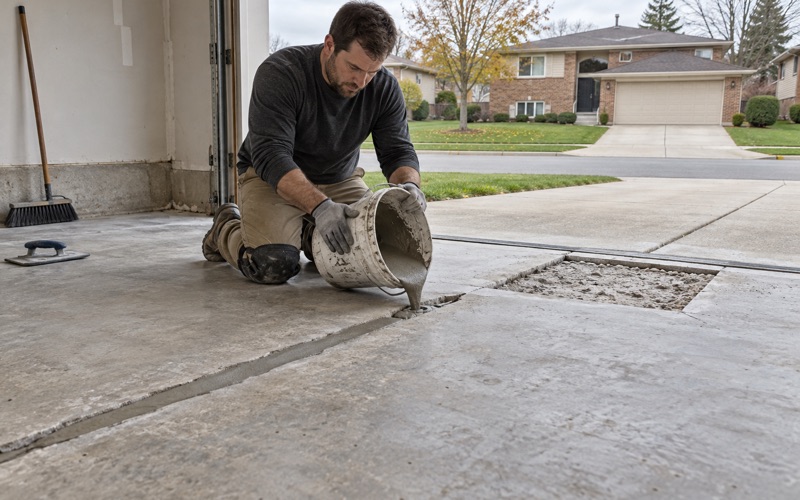
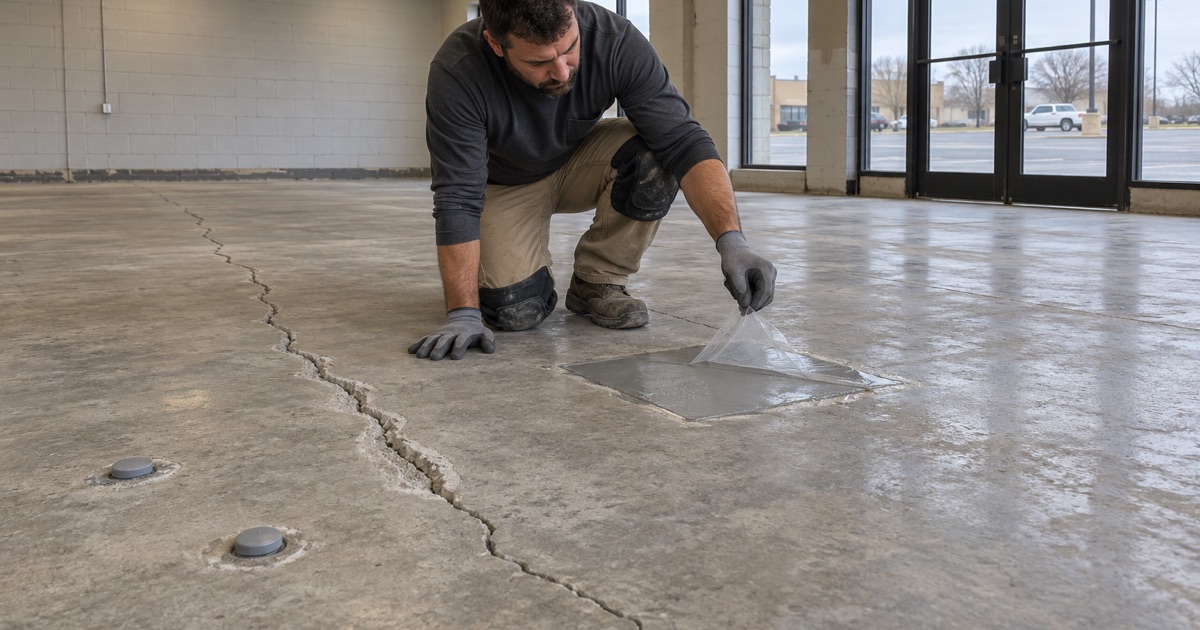
Before we price a coating, we map cracks, spalls, old coatings and every joint, and we say plainly when a section needs repair or replacement before it should be coated. On a deck over a basement, moving cracks and control joints are treated as joints that will keep moving, so they get a flexible fill rather than rigid epoxy bridged across them.
Static hairline cracks can usually be filled and ground flush. A crack that opens and closes with load will mirror through any rigid coating, so we leave it as a working joint and tell you where it will show. That conversation costs far less before the coating goes down than after.
Cold cases, condensate and nightly cleaning
Refrigerated cases and freezers bring condensate drips, cold spots and constant cart and pallet jack traffic along their fronts. Around them we look at urethane cement or a 100% solids epoxy with a quartz aggregate broadcast, chosen for thermal tolerance and wear before color. Slip resistance comes from the broadcast and the topcoat we specify, not from a promise on a brochure.
Forklift and pallet jack wheel loads concentrate on small contact patches, so coating thickness and the repair of joint edges matter as much as the resin itself. The proposal states the finished thickness so the store can check what it paid for, and a polyaspartic topcoat can be added where a faster return to service matters.
Working around a store that has to open
A store floor rarely gets to close for a week. We phase the work aisle by aisle with overnight and weekend windows, capture grinding dust at the machine with a vacuum instead of washing it toward a floor drain, and pick products inside the Illinois VOC limits for floor and industrial coatings. Cure times follow slab temperature and the dew point spread at the surface, not a clock printed on the can.
If you are planning a build-out in Forest Park, bring us the drawings and tell us what you know about what lies under the floor. We will tell you what we still need to find out before a coating is a sensible next step, and we will put that answer in writing.
- 20+ Years on Concrete
- Moisture Tested Before Pricing
- Written Specs on Every Quote