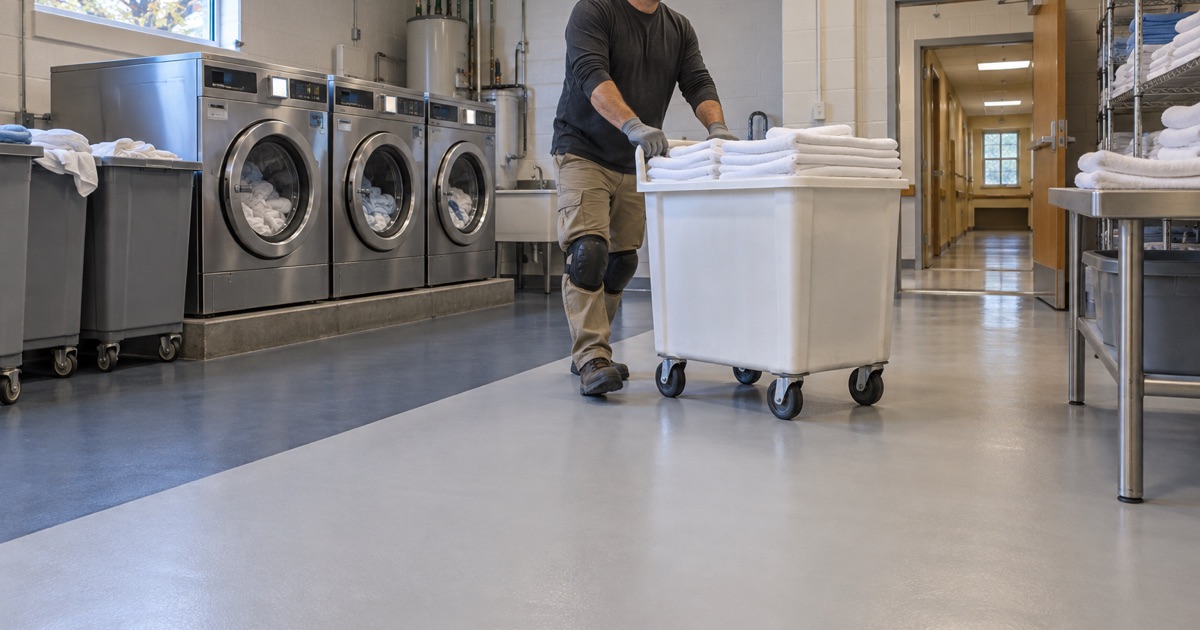
Orland Park Epoxy Flooring installs epoxy flooring in Evergreen Park with more than 20 years in the trade behind every slab we open. Much of that work happens in rooms nobody shows off, and the laundry is the clearest example. It runs wet, it carries carts and baskets all day, and in a care setting it has to keep dirty linen and clean linen apart in a way a tired worker can read at a glance.
A coated floor can do part of that job. A color line cast into the system, or a switch from one finish to another, puts the boundary on the slab itself rather than on a sign taped to a wall. The same idea scales down to a basement laundry at home, where a defined drop zone for dirty clothes and a floor that shrugs off a leaking washer are worth having.
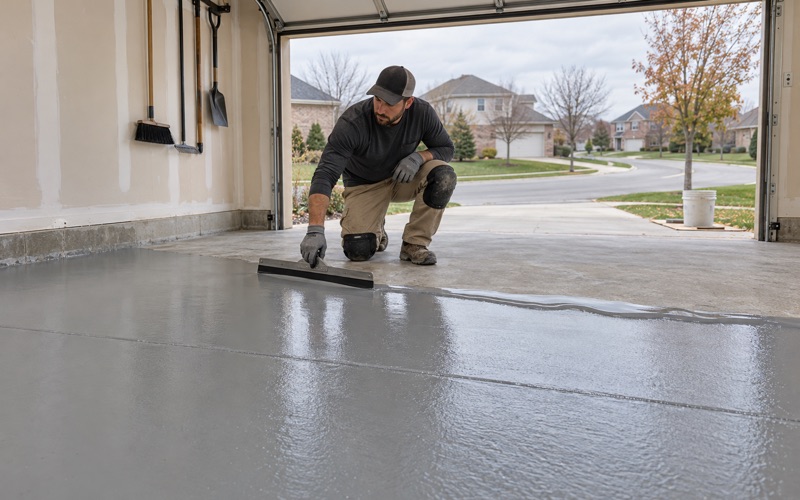
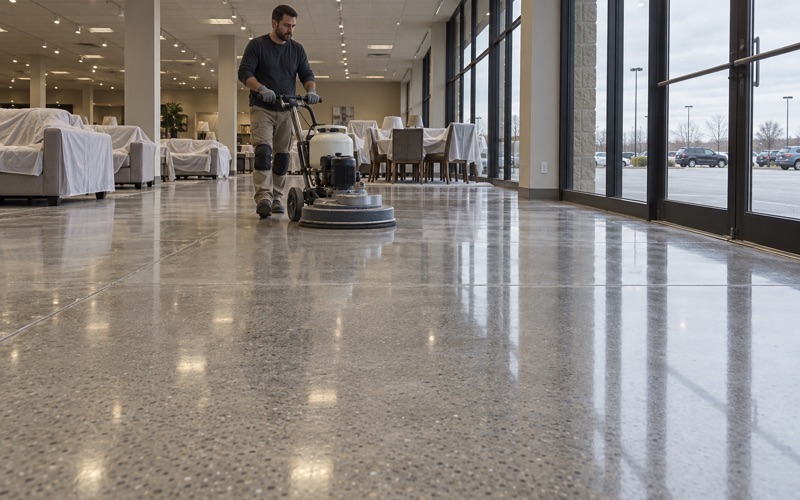
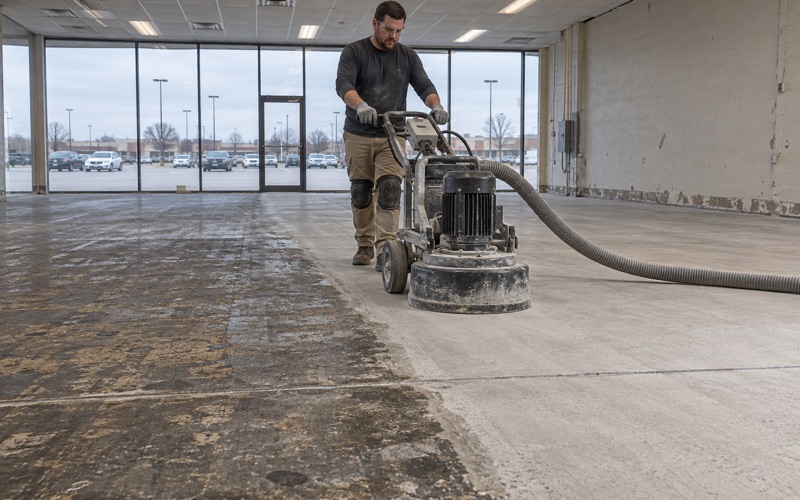
Every job starts the same way. We open the concrete with a diamond grinder or a shot blaster, test it for moisture before we put a final number on the work, and write the product line, coat count and finished thickness into the proposal so the floor can be checked against the quote.
A 242-Bed Nursing Home and the Laundry Rule It Answers To
Avantara Evergreen Park sits at 10124 South Kedzie Avenue, and federal nursing home listings show it with 242 certified beds. The address geocodes inside the village, in Worth Township, Cook County. We name it here as a local landmark, not as a customer, and we have not seen its laundry, its room layout or its floors, so nothing below describes that building.
What a home of that size does make concrete is the state rule every Illinois long-term care laundry is written against. A facility with hundreds of residents generates a steady stream of soiled bedding, towels and clothing, and the way that linen moves through a building is something the state has put into words.
What Section 300.3090 asks for
The Illinois Administrative Code, Title 77, Section 300.3090, covers laundry in existing long-term care facilities. Unless a commercial laundry service is used, a facility must provide a laundry room equipped for all of its laundering. It must also provide satisfactory and separate areas for soiled holding and sorting and for clean linen storage.
The rule then allows a practical compromise. Those two areas may share one room if the separation is well defined and adequate. That phrase is where a floor contractor becomes useful, because a room that holds both dirty and clean linen needs some visible way to show where one area ends and the other begins.
Laundry kept away from residents and food
The same section keeps the laundry out of any room used by residents and out of any room used for food storage, preparation or serving. It also asks that the laundry be placed so soiled linens are not carried through a food handling area on their way to the washers.
Those are layout decisions an architect and an operator make, not choices a coating can settle. Still, they explain why the laundry is usually tucked into a service wing or lower level, and why its floor sees a narrow, repeated traffic pattern of carts moving one way when dirty and another way when clean.
Looking for epoxy-flooring closer to Riverdale? See Epoxy-Flooring in Riverdale.
Well Defined: Letting the Floor Mark Where Soiled Linen Stops
The state rule names no floor material and no color system, and a coating does not make any facility meet it. What a coating can offer is a clear, durable mark on the slab that supports whatever separation the operator has already planned. The floor is the one surface every cart, basket and pair of shoes crosses, which makes it a natural place to show a boundary.
We treat that boundary as part of the scope from the first walkthrough. The operator decides where soiled holding and sorting ends and clean storage begins, and we work out how to show that line in a coating that will survive wet mopping, cart wheels and years of the same traffic.
Color lines cast into the system
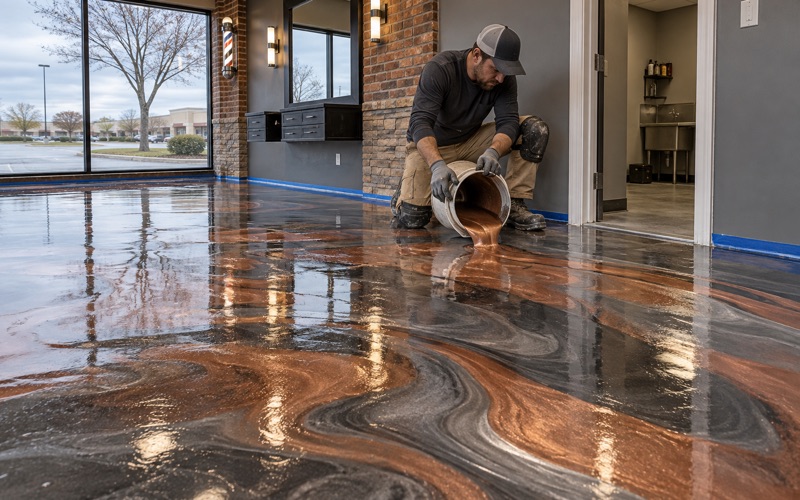
The plainest method is a color change inside the coating itself. We pour one body color on the soiled side and a contrasting one on the clean side, or run a wide band in a third color along the dividing line. Because the color is part of the 100% solids epoxy layer rather than paint on top, it does not wear off where carts turn.
The edge of that band is masked and cut before the second color goes down, so the line stays straight and sharp. On a busy floor a crisp edge matters, since a soft or wandering line reads as decoration rather than a rule people are meant to follow.
A change of finish as a second boundary
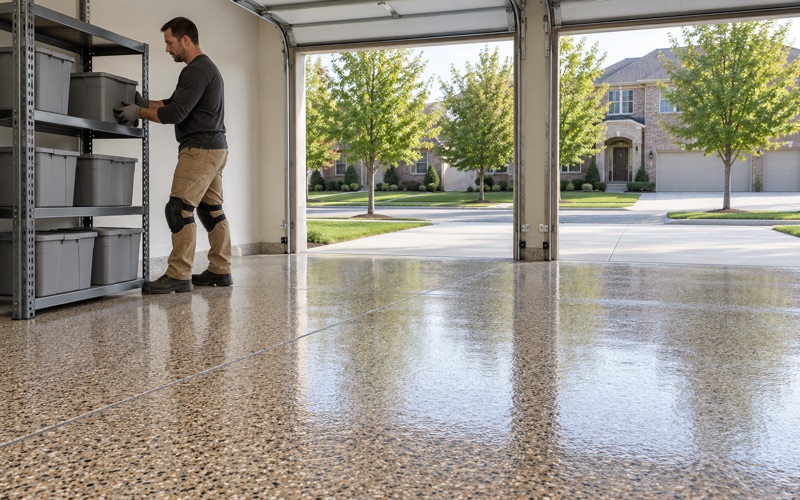
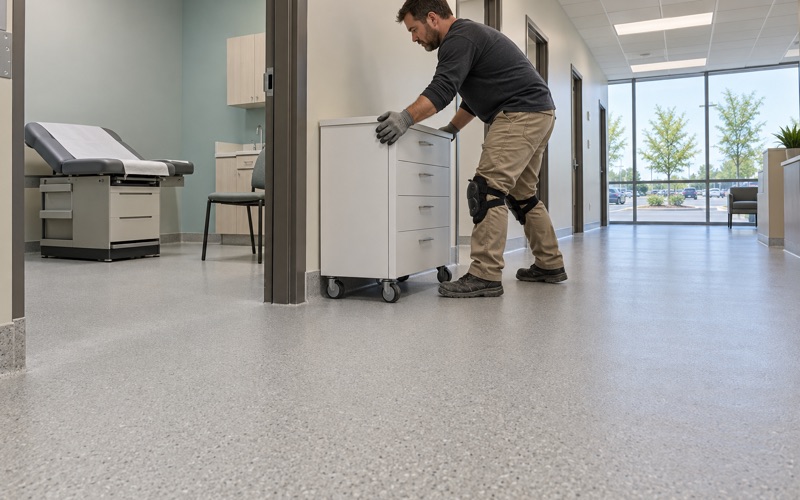
A change of texture can reinforce the color. A quartz aggregate broadcast on one side and a smoother vinyl flake or plain topcoat on the other gives the boundary a feel underfoot as well as a look. Staff pushing a loaded cart notice the change even when they are not looking down.
We set the texture by the broadcast and the topcoat chosen, and we write both into the proposal rather than promising a vague slip-resistant floor. The same choice decides how easily the surface mops clean, so we weigh grip against cleanup with the operator before anything is mixed.
Water Around the Washers and a Floor That Takes It
A laundry floor gets wet. Washers drip, hoses fail, wet loads get dropped and the room is mopped often. Section 300.3100 of the same code says floors in bathrooms, kitchens and utility rooms shall be completely covered with water resistant material, and a seamless coating that runs wall to wall is one way to give a utility floor that kind of continuous surface.
Coverage means the whole floor, including the awkward strips behind and between machines. We plan for washers and dryers to be moved so the slab underneath is ground and coated along with the open floor, and we carry the system up to the base of the walls where the room design calls for it.
Preparing a slab that will stay wet
A coating over standing water is only as good as its bond, and the bond depends on the concrete surface. We grind or shot blast to a real concrete surface profile on the ICRI CSP scale, never an acid etch, and we capture the dust at the machine with a vacuum rather than washing it toward a floor drain.
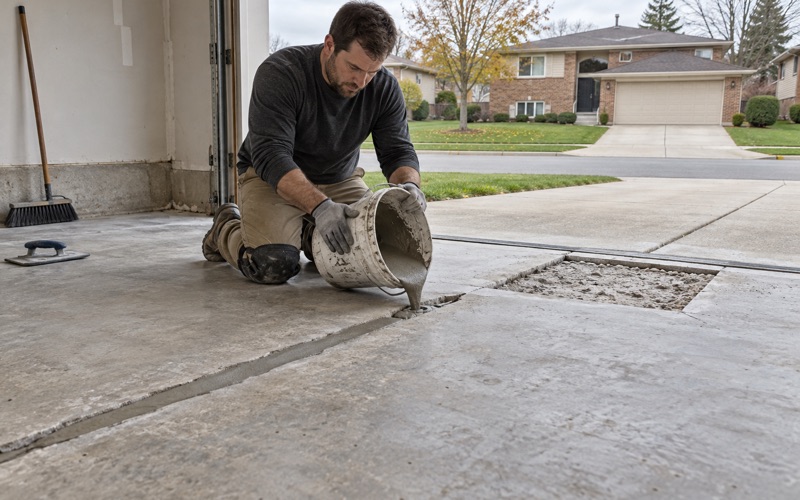
Before coating we map cracks, spalls and old coatings across the room. Drains get special attention, since the slab around them takes the most water. If a section is too damaged to coat well, we say so and recommend repair or replacement first rather than sealing over a problem.
Moisture testing before the price is final
Water from above is only half the story, because moisture can also rise through a slab from below. We test with ASTM F1869 calcium chloride kits or ASTM F2170 relative humidity probes, and the result goes into the written scope before the price is set.
A wet reading changes the system, often adding a moisture-mitigation primer under the epoxy. We also explain before the job is sold what a coating warranty leaves out, and moisture coming through the slab is the first exclusion we name, so nobody learns about it after a failure.
Curing around a working laundry
A care-home laundry rarely closes for long. We phase the work around operating hours, often in overnight or weekend windows, and coat one zone while machines keep running in another when the room layout allows it.
Cure times follow slab temperature and the dew point spread at the surface, not the calendar. A cool, damp lower-level room cures slower than the label suggests, and we hold the room closed until the coating is ready for carts rather than letting traffic back on early.
The Laundry Room at Home: A Drop Zone and a Floor That Takes Water
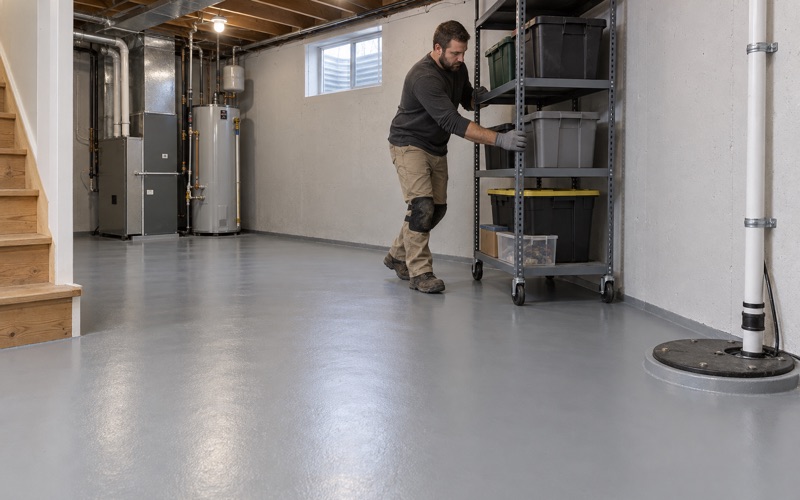
The same thinking works on a smaller scale in a house. Evergreen Park is mostly detached homes, and many have a laundry in the basement or a utility corner off the garage. A coated floor there can mark a drop zone for dirty clothes, keep folding space visually separate, and stand up to a washer that overflows.
At home the line is about habit rather than regulation. A colored square where hampers sit, or a band in front of the machines, tells the household where dirty laundry goes. It sounds small, but in a tight basement it keeps clean, folded stacks from landing on the same stretch of floor as the wet towels.
Choosing a system for a home utility floor
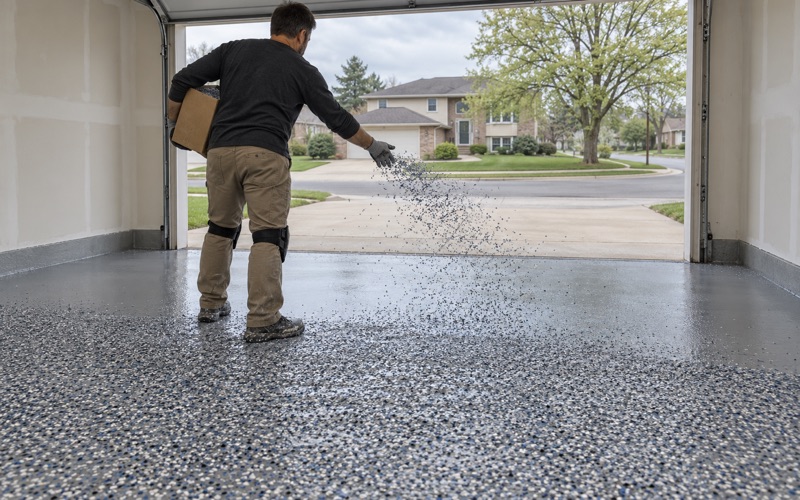
For a home laundry we usually recommend a 100% solids epoxy base with a vinyl flake broadcast and a polyaspartic topcoat. The flake hides lint and detergent drips, and the topcoat resists the bleach and cleaners that end up on the floor. Where a slab is especially damp, urethane cement can be the better choice, and we explain why.
The moisture test is part of a home quote just as it is for a facility. Basement slabs often carry earlier paint, patches or sealers, so we grind those off and check the bare concrete before we commit to a system or a final price.
Permits, contracts and village rules
The Evergreen Park Building Department at 9418 South Kedzie Avenue requires a contractor to be licensed by the village, with a number assigned, before any permit issues. It also requires a permit for any alteration, repair or remodel, so we confirm the village license, insurance and permit questions before booking the work.
Illinois licenses no flooring or coatings contractor, which makes the village license the credential that counts. Home jobs over the state threshold under the Illinois Home Repair and Remodeling Act get a written contract and the Home Repair: Know Your Consumer Rights pamphlet before any grinding starts.
- 20+ Years on Concrete
- Moisture Tested Before Pricing
- Written Specs on Every Quote