
Orland Park Epoxy Flooring installs ESD flooring in Orland Park, IL, serving surrounding cities including Palos Heights, Mokena, Worth, Palos Hills and Crestwood. In 20+ years of floor work, we have learned that a static-control floor is judged by a meter, not by its looks, so every ESD floor we install is grounded and resistance tested after it cures.
Electrostatic discharge can damage sensitive electronics long before anyone feels a spark. A person walking across an ordinary floor can build up a charge high enough to harm circuit boards, components and equipment. ESD flooring gives that charge a controlled path to ground through the floor itself, working together with grounded footwear, wrist straps and the rest of a facility’s static-control program.
Every proposal names the ESD system, the resistance class it is designed to meet, the grounding layout and the testing we will perform. We prepare the slab by grinding, not acid etching, and we test for moisture before pricing, because an ESD system fails the same way any coating does when the slab underneath is not ready.
How ESD Flooring Works
Conductive Versus Static-Dissipative Floors
Static-control floors are classed by how easily they carry charge. Under the ESD Association’s floor test method, conductive flooring measures at or below 1.0 x 10^6 ohms, while dissipative flooring measures above 1.0 x 10^6 and below 1.0 x 10^9 ohms. Conductive floors drain charge faster, and dissipative floors drain it in a more controlled way, which some equipment and safety programs prefer.
ANSI/ESD S20.20 and the Floor
Many electronics facilities follow ANSI/ESD S20.20, which sets requirements for static control programs. For floors in electronics handling areas, it calls for resistance below 1.0 x 10^9 ohms. When the floor is used as a primary grounding path for people, the standard also looks at how much voltage a person in approved, grounded footwear generates while walking, which must stay under 100 volts.
The Floor and Footwear Work Together
An ESD floor alone does not ground a person wearing insulating shoes. Static drains from the body through ESD footwear or heel straps, into the floor, and from the floor to ground. That is why we ask about the facility’s footwear program before choosing a system, and why testing is often done as a floor-footwear combination rather than on the floor alone.
Building an ESD Floor System
Slab Preparation and Moisture Testing
An ESD system starts like any other coating: the slab is diamond ground or shot blasted to a real surface profile, cracks and spalls are repaired, and old coatings or adhesives are removed. We test the slab for moisture with calcium chloride kits or in-situ relative humidity probes, because vapor rising through the concrete can cause blistering and can also affect electrical readings.
Conductive Primer and Grounding Points
Most ESD epoxy systems use a conductive primer layer across the floor, connected to building ground through copper grounding strips or ground points placed at planned intervals. The layout depends on the room’s size and shape. The grounding connections are made by a qualified electrician or the facility’s own electrical team, and we coordinate with them so the floor ties into a verified ground.
ESD Topcoat and Finish
The topcoat is a static-dissipative or conductive epoxy or urethane formulated to carry charge from its surface down to the conductive layer. These coatings come in a limited color range, often with visible conductive fibers or flecks, and they are usually smooth for easy cleaning. Texture can be added where a room needs better grip, as long as the additive does not interfere with the floor’s resistance.
Testing and Keeping the Floor in Range
Resistance Testing After Cure
Once the system has cured, we test resistance to ground and point-to-point resistance across the floor with a calibrated meter and standard electrodes. Readings are taken at spread-out locations and near grounding points, then recorded. A floor that reads out of range is investigated before handover rather than passed on the assumption that the product will settle in.
Walking Body Voltage Tests
Facilities that rely on the floor as a primary personnel ground may also require a walking test, where a person in approved footwear walks a set pattern while body voltage is measured. That test checks the floor and footwear together, which is how they will actually be used. We schedule it with the facility’s ESD coordinator so the right footwear is on hand.
Cleaning and Long-Term Performance
ESD floors can drift out of range when the wrong products are used on them. Floor waxes, polishes and some cleaners leave an insulating film that blocks the path to ground. We provide cleaning guidance with every ESD floor and recommend periodic resistance checks so the floor’s performance is documented as part of the facility’s static-control records.
Where ESD Floors Are Used
Electronics Assembly, Repair and Testing
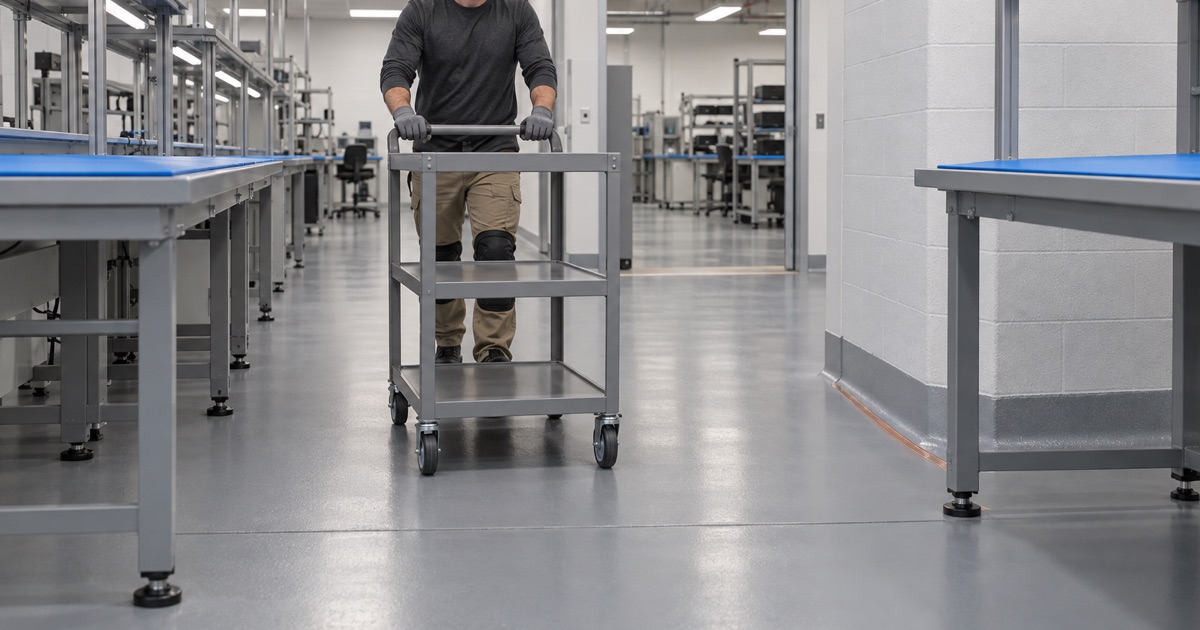
Assembly lines, repair benches and test areas that handle circuit boards and components are the classic ESD floor. Workers move between stations, carts roll across the floor, and every one of those movements can build charge. A grounded floor lets that charge drain away continuously instead of discharging into the product.
Server Rooms, Data Closets and Labs
Server rooms, telecom closets, labs and medical equipment rooms often need static control without the full production setup of an assembly plant. A dissipative epoxy floor gives those spaces a seamless, cleanable surface that controls static, and it can be installed after hours so the systems in the room keep running.
- 20+ Years on Concrete
- Moisture Tested Before Pricing
- Written Specs on Every Quote