Orland Park Epoxy Flooring installs epoxy flooring in Country Club Hills, drawing on more than 20 years of grinding, priming and coating residential and commercial concrete. Most of the floors we see here are garage slabs under single-family houses, along with the porches, patios and enclosed rooms that sit just outside them. Each one starts with the same question: where does the sunlight actually land?
That question matters because the most common floor resin, an aromatic epoxy, does not tolerate ultraviolet light well. Indoors it can last for years and look unchanged. Put it on concrete that catches afternoon sun and it can turn amber and chalky surprisingly fast, which is why we pick the topcoat by exposure rather than by habit.
Every quote we write names the product line, the coat count and the finished thickness, so you can hold the floor up against the paper when the work is done. We open each slab mechanically with a diamond grinder or a shot blaster instead of an acid etch, and we run a moisture test before the price is final.
Summer Sun on 183rd Street and What It Does to Epoxy
An outdoor amphitheater that plays June through September
Country Club Hills is a city in Cook County, south of Chicago, and one of its summer fixtures sits beside City Hall. The Country Club Hills Amphitheater at 4150 West 183rd Street is listed by the Illinois Office of Tourism as an intimate, 2,100-seat outdoor venue, with office hours from June through September. Recent shows there have been billed rain or shine.
The venue has a history of its own. It hosted no performances after the 2013 season and reopened in 2016 following a major renovation, and the city now carries it as its own enterprise fund in its annual financial report. We mention it for one reason: it is a reminder of how much of local summer life happens outdoors, on concrete that sits in full sun for months.
What ultraviolet light does to an aromatic epoxy
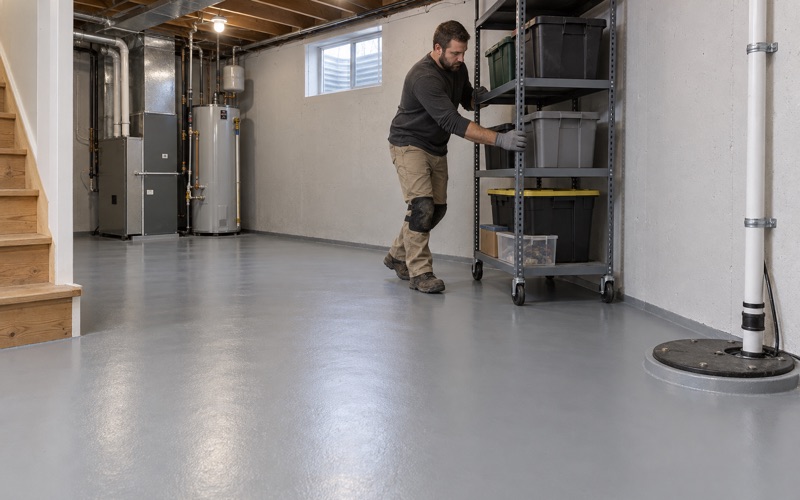
Most garage and basement epoxies are aromatic, built on bisphenol-A resin. The aromatic rings in that chemistry absorb ultraviolet light, and the polymer oxidizes as they do. The visible result is yellowing, then a dull, powdery surface known as chalking, and the color shift does not reverse on its own.
Fixing it means sanding the surface and recoating, which is real labor on a floor that may otherwise be sound. That is why we treat a sunlit slab as a different job from a closed garage or a basement. The base coat can still be epoxy, but whatever sits on top of it has to be chosen for the light it will see.
Why we ask where the sun lands first
Before we talk color or flake, we walk the site and note which surfaces get direct sun and for how long. A covered porch facing north may see little more than reflected light, while an open patio or a glassed three-season room can take hours of it every afternoon. Those two floors should not get the same topcoat, even on the same house.
Looking for epoxy-flooring closer to Lemont? See Lemont Epoxy-Flooring.
UV-Stable Topcoats for Porches, Patios and Three-Season Rooms
Polyaspartic and aliphatic polyurethane topcoats
For exposed concrete we specify a UV-stable topcoat, usually a polyaspartic or an aliphatic polyurethane, over the epoxy or polyurea base. These chemistries are made without the aromatic structure that drives yellowing, and manufacturers market them as non-yellowing. They also hold gloss and color better than an ordinary epoxy when they sit in sunlight.
We are careful about how far that promise goes. Vendors disagree on how much ultraviolet light still reaches an epoxy base under a clear topcoat, so no system we install comes with a claim that it will stay perfectly colorless forever. What a UV-stable topcoat does is slow the change considerably, and on a pigmented system the color underneath is far less likely to show it.
Porches and patios
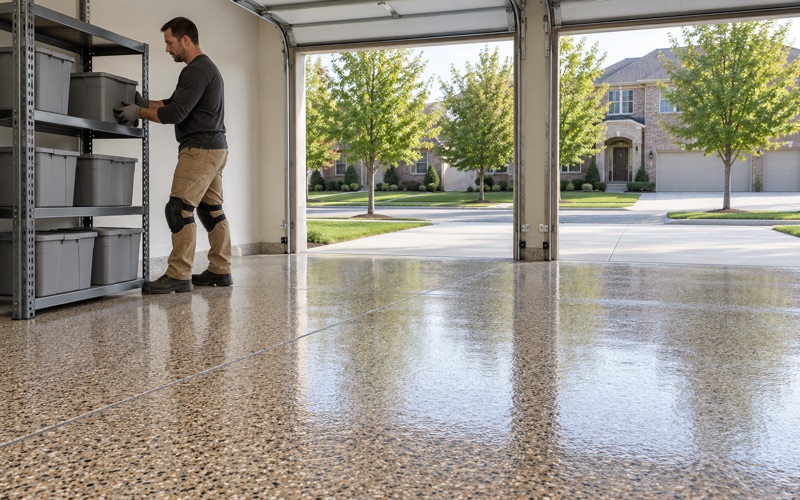
An open porch or patio slab is the harshest case. It sees direct sun, foot traffic in shoes that carry grit, and furniture dragged across it all summer. On those floors we lean toward a pigmented base, a broadcast of vinyl flake or quartz aggregate, and a UV-stable clear coat that locks the broadcast in and takes the light.
Texture is part of the specification too. A smooth, glossy coating on an outdoor step gets slippery when it is wet, so we specify slip resistance by the broadcast size and the topcoat used rather than calling a floor safe. If you want a finer feel underfoot, we can show you the tradeoff on a sample board before anything goes down.
Three-season rooms
A three-season room is often the surprise. It feels like an indoor space, but the windows let in a lot of sunlight, and the floor near the glass can fade or yellow faster than the rest. We treat those rooms as semi-outdoor, and we test the slab for moisture first, because a room enclosed over an old patio slab may have no vapor retarder under it.
For moisture we use the methods the industry relies on, such as an ASTM F2170 in-situ relative humidity probe or an ASTM F1869 calcium chloride test, and the result goes into the written scope. If the readings are high, we discuss a moisture-mitigation primer, and we tell you plainly that moisture is the first exclusion on any coating warranty.
The Sunny Strip Inside an Open Garage Door
Why the first few feet get the most light
Garages are the floor we coat most here, which fits the housing: about 74.1 percent of homes in Country Club Hills are detached houses, and most of the rest are attached single-family units. In many of those garages the door stays open on summer afternoons while someone works or the kids come and go. That leaves a band of concrete just inside the opening in direct sun.
On a south- or west-facing garage, that band can take hours of afternoon light while the back of the floor stays in shade. Over time an ordinary epoxy can show a visible line where the sun stops, amber at the front and unchanged at the back. Owners often notice it first as the floor looking dirty at the door when it is actually discolored.
Choosing a garage system with the sun band in mind
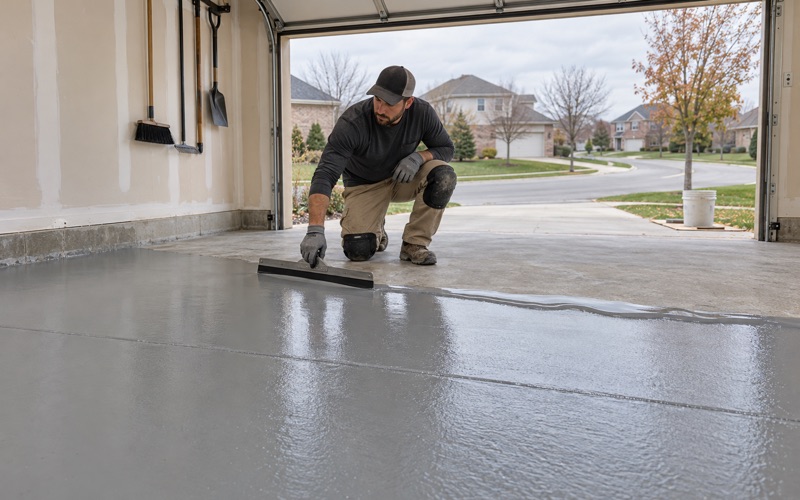
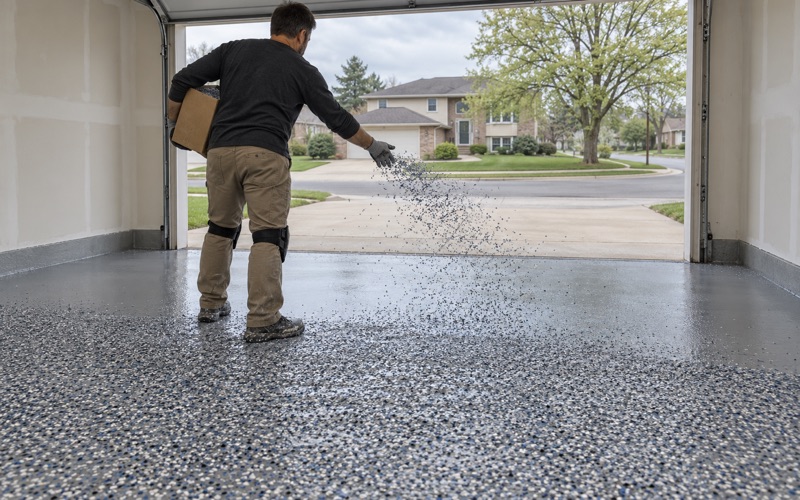
For a garage that opens toward the sun, we usually recommend a full flake system with a polyaspartic or other UV-stable topcoat across the whole floor rather than just at the door. Coating the entire slab in one topcoat keeps the color and sheen even, and it avoids a seam where two products meet. A north-facing garage that stays closed may not need the same upgrade.
The topcoat also does the hard work against tires. Hot tire pickup happens when a warm tire softens a weak coating and lifts it from the slab, and it shows up most where cars park after a drive. A properly bonded system with a tough topcoat resists it, and that bond starts with a surface ground to a suitable ICRI concrete surface profile.
Surface preparation still decides the outcome
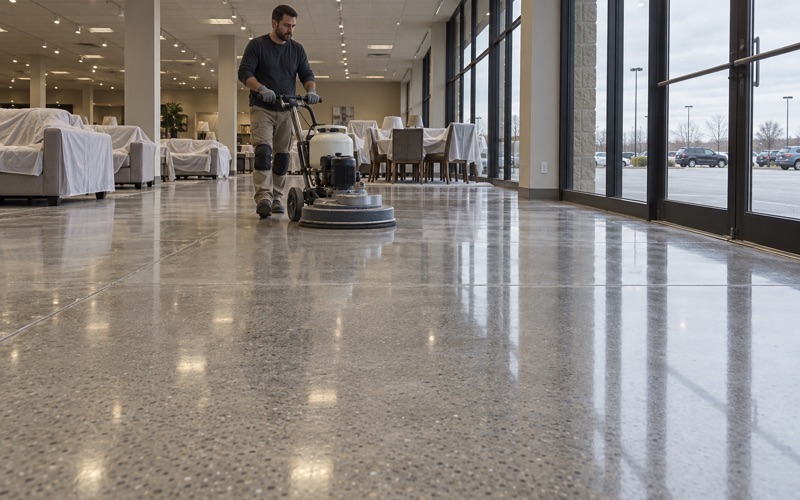
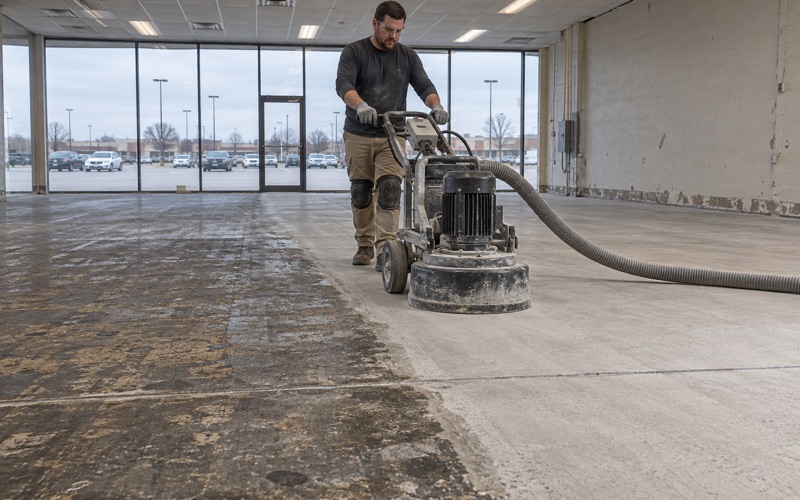
No topcoat saves a coating that was never bonded. We grind or shot blast every garage floor, map cracks, spalls and old coatings before we price the work, and tell you if a slab needs repair or replacement before it should be coated. Grinding dust is captured at the machine with a vacuum instead of being washed toward the driveway or a storm inlet.
Many garages here sit under houses from the 1970s, the city’s largest building decade at about 30.2 percent of homes. A slab that age may carry old sealers, oil stains or a past paint job, and each one changes the prep. We find those during the walkthrough so the price you sign reflects the floor you actually have.
City License, Bond and Permits at City Hall
A city with its own contractor rules
Country Club Hills is a city, not a village, incorporated in 1958, and it sets its own requirements for anyone working inside its limits. Illinois licenses no general, flooring or coatings contractor, so the city’s rules are the ones that apply. Every contractor needs a Country Club Hills Contractor’s License, which costs $150, plus a $10,000 surety bond and a certificate of insurance.
We check those requirements before a job is booked. The license is municipal registration, not a trade qualification, and we describe it that way. Permits are handled by the Community Development and Building Department under the Building Commissioner, on the lower level of City Hall at 4200 West 183rd Street, just west of the amphitheater.
Does a floor coating need a permit?
The city’s own handout says all new construction work, including additions, alterations and repairs, requires a building permit, while normal maintenance and repairs do not. A coating on an existing garage floor may fall on the maintenance side, but that is the Building Commissioner’s call, not ours. We ask before work starts rather than guess.
When a permit is needed, the application is picked up at City Hall and handled in person. The city states that emailed or faxed permits are not accepted, and reviews take about two weeks, with commercial reviews running longer. If your floor is part of a larger project, such as enclosing a patio into a three-season room, the permit for that work comes first.
Paperwork on a home job
For home jobs above the state threshold, we provide a written contract and the Home Repair: Know Your Consumer Rights pamphlet before any grinding begins, as the Illinois Home Repair and Remodeling Act requires. The products we choose sit inside the Illinois VOC limits for floor coatings. We never present a floor coating as flood protection or radon reduction, because it is neither.
If you have a porch, patio, three-season room or garage in Country Club Hills that sits in the sun, we can walk it, test it and write a scope that names the exact topcoat for each surface. You will know before we start which floors get which system, and why the sunny ones are built differently.
- 20+ Years on Concrete
- Moisture Tested Before Pricing
- Written Specs on Every Quote