Orland Park Epoxy Flooring installs commercial epoxy flooring in Orland Park, IL, serving surrounding cities including Palos Heights, Mokena, Worth, Palos Hills and Crestwood. For more than 20 years we have coated showroom, service drive, clinic and back-of-house floors, and the work that matters most on a commercial job happens before the first coat: planning the phases, testing the slab and writing a specification the owner can check.
A commercial floor has more riding on it than a home garage. It carries customers, carts and equipment, it is cleaned with stronger chemicals, and it often cannot close for long. A failed floor means lost business days and a second disruption to fix it, so we prepare every slab mechanically and test it for moisture before we price the system.
Each proposal names the product line, the number of coats, the finished thickness and the texture. Grinding dust is captured at the machine, and the schedule is built around the business rather than around our crew.
Commercial Floors in Orland Park
Retail Stores and Furniture Showrooms
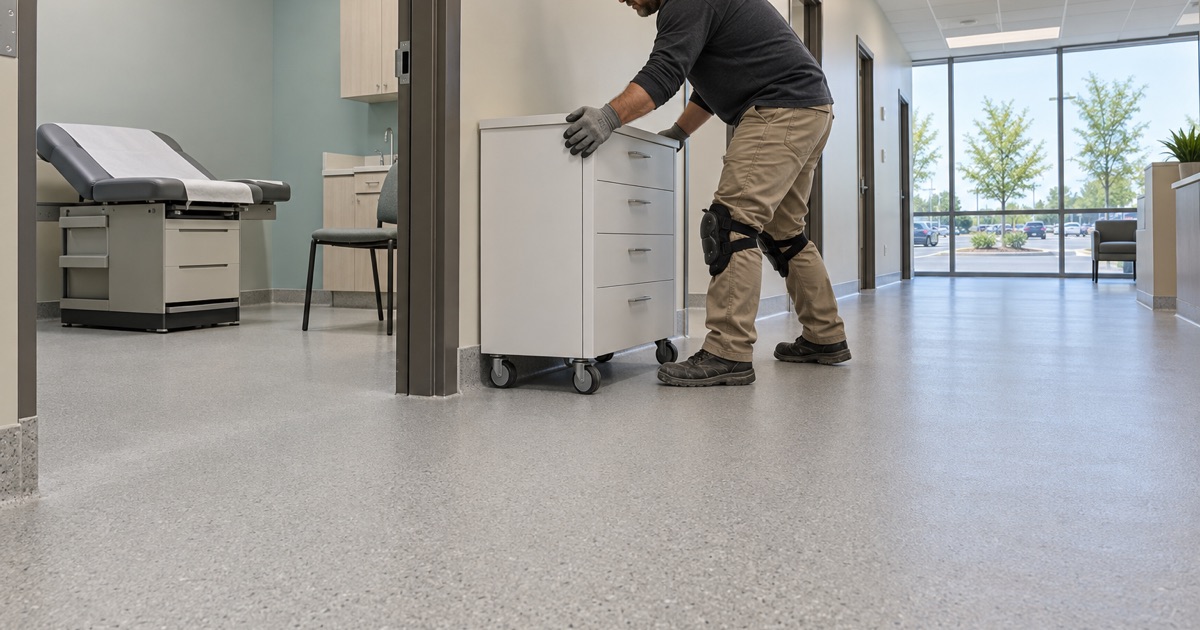
Retail, furniture stores and restaurants are among the largest sources of the village’s sales tax, and their floors take constant foot traffic, carts and moving displays. A seamless epoxy or polyaspartic floor is easy to clean and holds up under that use. We phase showroom floors so displays can move section by section, and we use fast-curing topcoats when a section must reopen the next morning.
Dealership Showrooms and Service Drives
Automotive sales and filling stations were the village’s largest sales-tax category in 2022, and dealership floors take hot tires, oil and coolant drips and the brine dragged in from the lot all winter. Service drives need a ground profile, a chemical-resistant topcoat and texture that stays safe when wet, while showroom floors lean toward a cleaner, glossier look that still resists tire marks.
Medical Offices and Clinics
Medical facilities are a growing part of the local commercial floor stock, with a large cancer institute planned on the Northwestern Medicine campus in Orland Park. Clinic and medical office floors are cleaned with strong disinfectants every day, so we specify chemical-resistant topcoats and seamless coved edges and schedule the work around patient hours.
Banquet Halls, Gyms and Event Spaces
Banquet halls, fitness centers and event spaces are part of the local economy too, and their back-of-house and service floors take loaded carts, spills and daily mopping. We work around booked events with overnight and weekend windows, coat service corridors and kitchens with a seamless system, and leave lifting areas in gyms to rubber matting.
Choosing a Commercial Floor System
Epoxy, Polyaspartic and Urethane Cement
A 100% solids epoxy base builds thickness and bonds deeply into ground concrete, which makes it the backbone of many commercial systems. Polyaspartic topcoats add fast cure, abrasion resistance and color stability where sunlight reaches the floor. Urethane cement is the choice where hot water, steam cleaning or thermal shock would soften an epoxy, such as commercial kitchens and food prep rooms.
Texture and Slip Resistance
Commercial floors need a texture matched to the conditions, not a general promise of slip resistance. We specify it by the broadcast, such as vinyl flake or quartz aggregate, and by the topcoat and any grit additive. Wet entries, kitchens and service drives get more texture, while dry showrooms can be smoother and easier to clean.
Coved Bases and Wall Transitions
In kitchens, clinics and wash areas, a coved base that runs the coating up the wall removes the open seam where dirt and water collect. We form the cove with a patching material, then coat over it so the floor and base are one continuous surface. Transitions to tile, carpet or doorways are finished flush so carts and wheelchairs roll across cleanly.
Working Around an Open Business
Phasing, Nights and Weekends
We plan commercial floors in phases, with each area closed, ground, coated and reopened on a schedule the owner agrees to before work begins. Overnight and weekend windows keep stores, clinics and offices running. Cure times are part of that plan, so no section reopens before the coating can take traffic.
Odor, Ventilation and Illinois VOC Limits
Coatings can carry odor while they cure, which matters in occupied buildings. We ventilate to the outside, isolate work areas and choose products inside the Illinois VOC limits for floor and industrial maintenance coatings. The Chicago area sits in the 2015 ozone nonattainment area, and those limits bind the person applying the coating, so compliance is our responsibility, not the tenant’s.
Dust Control and Drains
Grinding in an occupied building has to stay clean. Every machine runs with a vacuum at the grinder, work areas are sealed off, and dust and debris are bagged rather than swept or rinsed toward floor drains or storm inlets. That keeps neighboring tenants, shoppers and patients away from the dust.
Specifications, Licensing and Warranty
Written Specs Facility Managers Can Check
Property managers, architects and owners need to know exactly what is going down. Our proposals list each layer by product, the coat count, the finished thickness, the profile we will reach and the texture. Data sheets and safety data sheets are available before approval, so the floor can be compared with the specification after it is installed.
Village Licensing, Bond and Insurance
Illinois has no state flooring license, but Orland Park requires a village contractor license before any permit is issued, and other villages set their own license, bond and insurance rules. We confirm those requirements for each site before the job is booked, and we coordinate with landlords and property managers on any paperwork their lease or building rules call for.
- 20+ Years on Concrete
- Moisture Tested Before Pricing
- Written Specs on Every Quote