Orland Park Epoxy Flooring installs epoxy flooring in Burr Ridge for homeowners, trade shops and commercial tenants, and after more than 20 years on concrete we start every job by asking what will actually roll, drag or turn on the slab. That answer decides the system and the thickness, and sometimes it decides whether a section of floor should be coated at all.
Some loads are routine for a well-built coating: car tires, foot traffic, rolling tool chests and pallet jacks. Others are not, and an honest proposal says so in writing. Our scope maps where the coating goes, where it stops and why, so nobody is surprised by a worn lane six months after the crew leaves.
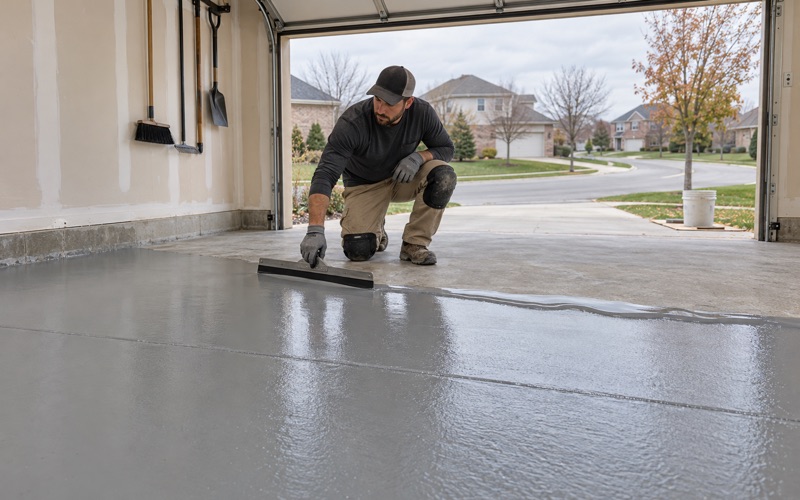
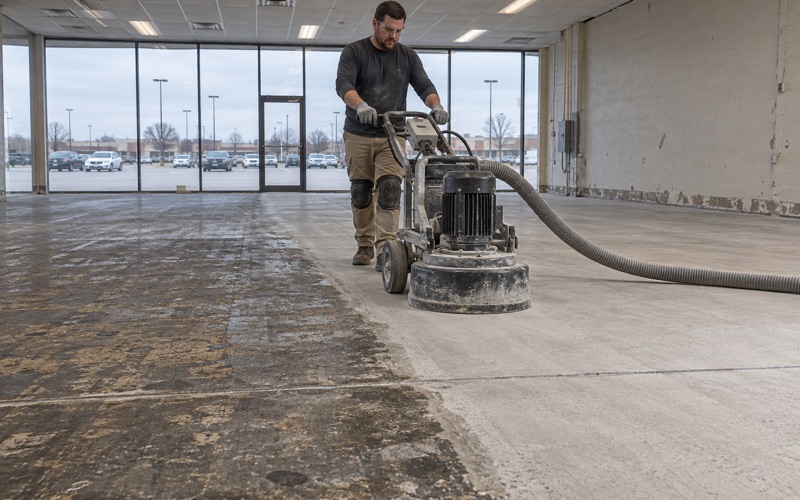
Before any price is final, we open the slab with a diamond grinder or a shot blaster and run a moisture test, because a coating is only as good as its bond. The proposal names the product line, the coat count and the finished thickness, so the floor on the ground can be checked against the paper.
An Equipment Dealer on the Frontage Road, and What Tracks Do Indoors
Finkbiner Equipment on North Frontage Road
Finkbiner Equipment Company sits at 15W400 North Frontage Road, an address that geocodes inside the Village of Burr Ridge in Downers Grove Township, DuPage County. Company and directory listings describe a dealer that sells, rents and services loaders, paving and milling machines, crushing and screening equipment and excavators, and it operates as a subsidiary of American State Equipment Co.
In March 2015, Waste Advantage reported that McCloskey International had added Finkbiner to its dealer network for crushers, screeners and stackers. Company president Marty Ahrendt put the reason plainly: “We wanted to offer a track mounted option for our customers.” We point to the dealer as a local landmark, not a client, because its line of business raises a floor question that reaches well past its own lot.
What Steel Grousers Do to Concrete
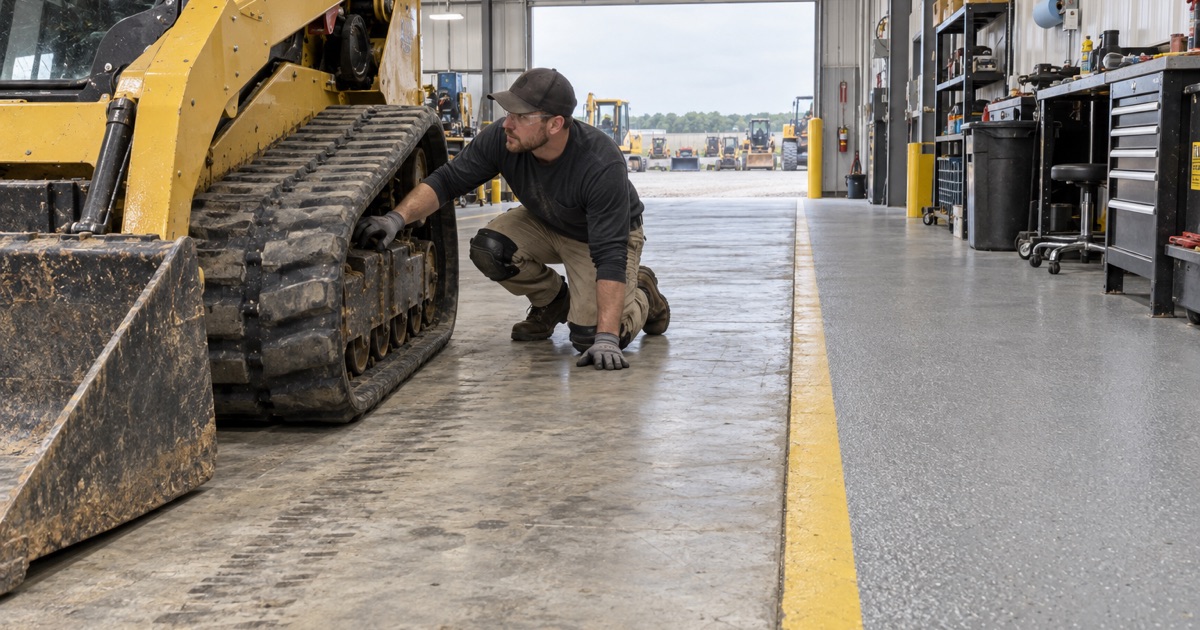
A crawler track is a chain of steel shoes, and each shoe carries a raised bar called a grouser that is built to bite into dirt. On a hard surface that bite does not go away. Track vendors and operators report that steel grousers mark concrete and asphalt and can crack them, which is why track makers sell bolt-on and clamp-on rubber pads for machines that have to run on pavement.
If bare concrete gives up under that treatment, a floor coating fares worse, because it is a far thinner layer sitting on top of the slab. A 100% solids epoxy or a polyaspartic topcoat is tough against tires, chemicals and dropped tools. No coating is built to carry steel crawler tracks, though, and we will not describe one as if it were.
Turning in Place: The Move That Does the Damage
Operators describe the worst damage as coming less from straight travel than from turning. A tracked machine steers by slowing or reversing one track against the other, and when it pivots in place the grousers are dragged sideways across the surface instead of rolling over it. That scrubbing is what gouges, and it concentrates in exactly the spots where a machine gets positioned.
In a shop, those spots are predictable: the turn just inside the door, the approach to a bay, the space where a machine is lined up with a stand. Counter-rotation on a coated floor would shear the film at those points first. Abrasive rock fines riding in on crushing and screening equipment would then work at the torn edges until the damage spread along the lane.
Looking for epoxy-flooring closer to Justice? See Epoxy-Flooring Services in Justice.
Bare Lanes Where Tracks Run, Coating Where They Never Do
The practical answer in an equipment shop is not a stronger product. It is a floor plan that keeps tracks and coating apart, drawn before anyone opens a kit. We walk the space with whoever runs it, mark where machines enter, turn and park, and then build the coating layout around those paths rather than across them.
Drive Lanes and Service Bays
Where tracked machines travel and pivot, the usual plan is bare or armored concrete, steel plate or timber mats rather than a film coating. A lithium silicate densifier can harden and dustproof the bare concrete in those lanes without forming a layer that can be torn loose. Plates and mats can be lifted and replaced as they wear, which a coating cannot.
Rubber track pads change the picture somewhat, since they are made to let steel-tracked machines run on pavement. Pads come off when a job calls for bare steel, however, and the floor cannot tell which undercarriage is rolling in. We plan each lane for the hardest machine that might use it, not the best-equipped one, so the layout still holds on the day the pads are off.
Parts Rooms, Benches and Walk Areas
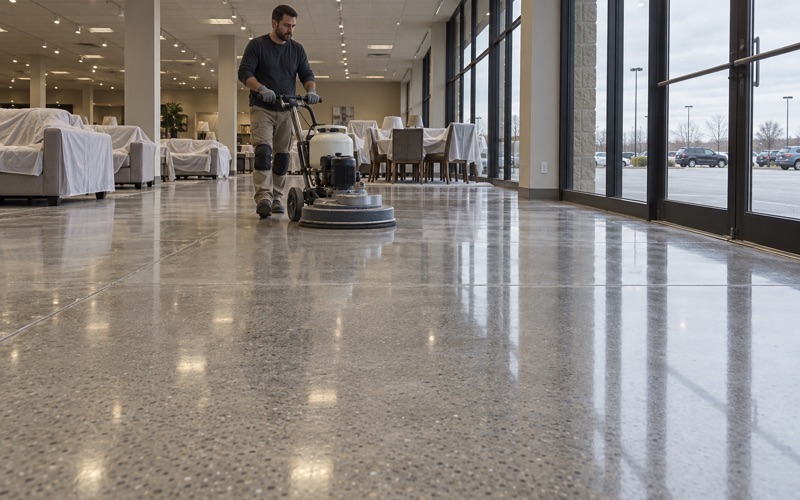
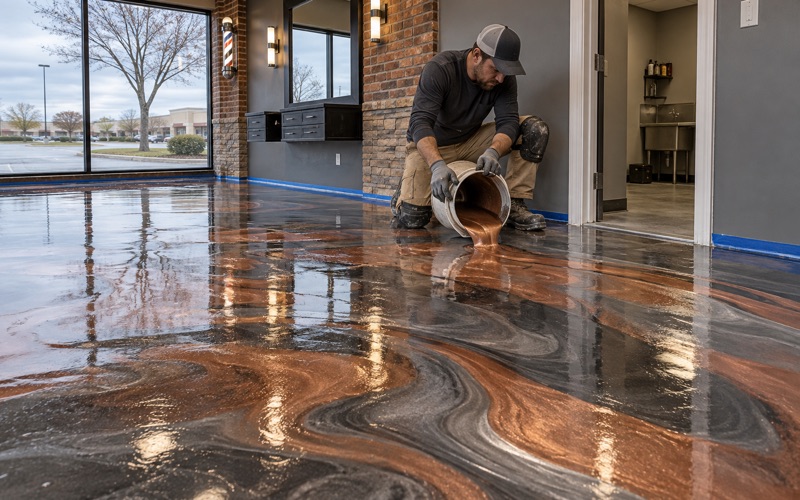
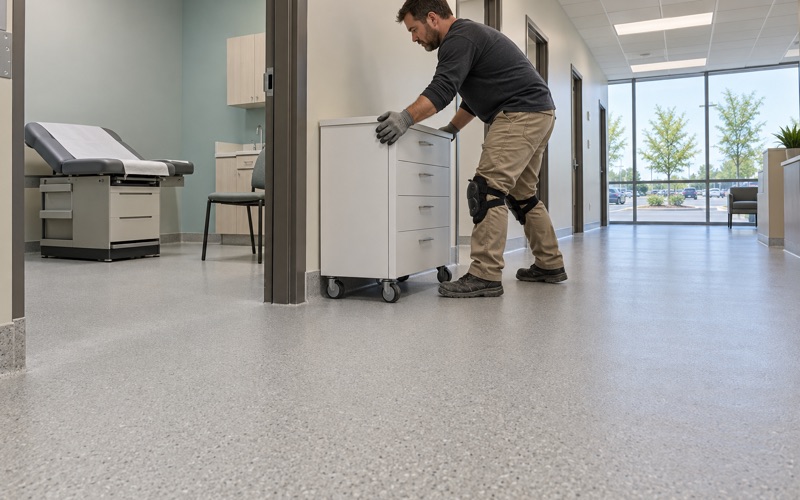
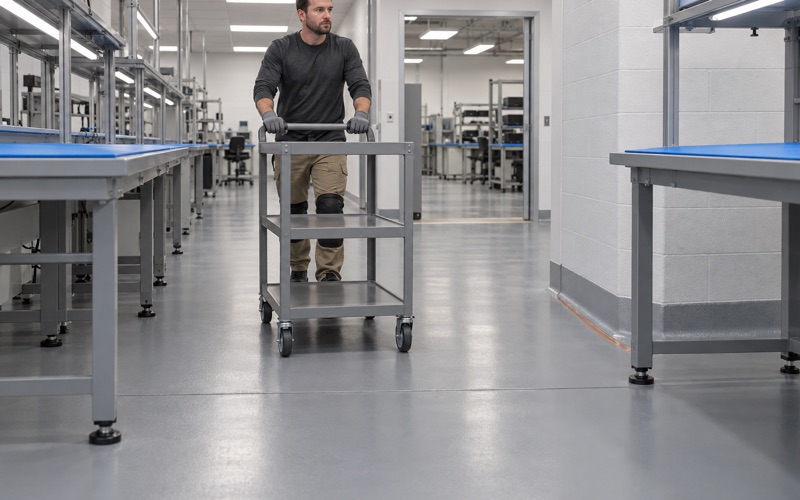
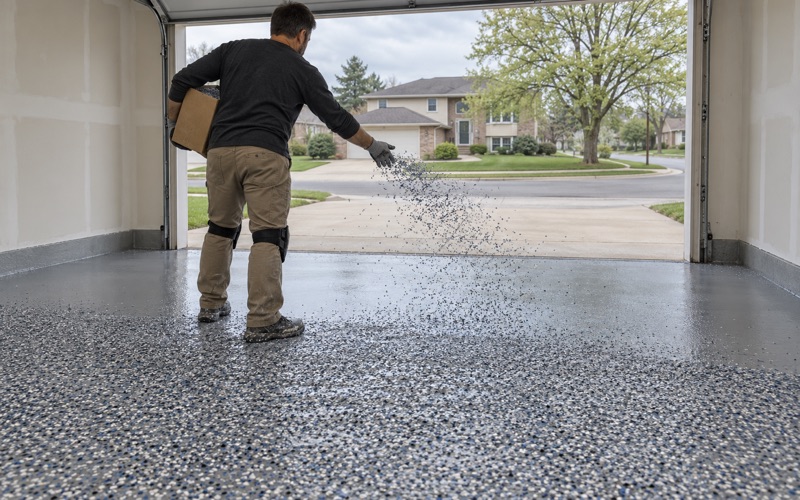
Coating earns its place in the rooms and strips that tracks never cross: parts counters, storage rooms, offices off the shop, restroom corridors and the walk paths along the walls. There, a 100% solids epoxy body coat with a quartz aggregate broadcast and a polyaspartic or polyurea topcoat gives a cleanable, bright surface that stands up to carts, pallet jacks and work boots.
A slip-resistant texture is specified by the broadcast and topcoat we use, not promised as a slogan, and it is written into the proposal. Where a pallet jack or forklift crosses from a coated area into a bare lane, we detail the transition so the coating edge is ground in flush and protected. A raised lip at that seam is what catches a wheel and starts a peel.
Making the Boundary Visible
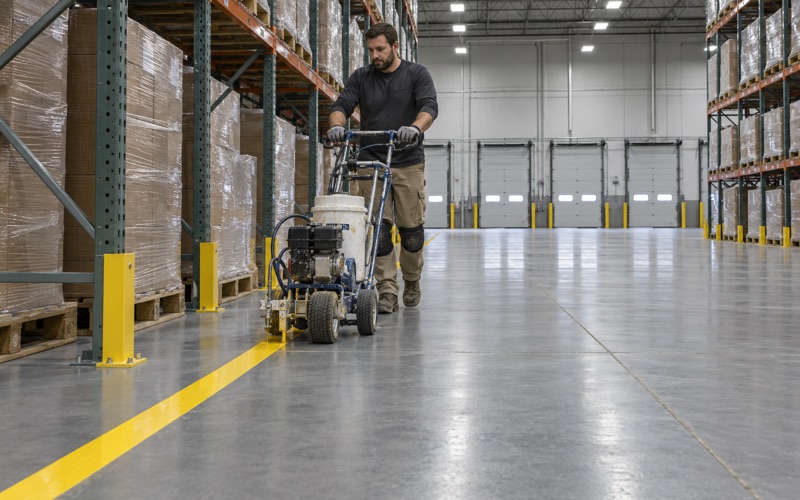
A coated floor beside a bare lane works only if people can see where one ends and the other begins. We set boundary lines and zone colors into the coating system itself, so the edge of a drive lane is obvious to an operator lining up a machine. The line costs little compared with repairing a coating edge that a machine clipped because nobody could tell where the coated floor stopped.
Skid Steers, Compact Track Loaders and the Home Shop
Tracked equipment is not only a dealer concern. Compact track loaders, mini excavators and tracked skid steers end up in contractor garages and outbuildings, and a garage floor that hosts one faces the same physics on a smaller scale. The machine is lighter, but the grousers and the pivot work the same way, and so does the damage to a coating under them.
Where a Small Tracked Machine Parks
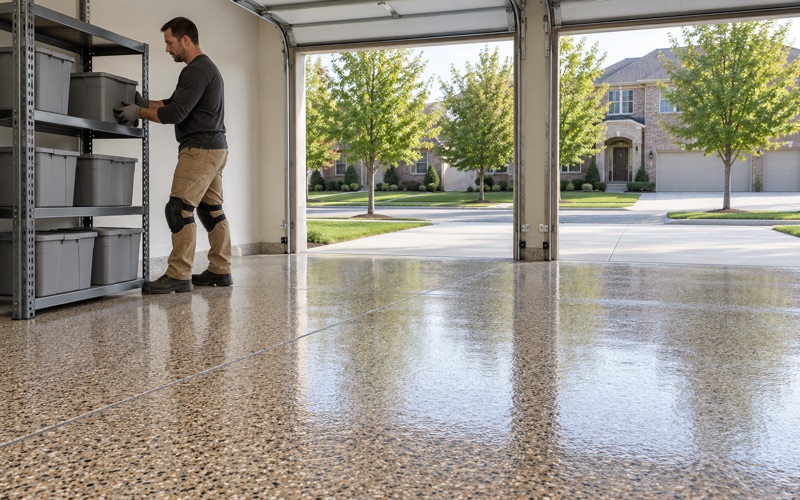
For a homeowner or a small trade shop, the fix is usually a dedicated pad for the tracked machine, left as densified bare concrete or covered with a mat, with the rest of the garage coated. Rubber tracks or bolt-on pads lower the risk. Turning the machine in place on a coated floor is still the move we ask owners to avoid, whatever is on the undercarriage.
We set the coated area’s edge where the machine stops, not at the garage door, and we mark the pad so anyone backing in a car knows which part of the floor is which. A trailer that hauls the machine can usually sit on the coating, since it rides on tires. It is the track contact that the plan keeps off, and the layout drawing shows exactly where that contact happens.
With 94.0 percent of Burr Ridge households owning their homes, the conversation about a tracked machine in the garage usually happens with the person who parks it, not a landlord. That makes it easier to settle the layout up front. The owner knows which machine comes in, how often and which way it turns, and those answers go straight into the drawing.
Testing the Slab Before Any of It
Whatever the layout, the coated part of the floor still depends on the slab beneath it. Most Burr Ridge housing dates from 1980 through 2009, and whether a slab of that era was poured over a vapor retarder is not recorded anywhere at the place level. We test rather than assume, using ASTM F2170 in-situ relative humidity probes or ASTM F1869 calcium chloride testing to get a number the product data can be checked against.
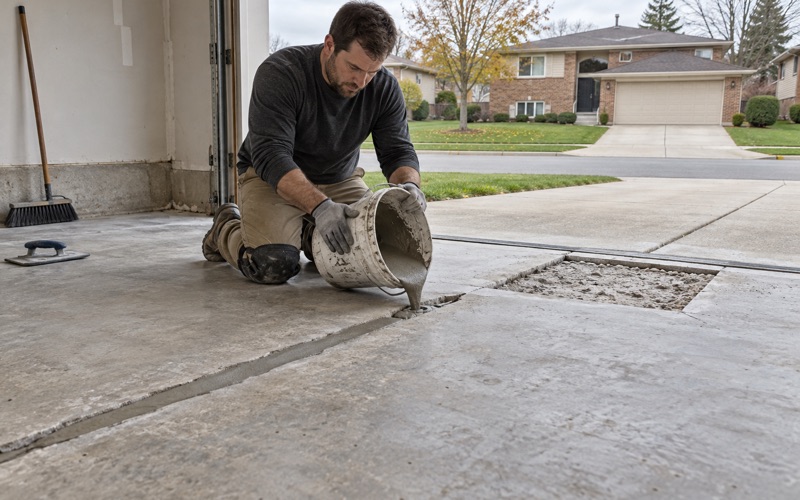
We also map cracks, spalls and any old coating first, and we tell an owner when a section needs repair or replacement before it should be coated. What a coating warranty leaves out is explained before the job is sold, and moisture is the first exclusion we name, because a high reading changes the primer and sometimes the whole system.
Permits, Scheduling and Working Around a Busy Shop
Who Signs Off
The Village of Burr Ridge Community Development department handles building permits. Its permit page exempts finish work including painting, hardwood refinishing, tile replacement and carpeting, while work that affects foundations, patios, driveways and garages needs a permit. If a floor job grows into slab repair or replacement, it can cross from finish work into permitted work, and we raise that early.
Illinois licenses no general, flooring or coatings contractor, so the village rules are the ones that bind. On a permitted job every contractor and subcontractor holds the village license, posts a $10,000 surety bond naming the village, and lists the village as additional insured on at least $1,000,000 in liability coverage. We check those terms before a job is booked, not after the crew arrives.
Scheduling Around a Working Shop
A service shop rarely closes for a week. We phase the coated zones so parts rooms and walk areas are finished in sections, with overnight and weekend windows where a space cannot shut down. The drive lanes stay in use the whole time because they are not part of the coating scope, which is one quiet advantage of zoning: the busiest paths never wait for a cure.
Cure schedules follow slab temperature and dew point rather than the calendar. A bay door left open during a cure can pull the slab temperature toward the dew point and leave amine blush on an epoxy surface, so we agree on door use before the first coat goes down. Grinding dust is captured at the machine with a vacuum rather than washed toward a floor drain.
If tracked equipment shares your floor, show us the machines and the paths they take. We will come back with a drawn layout, a moisture result and a proposal that states which part of the slab gets coated, which part stays bare, and the reason for each line on the drawing.
- 20+ Years on Concrete
- Moisture Tested Before Pricing
- Written Specs on Every Quote