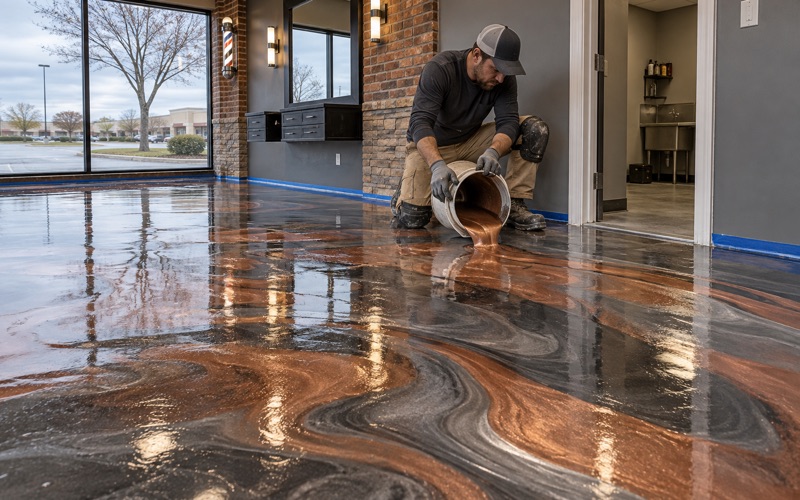
Orland Park Epoxy Flooring brings more than 20 years of epoxy flooring work to Brookfield, and the first question we ask about any slab here is not which flake color to choose but what is already sitting on the concrete. A garage or basement floor that looks bare can still carry a curing compound from the day it was poured, a clear sealer from a past owner, or a patch nobody wrote down. Each of those changes how a new coating behaves.
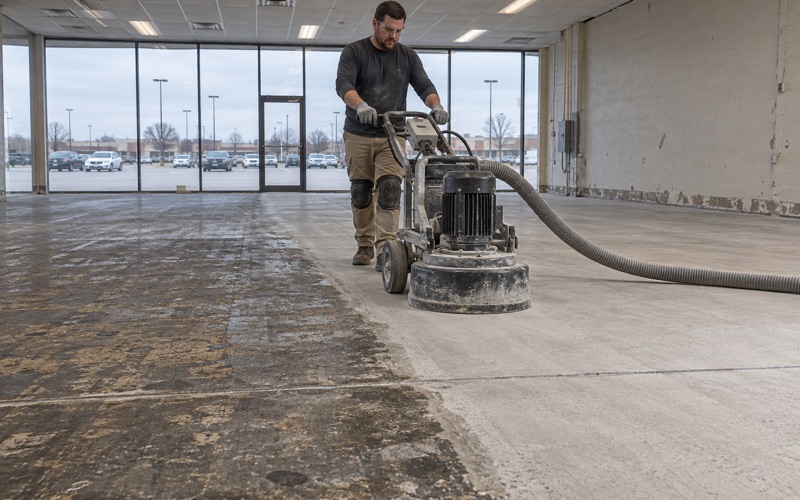
That is why our scope starts with identification rather than a product pick. We look, we test, and when a residue will not accept a coating we grind it off with a diamond grinder or a shot blaster, never an acid etch, so the new system bonds to clean, profiled concrete. The written proposal then names the product line, the number of coats and the finished thickness, so the floor can be checked against the quote.
The reasoning behind that order is easier to see on a building than on a floor, and Brookfield has a clear public example of it. The sections below walk through that case, what it teaches about products that touch, and how the same check plays out on a residential slab.
A 2021 Library, New Walls in 2026, and Products That React
What happened at the library on Park Avenue
The Linda Sokol Francis Brookfield Library at 3541 Park Avenue was completed in July 2021, and shortly afterward a black substance began dripping down its exterior. According to the library’s unfiled complaint, as reported by the Riverside-Brookfield Landmark in March 2025, the engineering firm Wiss, Janney, Elstner Associates found three wall-system products in that substance: a liquid air barrier membrane, a sealant and a sheathing.
The library alleged that the design left insufficient air space, so the wall ran hot and the materials liquefied on contact with each other. Those were allegations in a complaint that was never filed, and the matter was settled out of court, so no fault has been established for anyone involved. The Landmark later reported that the substance formed when several building materials chemically combined.
The 2026 envelope replacement
Replacement of the building envelope began May 11, 2026 and was expected to run through the end of September, with the library open on regular hours. Under the settlement, the construction companies provide $635,000 and the library covers the remaining $1.13 million from its reserves. The problem and the repair are both in the exterior walls; nothing about the library’s interior or its floors was reported.
We have no connection to the library or to anyone working on that repair. We bring it up because it is one of the clearest local illustrations of a principle every coating job depends on, and it played out on a building many Brookfield residents pass on an ordinary day.
Compatibility is a separate question from quality
The useful lesson is that each product in an assembly can be sound on its own and still cause trouble next to another one. Compatibility is a property of the pair, not of either product alone, which is why manufacturers publish which primers, membranes and sealants their materials are approved to touch.
A floor is a smaller assembly than a wall, but it is still an assembly. The slab, whatever residue sits on it, a primer, a body coat and a topcoat all touch one another, and the coating performs only as well as the weakest bond in that stack. So before we choose a system, we find out what the slab is already carrying.
Looking for epoxy-flooring closer to La Grange Park? See La Grange Park Epoxy-Flooring.
What Might Already Be on a Brookfield Slab
Curing compounds from the original pour
Many slabs are sprayed with a curing compound right after finishing, to hold moisture in the concrete while it gains strength. The film does its job in the first days, then it can sit there for years under dust and tire marks. A resin coating applied over it bonds to the compound instead of the concrete, and prep guides are blunt that a coating over an unremoved curing compound will fail.
The concrete industry recognizes the conflict. ACI 302.1R-15, the American Concrete Institute’s guide to floor construction, advises that a letter of compatibility be issued before a curing compound is used on a floor that will receive a later finish, and that letter has to come from the compound’s manufacturer. On a new pour, that is a question to settle before the concrete truck arrives.
Sealers, densifiers and old paint
A clear sealer rolled on by a previous owner is a common surprise in a garage, because it looks like bare concrete until water beads on it. Old floor paint and earlier one-part epoxy kits are easier to spot, usually by the peeling along the tire paths. A lithium silicate densifier is a different case, since it reacts into the surface rather than sitting on top, and it can leave the concrete tighter than a primer expects.
Each of these calls for a different response. Some sealers come off cleanly under a grinder, peeling paint is mapped and removed down to sound concrete, and a densified surface is opened mechanically until the primer can penetrate. Grease, oil and wax belong on the same list, since trade guidance holds that coating over a slab contaminated with them guarantees a failure.
Patches and repairs nobody wrote down
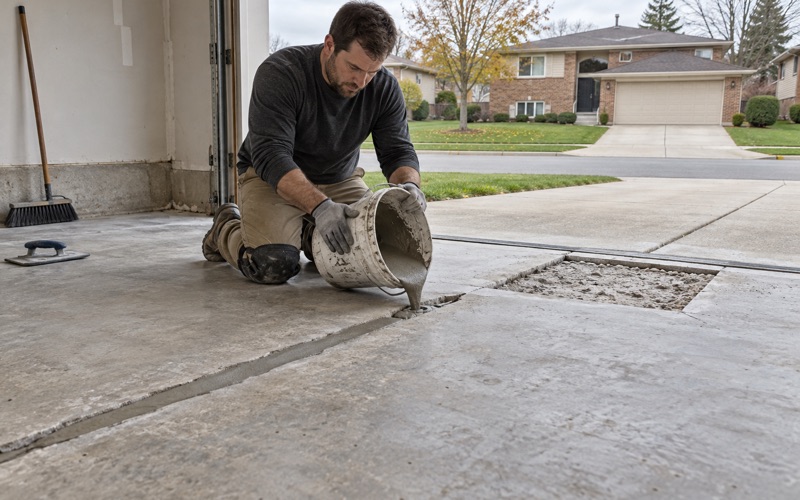
Patching mortars and crack fillers are products with their own chemistry. A cement-based patch may accept a primer well, while some flexible fillers and modified toppings may not, and a patch that is still releasing moisture can blister the coating above it. A patch is also a boundary, and boundaries are where a coating tends to lift first.
We map cracks, spalls, patches and old coatings before quoting, and we say so plainly when a slab needs repair or replacement before it should be coated at all. That map becomes part of the proposal, so the owner can see which areas were treated differently and why.
Letters of Compatibility, Acid Spot Tests and Test Patches
Asking the manufacturer first
Where the product on a slab can be identified, the first step is paperwork. A letter of compatibility from the maker of a curing compound or sealer states whether a given coating can go over it, and the coating manufacturer’s own data usually lists the surfaces its primer is approved for. On a slab poured recently for a garage or an addition, the builder or concrete supplier may know exactly which compound was sprayed.
On an older home the answer is usually unknown, because nobody kept the bucket. That is not a reason to guess. When the paperwork does not exist, the slab itself has to answer the question, and that is what the field tests are for.
The dilute-acid spot test
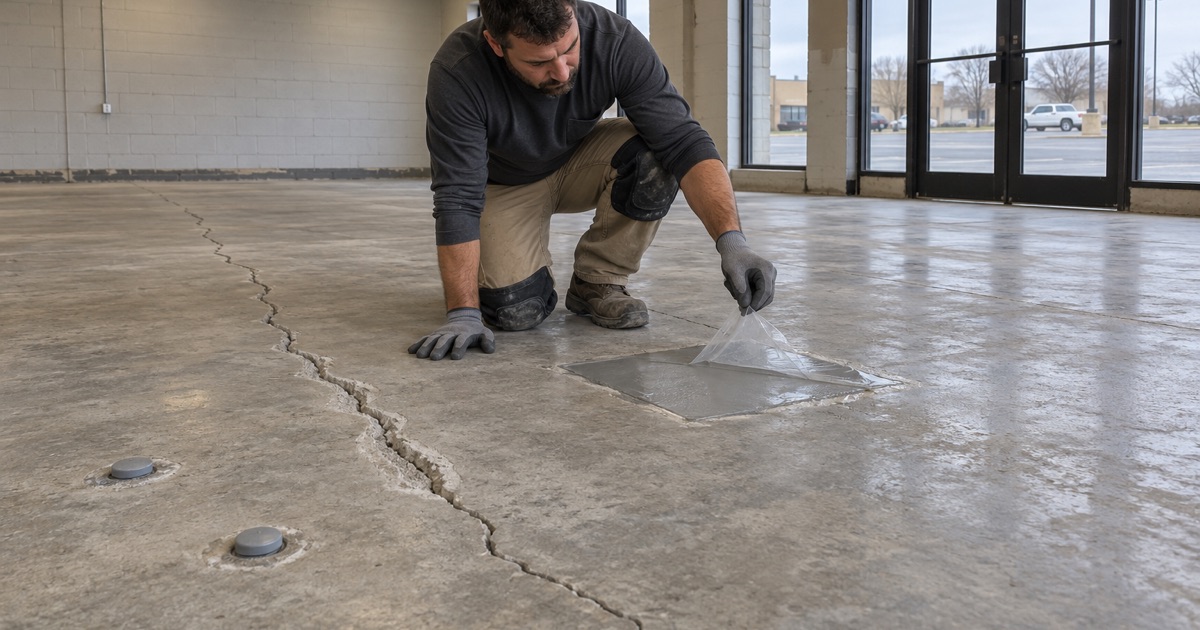
A few drops of dilute acid on clean, bare concrete fizz as they react with the cement paste. When the drops sit on the surface without fizzing, something stands between the acid and the concrete, and prep guides read that as residue still on the slab. We run the test across the whole floor rather than in one corner, because a sealer is often rolled unevenly and a curing compound may have missed areas.
This is a diagnostic, not a preparation method. We never acid etch a floor to get it ready for coating; the spot test only shows where the grinder has more work to do. The drops are a few square inches of evidence, and the profile that the coating actually grips still comes from mechanical preparation.
Bond test patches and moisture readings
A test patch is the most direct evidence there is. We prepare a small area, apply the intended primer or coating, let it cure and then try to pull it off. One prep guide treats a failure after 72 hours as the sign that the compound must come off, and a patch that holds on ground concrete but lifts on unground concrete tells us the same thing another way.
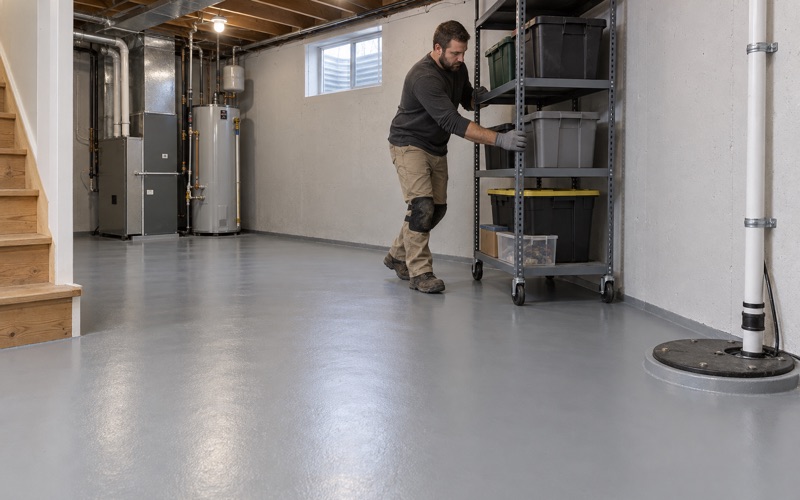
Moisture is tested in the same visit, because a residue and a damp slab can produce the same blistered result. Depending on the slab we use ASTM F1869 calcium chloride testing or ASTM F2170 relative humidity probes, and the result goes into the written scope before the price is final. Moisture is also the first exclusion we name when we explain what a coating warranty does not cover.
Grinding Off What Will Not Bond: The Brookfield Garage Version
Mechanical removal and surface profile
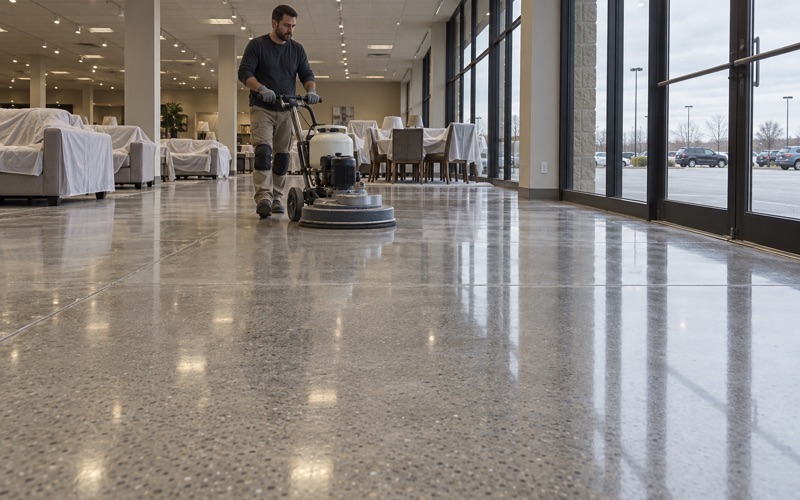
When a test says the residue has to go, we remove it mechanically. A diamond grinder or a shot blaster takes off the sealer, compound or paint and leaves the concrete with a texture, described on the ICRI CSP scale, that a 100% solids epoxy primer can actually grip. The profile is matched to the system, since a thin coat needs less texture and a thicker broadcast build needs more.
Grinding dust is captured at the machine by a vacuum rather than rinsed toward a floor drain or a storm inlet. After grinding, we repeat the spot test in every area that failed it the first time, and priming starts only when the acid fizzes evenly across the floor.
How a typical garage job runs
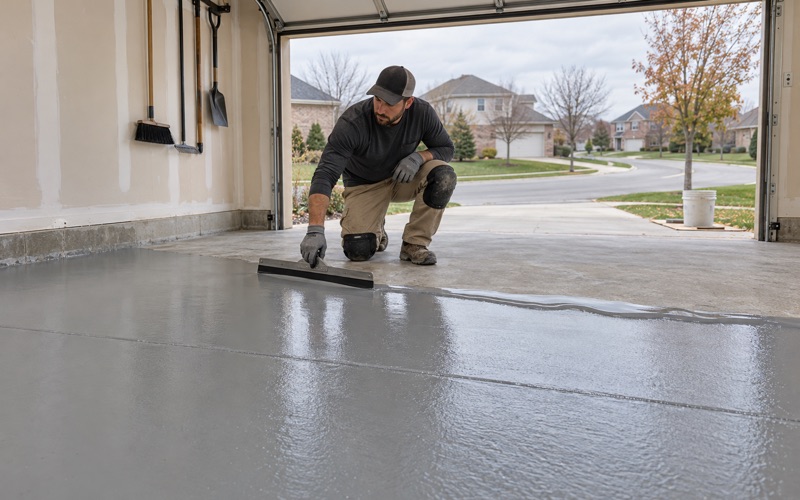
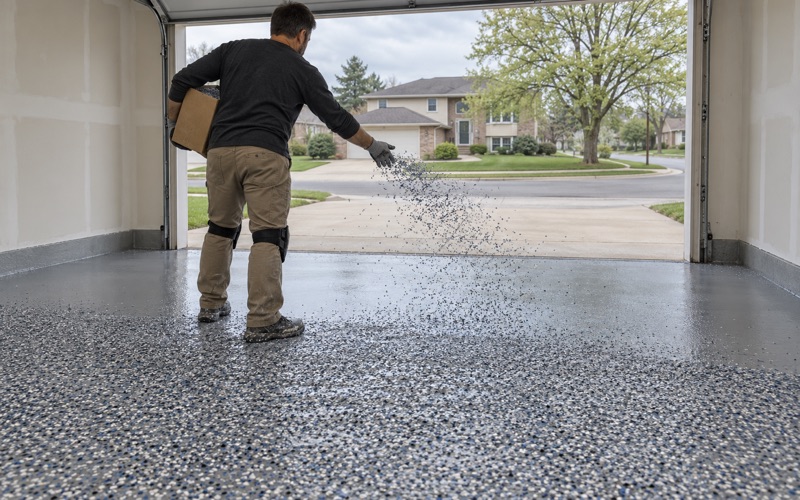
Most of Brookfield’s homes are single-family detached houses, so the usual job is a private garage whose coating history is unknown. We walk the floor with the owner, note any peeling, staining or beading, run spot tests on a grid, and set a test patch wherever the result is in doubt. The findings decide how much grinding the price has to include.
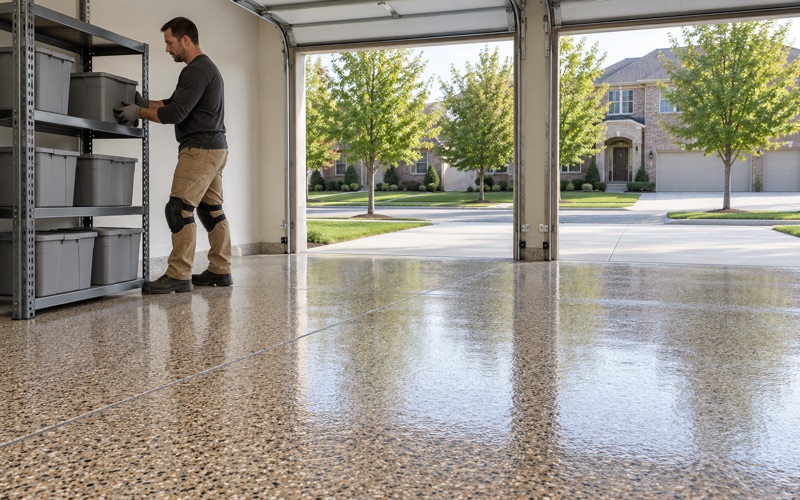
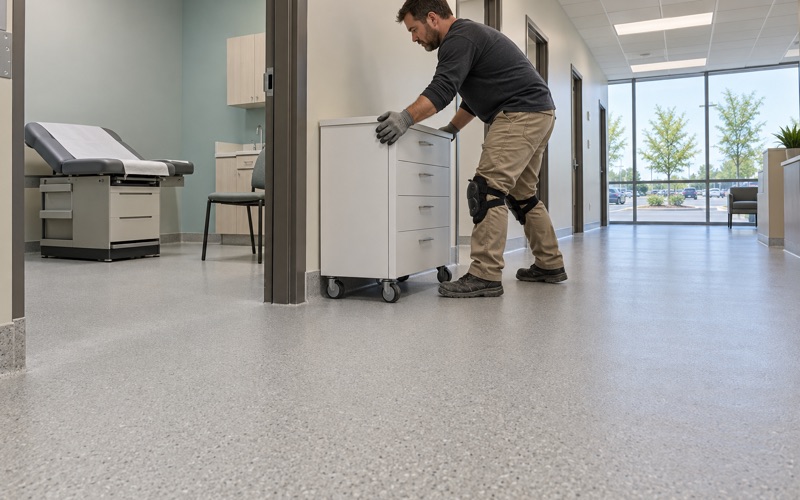
The proposal then spells out the system, for example a 100% solids epoxy body coat with a vinyl flake broadcast and a polyaspartic topcoat, along with the number of coats and the finished thickness. Cure timing follows the slab temperature and the dew point spread at the surface rather than the calendar, and a garage that cannot hold those conditions is told to wait.
When the answer is not to coat yet
Sometimes the honest answer is that a floor is not ready. A slab with widespread spalling, a residue that keeps failing tests after removal, or moisture readings beyond what a mitigation primer can handle may need repair, more removal time or replacement before a coating is worth the money.
The library’s walls are a reminder that the cost of an incompatibility shows up after the work looks finished. On a floor, the cheapest moment to catch one is before the first primer coat, with a letter from the manufacturer, a few drops of acid and a test patch that either holds or does not.
- 20+ Years on Concrete
- Moisture Tested Before Pricing
- Written Specs on Every Quote